Article
Bioprocess Orders Are Growing but Project Timelines Are Moving: How Should Buyers Plan Inventory?
By Iri ·

When bioprocess orders rise while customer projects move, you can receive two apparently contradictory signals: demand is strengthening, yet near-term shipments or supplier revenue do not move in step. That is a planning problem, not proof of a shortage. Your inventory decision should therefore follow the date on which a material can actually enter a qualified process, not a quarterly headline or an untested lead-time estimate. By separating commercial signals from operational milestones, you can reserve scarce capacity where delay would stop a batch, stage deliveries where schedules remain fluid, and keep flexible stock where substitution is straightforward.
Why Orders, Revenue, Shipments, and Shortages Are Different Signals
Danaher reported on July 21, 2026 that customer project timing affected its quarterly bioprocessing revenue even though underlying order trends remained strong and bioprocessing orders grew in the mid-teens. Thermo Fisher reported two days later that quarterly revenue grew 10% and customer activity across its end markets continued to strengthen. Together, those announcements indicate active demand, but neither announcement proves that a particular bag, filter, resin, or reagent is unavailable to you.
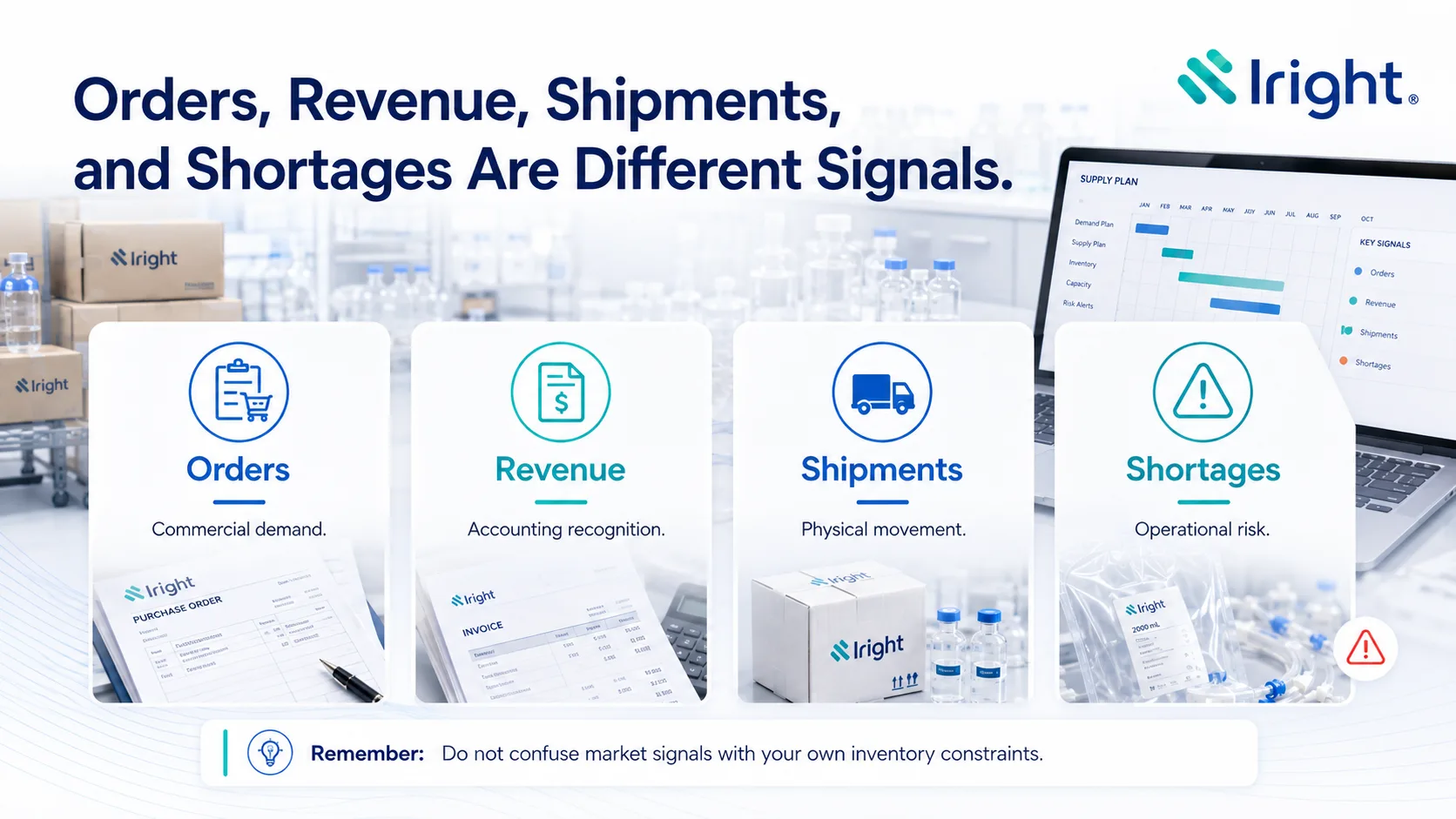
You need to keep four signals separate. An order records commercial demand. Revenue depends on accounting recognition and may follow shipment, acceptance, installation, or another contractual event. A shipment means a supplier moved goods, but not that your quality team has released them. A shortage exists only when the required material cannot be obtained in the quantity, specification, documentation, and time window your process needs.
Planning rule: Treat market updates as prompts to verify your own constraints. Do not convert a supplier's order growth into an automatic instruction to buy a year's inventory.
That distinction protects you in both directions. If you react too aggressively, you may hold configured assemblies or dated materials while a study, validation activity, facility milestone, or funding decision moves. If you react too slowly, you may discover that the item with the highest operational consequence also has the least scheduling flexibility. Your next step is to replace one vague "need-by" date with three controlled dates.
Put Arrival, Validation Readiness, and Batch Start on Separate Dates
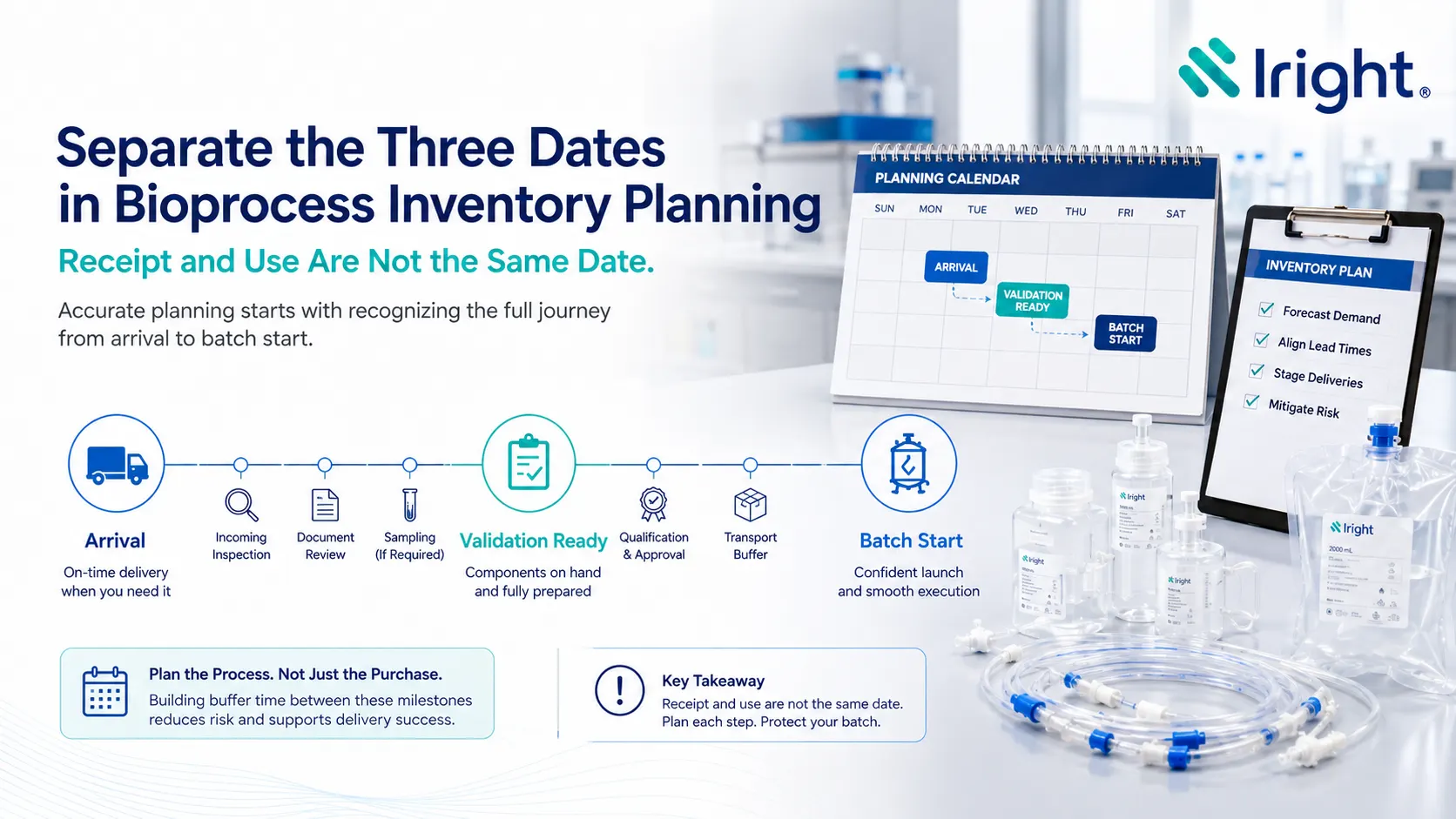
A single delivery date hides the work that happens between receipt and use. You should place the material's physical arrival, quality or validation readiness, and first planned batch on separate lines in your project plan. The gaps between them are decision windows: they show when you still have time to correct a documentation issue, qualify a substitute, or move a shipment without affecting production.
Planning node | What the date means | Evidence you should attach | Action if the date moves |
Expected arrival | The shipment is expected at your receiving location | Supplier confirmation, transport mode, destination, and current lead-time basis | Reconfirm allocation and freight; do not treat an unconfirmed estimate as committed supply |
Validation-ready date | Your approved item, lot, configuration, and documents can be used under the applicable procedure | Approved specification, required certificates, incoming-release status, and any qualification record | Escalate missing documentation or open a controlled alternative assessment |
Batch-start date | The material must be available at the point of use for the planned run | Production schedule, batch bill of materials, campaign quantity, and safety allowance | Recalculate consumption, expiry exposure, and the last responsible order date |
Work backward from the batch-start date. Add the time needed for incoming inspection, document review, sampling where applicable, and any process-specific qualification. Then add transport time and a risk allowance that reflects how much confidence you have in the quoted lead time. This produces a latest acceptable arrival date rather than a purchasing date chosen from habit.
You should also record date confidence. A locked manufacturing slot supported by approved materials has a different confidence level from a provisional forecast awaiting engineering, clinical, or financing decisions. When confidence is low, protect access without forcing physical delivery too early. When confidence is high and the consequence of delay is severe, secure the constrained part of supply first.
Segment Inventory by Consequence and Demand Stability
Inventory segmentation becomes more useful when you classify each material on two axes: what happens if it is late, and how stable your demand date is. Value alone is not enough. An inexpensive, configured single-use component can stop a run, while a costly but readily transferable general laboratory item may have several workable alternatives.
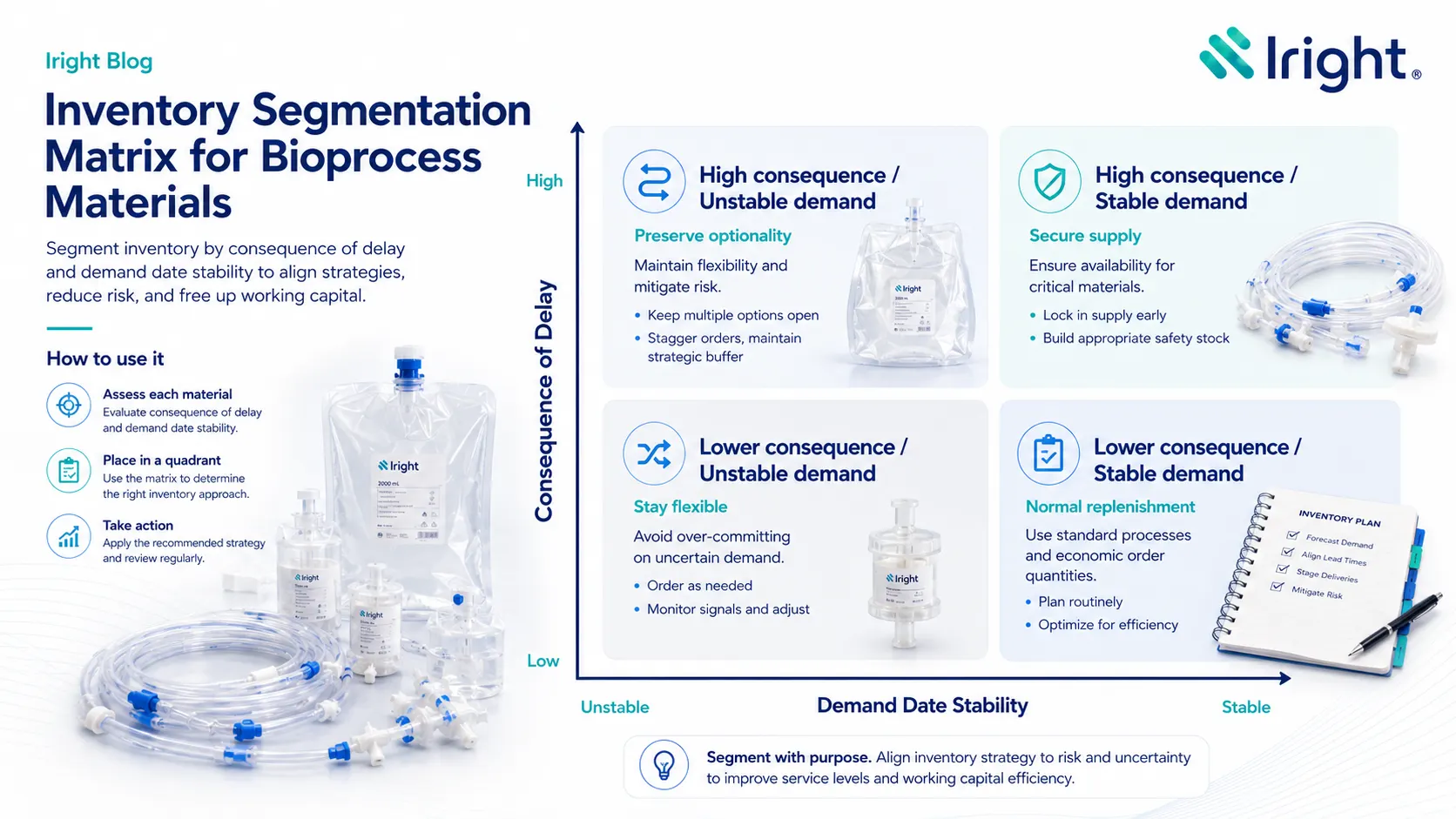
High consequence, stable demand. You have a confirmed process need and little tolerance for delay. Your priority is secured supply, complete documentation, and a receiving date that leaves room for release. Capacity reservation or an earlier first delivery may be justified.
High consequence, unstable demand. You may need the material, but the batch date can still move. Your priority is optionality. Seek a reservation, call-off arrangement, or staged delivery so you do not convert schedule uncertainty into expiry, storage, or cash exposure.
Lower consequence, stable demand. You can manage the item through normal reorder points, consumption data, and defined substitutes. Your priority is reliable replenishment rather than a special commercial structure.
Lower consequence, unstable demand. You should preserve flexibility. Aggregate demand across projects where possible, avoid project-specific excess, and use short review intervals instead of committing the full forecast.
This segmentation should be reviewed at the material-and-use level, not only at the supplier level. Two items from the same vendor can carry very different consequences because one is locked into a validated flow path and the other is a standard support consumable. Your segmentation should change when the process, approved specification, or project confidence changes.
Choose Between Capacity Reservation, Staged Delivery, and Waiting
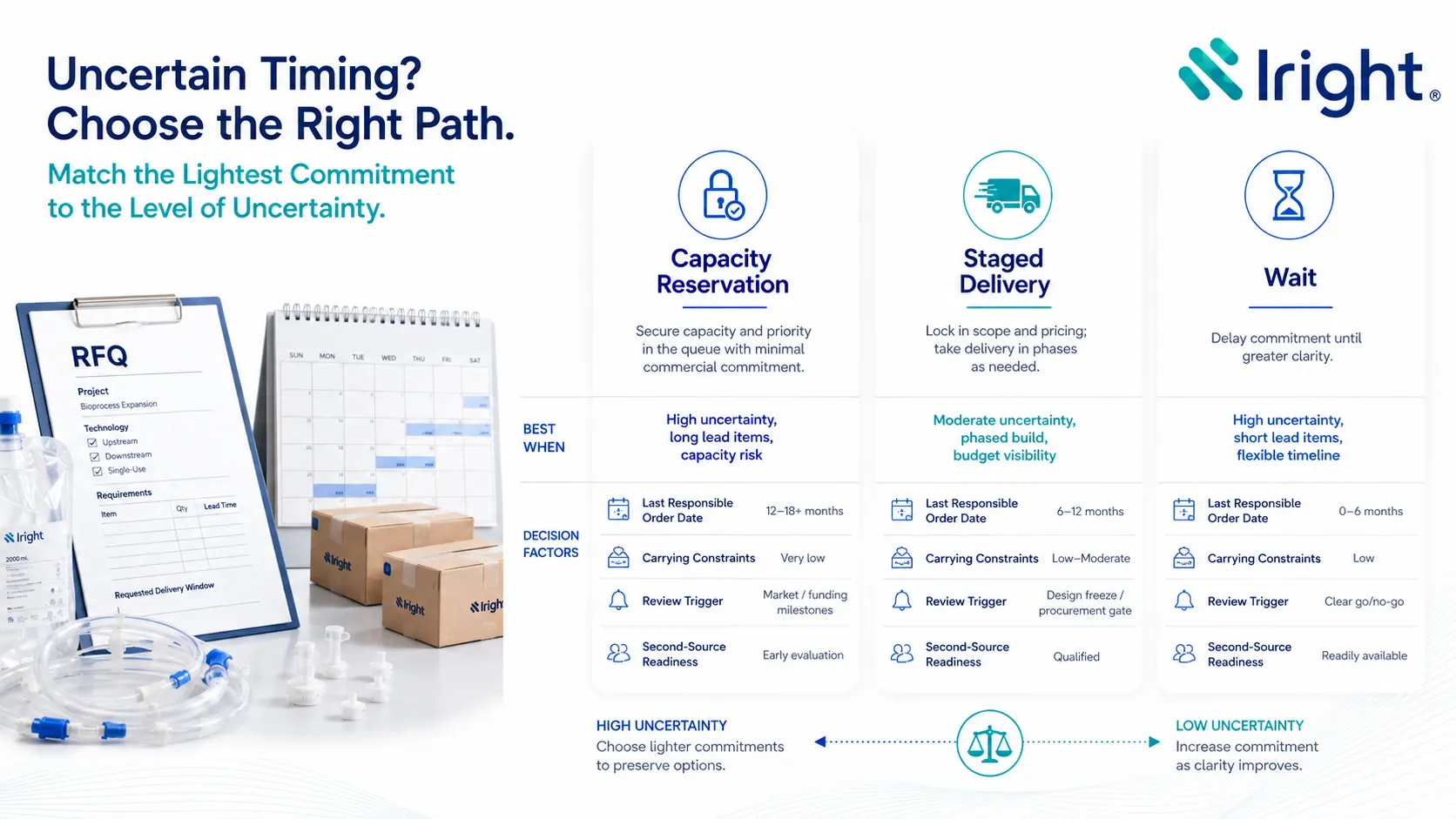
Your commercial structure should match the uncertainty you are trying to manage. A capacity reservation protects access to a constrained manufacturing slot. Staged delivery separates the commercial commitment from physical receipt. Waiting preserves cash and storage space but leaves you exposed if the true last-order date is earlier than expected.
1. Rate the batch date. Classify it as committed, probable, or provisional, and record the event that would move it into the next confidence level.
2. Calculate the last responsible order date. Work backward through release, validation, transit, supplier production, and a stated risk allowance. Use the longest relevant path, not only the quoted transit time.
3. Check carrying constraints. Confirm shelf life, storage temperature, lot or configuration restrictions, warehouse capacity, and the cost of holding material before you request early delivery.
4. Select the lightest commitment that protects the run. Reserve capacity when supplier production is the constraint; use staged delivery when timing is uncertain but total demand is credible; wait when alternatives are qualified and the schedule remains provisional.
5. Set a review trigger. Tie the next decision to a project event, such as protocol approval, engineering release, facility readiness, or a fixed number of weeks before batch start.
You should make cancellation, rescheduling, partial-release, and substitution rules explicit before a purchase order is placed. If a supplier cannot support a formal reservation, ask what evidence of allocation it can provide and which components determine the lead time. A quoted date is more useful when you know whether it is based on finished stock, component availability, production capacity, or an estimate awaiting confirmation.
Decide Which Materials Need a Second Source—and Which Need Flexible Stock
A second source is not simply another brand name in a spreadsheet. You need an alternative whose material, configuration, documentation, and process performance can be assessed before the primary item becomes unavailable. Where substitution would require significant technical work, the near-term answer may be better continuity planning with the primary source rather than a nominal backup that has never been qualified.
Material type | Typical exposure | Better default response | What you should verify |
Configured single-use bags and assemblies | Fit, connector, film, sterilization, and documentation differences can make substitution project-specific | Reserve or stage the approved configuration; start second-source work early if the consequence is high | Drawing, contact materials, connector map, sterilization status, certificates, and change control |
Process filters and TFF devices | Membrane, area, flow path, scale, and process performance may be tied to development data | Qualify an alternative where the operation is critical; otherwise hold a risk-based buffer of the approved item | Membrane and device format, process scale, performance criteria, integrity testing, and documentation |
Media, reagents, and chromatography resins | Lot, shelf life, storage, and method or process dependence can affect usability | Use staged releases and lot-aware planning; qualify alternatives only through the appropriate technical process | Grade, formulation or ligand, pack size, lot requirements, expiry, storage, and release documents |
General support consumables | Demand can be pooled and alternatives may be easier to assess | Keep flexible stock and approved equivalents rather than project-dedicated excess | Critical dimensions, material compatibility, sterility, and approved substitute list |
You can use real catalog records to make the assessment concrete without assuming interchangeability. Cytiva ReadyCircuit single-use 3-D bag assembly 29064855 represents a configured fluid-handling item for which ports, size, and documentation matter. Cytiva MidGee ultrafiltration cartridge UFP-1-C-MM01 represents a small-scale TFF device whose membrane and process role must match your work. Sartorius Virosart Max Maxicaps MR8 FMR500052 represents a production-scale filtration format that needs a specification-level review. Cytiva Protein G Sepharose 4 Fast Flow resin 17061806 represents a chromatography material for which pack size, application, lot planning, and storage should be checked.
These examples show inventory roles, not interchangeable choices. You should confirm the exact specification, process fit, regulatory documentation, and availability before placing any item into a primary-source or second-source plan.
Write Timing Flexibility Into the RFQ
Your RFQ should turn schedule uncertainty into questions a supplier can answer. Ask for a commercial response that separates what is available now, what must be manufactured, what can be reserved, and what can move without penalty. This gives your technical, quality, operations, and finance teams the same view of the commitment.
· State the required specification, configuration, quantity, and destination.
· Give the target arrival, validation-ready, and batch-start dates separately.
· Ask whether the quoted lead time is based on stock, components, or production capacity.
· Request options for capacity reservation, partial release, and staged delivery.
· Define the acceptable delivery window and the process for rescheduling or cancellation.
· Request shelf-life or expiry information, lot requirements, and required certificates before shipment.
· Identify any approved alternative and ask the supplier to flag substitutions rather than applying them automatically.
· Require confirmation of allocation, transport assumptions, and the date on which the quotation must be refreshed.
Iright can help your team compare cross-brand availability, staged RFQs, and alternative options for critical consumables against actual project start dates.
The useful response to stronger bioprocess demand is not blanket stockpiling. You need a calendar that links supply commitments to validation and batch use, plus a material segmentation that reflects the consequence of delay. When dates remain uncertain, preserve access through reservations and staged delivery. When the process is fixed and substitution is difficult, secure the approved item with enough time for release. By writing those distinctions into your RFQ, you can protect the run without turning every market signal into excess inventory.