Article
In-House vs CDMO IVD Reagent Manufacturing: How Should You Compare Scale-Up Risk and Total Cost?
By Iri ·

Choosing between in-house and outsourced IVD reagent manufacturing is not a one-time make-or-buy calculation. You are choosing where process knowledge lives, who absorbs demand volatility, how quickly a change can be investigated, and which costs remain visible after the first quotation. That choice becomes more consequential as you move from development lots to controlled commercial production. A useful comparison therefore starts with your product stage and risk profile, not with unit price alone. By examining capacity, technology transfer, quality responsibilities, critical inputs, and total ownership cost together, you can select a manufacturing model that remains governable as your assay scales.
Why Contract Manufacturing Is Now a Capacity Decision, Not Just a Cost Decision
At ADLM 2026, Thermo Fisher framed IVD contract manufacturing around capacity constraints, demand volatility, global expansion, supply-chain resilience, and capital efficiency. That framing is useful because it moves your decision beyond the familiar question of whether an external batch costs more or less than an internal one. Your real comparison is whether each model can provide the capacity, control, and response time your program needs without creating an unacceptable dependency.
You may gain flexibility from a CDMO when your demand is uncertain, your internal facility is not ready, or your launch window is shorter than your build-out schedule. You may still prefer internal manufacturing when your process contains closely held know-how, requires frequent development changes, or depends on rapid feedback between assay development and production. Neither choice removes risk; each places risk in a different part of your operating model.
Decision lens: Treat manufacturing capacity as a controlled resource. Compare the capacity you can actually reserve, qualify, and govern—not the theoretical capacity shown in a supplier presentation.
The same logic applies to capital efficiency. An external partner can reduce the need to build every capability before launch, but you may exchange fixed internal cost for transfer fees, minimum commitments, schedule constraints, and supplier-management work. An internal line can give you direct control, but idle equipment, specialist staffing, maintenance, environmental controls, and quality oversight remain costs even when demand falls. You need the next comparison—product stage—to see which burden is appropriate now.
Match the Manufacturing Model to Your Product Stage
Your preferred model can change as the product matures. A process that belongs beside your development team during early optimization may become suitable for external scale-up after specifications, methods, and release criteria stabilize. Conversely, an outsourced launch can later justify an internal line if volume, strategic importance, and process maturity support the investment.
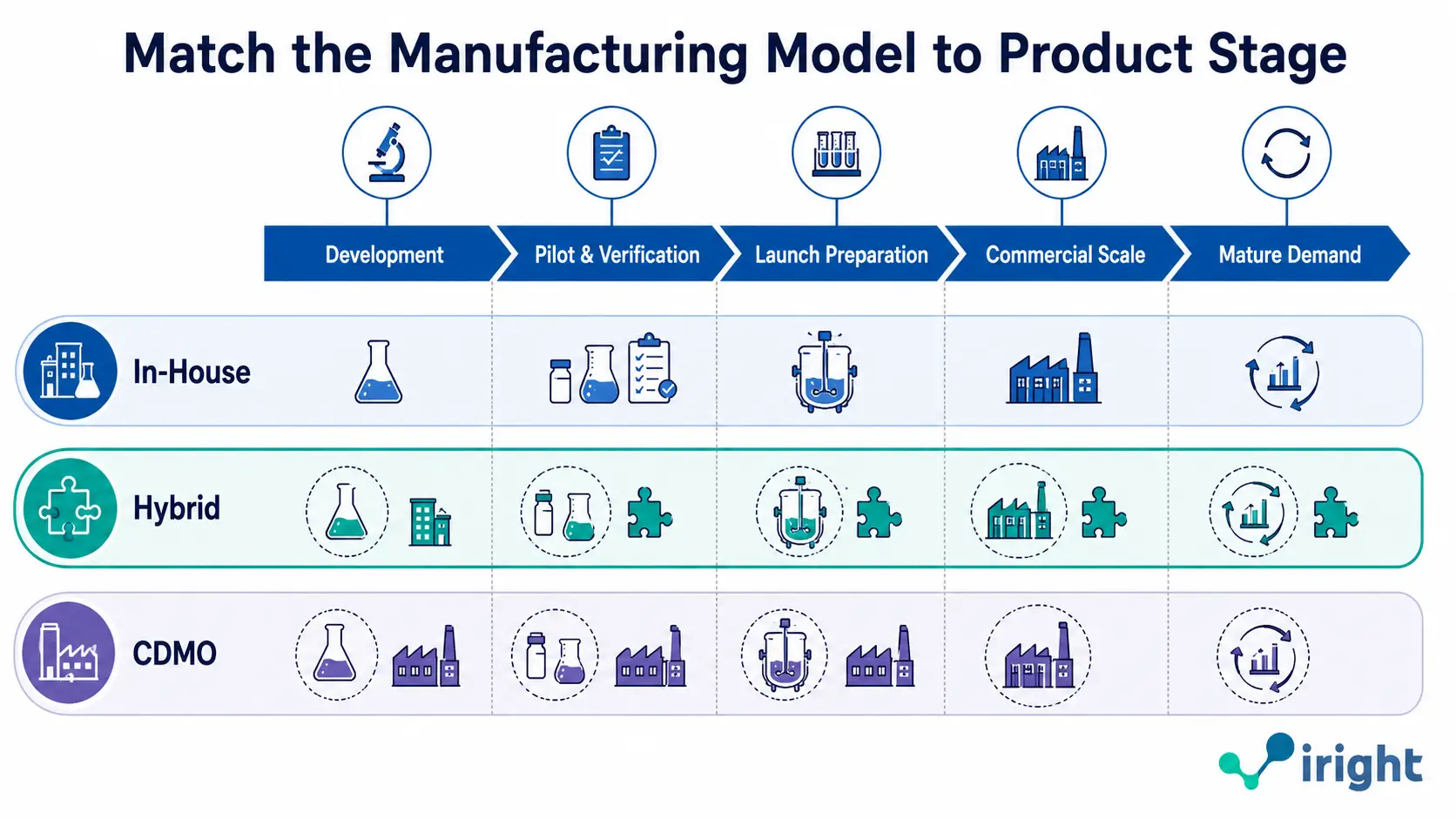
Product stage | In-house can fit when... | A CDMO can fit when... | A hybrid option |
Development | You are changing formulations or methods frequently and need tight feedback loops. | You need a specialist capability that would take too long to establish internally. | Keep formulation and analytical development inside; outsource a defined unit operation. |
Pilot and verification | You need direct learning from every lot and can control the environment. | You need representative equipment, documentation, or scale that your pilot space cannot provide. | Run engineering lots internally and transfer a locked process for confirmation lots. |
Launch preparation | You have qualified capacity, trained staff, and a functioning quality system. | Your launch timing precedes your facility readiness or demand remains difficult to forecast. | Reserve external launch capacity while qualifying a later internal or secondary route. |
Commercial scale | Your demand is stable enough to use the line efficiently and the process is strategically important. | You need flexible volume, geographic reach, or mature manufacturing infrastructure. | Split volume by region, product family, or base-versus-surge demand. |
Mature or declining demand | You can consolidate production efficiently with other products. | Low or uneven volume no longer justifies dedicated internal capacity. | Retain process ownership and critical materials while outsourcing intermittent campaigns. |
This table should not become an automatic stage gate. You still need evidence that the chosen site can reproduce the process. Before you commit, define what “transfer-ready” means for your product: approved specifications, controlled work instructions, qualified methods, known critical parameters, reference materials, packaging requirements, stability expectations, and a documented path for deviations. If those elements are moving targets, outsourcing can relocate uncertainty without resolving it.
Test Capacity, Technology Transfer, and Demand Volatility Together
Capacity and transfer readiness should be evaluated as one decision because a reserved production slot has little value if your process cannot enter it cleanly. You can test the connection through a six-step sequence.
1. Define the transferable process. Identify the current formulation, bill of materials, critical steps, in-process controls, release methods, data package, and responsibilities. Mark every item that is provisional.
2. Map the receiving site. Compare equipment principles, contact materials, environmental conditions, utilities, software, operators, and analytical capabilities. A nominally similar line may still require bridging work.
3. Build the transfer plan. Agree on engineering runs, comparability evidence, acceptance criteria, deviation handling, training, and document approval. Assign an owner on both sides for every output.
4. Confirm usable capacity. Ask which line, shift pattern, campaign window, and quality-review resources support your forecast. Separate a forecast from a contractual reservation.
5. Stress both sides of the forecast. Model a surge that requires additional lots and a downside case that leaves committed capacity unused. Examine response time, fees, material exposure, and rescheduling rights in each case.
6. Set a launch decision gate. Do not treat the purchase order as the gate. Use successful transfer evidence, approved documentation, qualified materials, and an executable supply plan as the basis for release into commercial scheduling.
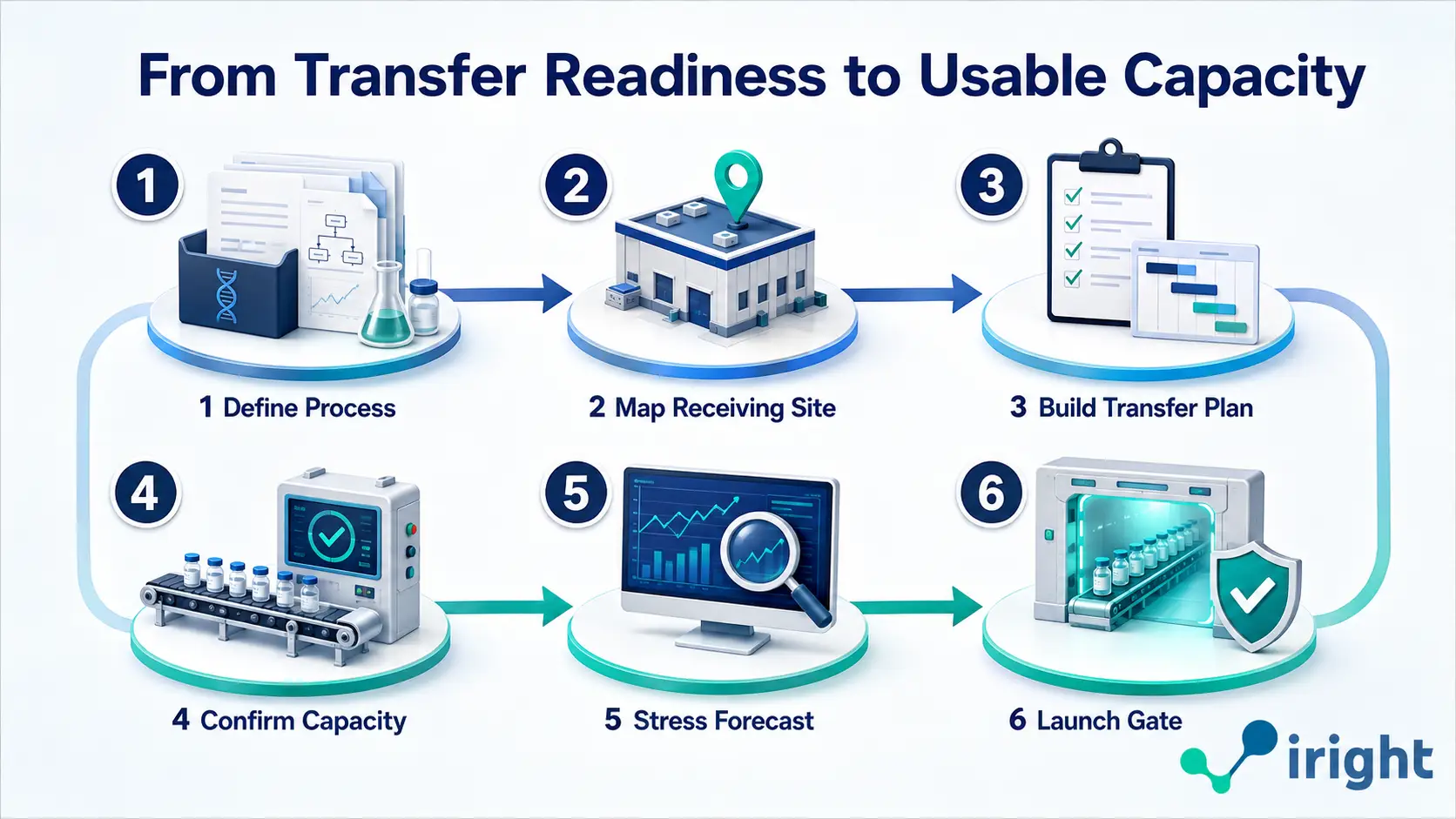
This sequence helps you expose a common mismatch: you may negotiate attractive manufacturing terms before you understand the work required to reproduce the process. The reverse can also happen—you may complete a technically strong transfer without securing enough quality-review or packaging capacity to release finished lots on time. Your RFQ needs to connect both views.
Put MOQ, Release, Quality, and Change Control Into the CDMO RFQ
A useful CDMO RFQ should produce comparable operating commitments, not simply comparable prices. Give each bidder the same process scope, forecast assumptions, documentation expectations, and responsibility matrix. Then ask for answers that can move into the quality agreement and supply contract rather than disappearing after supplier selection.
· Volume and scheduling: State forecast ranges, proposed batch sizes, minimum order quantities, campaign frequency, frozen-window assumptions, standard lead time, and surge scenarios. Ask bidders to distinguish quoted lead time from committed lead time.
· Technology transfer: Request the transfer plan, required input package, engineering-run assumptions, method-transfer responsibilities, acceptance criteria, and treatment of repeat work when a run does not meet the agreed gate.
· Quality and release: Define who owns specifications, sampling, testing, review, disposition support, deviations, investigations, CAPA, retain samples, certificates, and record retention. Ask which records you will receive and when.
· Materials and inventory: Clarify who approves suppliers, purchases long-lead inputs, owns safety stock, manages expiry, and pays for obsolete material after a forecast change. Require visibility into critical sub-tier dependencies.
· Change control: Ask for notice periods and approval rules covering site, equipment, process, method, software, specification, packaging, and raw-material changes. Include emergency-change handling and evidence requirements.
· Continuity and exit: Define business-continuity expectations, data ownership, tooling ownership, transition assistance, remaining inventory, and the format and timing of a transfer-out package.
Price should be tied to these answers. For example, a low unit quote may depend on a large MOQ, a narrow forecast tolerance, client-owned materials, limited investigation support, or long frozen windows. Another quote may include more quality work, inventory protection, or flexibility. If you normalize only unit price, you hide the commercial value of those differences.
You should also score ambiguity. A supplier that returns a polished quotation but leaves responsibility boundaries unresolved has not reduced your risk. Record each open assumption, identify who bears the cost if it proves wrong, and close material gaps before award.
Keep Critical Raw Materials and Second Sources Under Your Control
Outsourcing production does not require you to surrender control of your critical supply base. You should decide which inputs the CDMO may source independently, which require your approval, and which remain client-supplied. That decision can include biological reagents, reference or quality-control materials, membranes, containers, closures, labels, and other components whose variation could affect performance or release.
Use three risk categories to make the boundary visible:
Performance-critical inputs directly influence assay behavior or analytical acceptance. You should maintain approved specifications, supplier identity, lot traceability, change-notification expectations, and a qualification strategy.
Continuity-critical inputs may be technically replaceable but difficult to obtain within your replenishment window. You should review lead time, shelf life, order constraints, geographic concentration, and the time required to approve an alternative.
Compliance-critical inputs carry documentation or status needed for your controlled process. You should define the required certificate, traceability record, release evidence, and retention period before the first commercial order.
Representative items can make an RFQ more concrete. Thermo Fisher BSA, acetylated (AM2614) is an example of a reagent input; Waters MassTrak Immunosuppressant Quality Control Set (186010252IVD) illustrates an IVD quality-control material; Cobetter sterile PES syringe filters (SFMPES-2213S) and Sartorius Sartolab RF 500 filtration units (180E04---------E) illustrate filtration consumables at different handling scales. These examples are not interchangeable recommendations. You still need to confirm suitability, regulatory status, material compatibility, specifications, and supply terms for your process.
A second source also needs more than a vendor name. Define the trigger for qualification, the comparability work required, the data owner, and the point at which contingency inventory is no longer enough. If you wait for a shortage before building this package, the alternative may arrive too late to protect your schedule.
Compare Total Ownership Cost—and Leave Room for a Hybrid Model
Your final comparison should combine visible payments with the work and exposure retained by your organization. Use a common planning horizon and the same demand scenarios for every option. Avoid false precision: the purpose is to reveal cost drivers and risk transfer, not to manufacture a single flawless forecast.
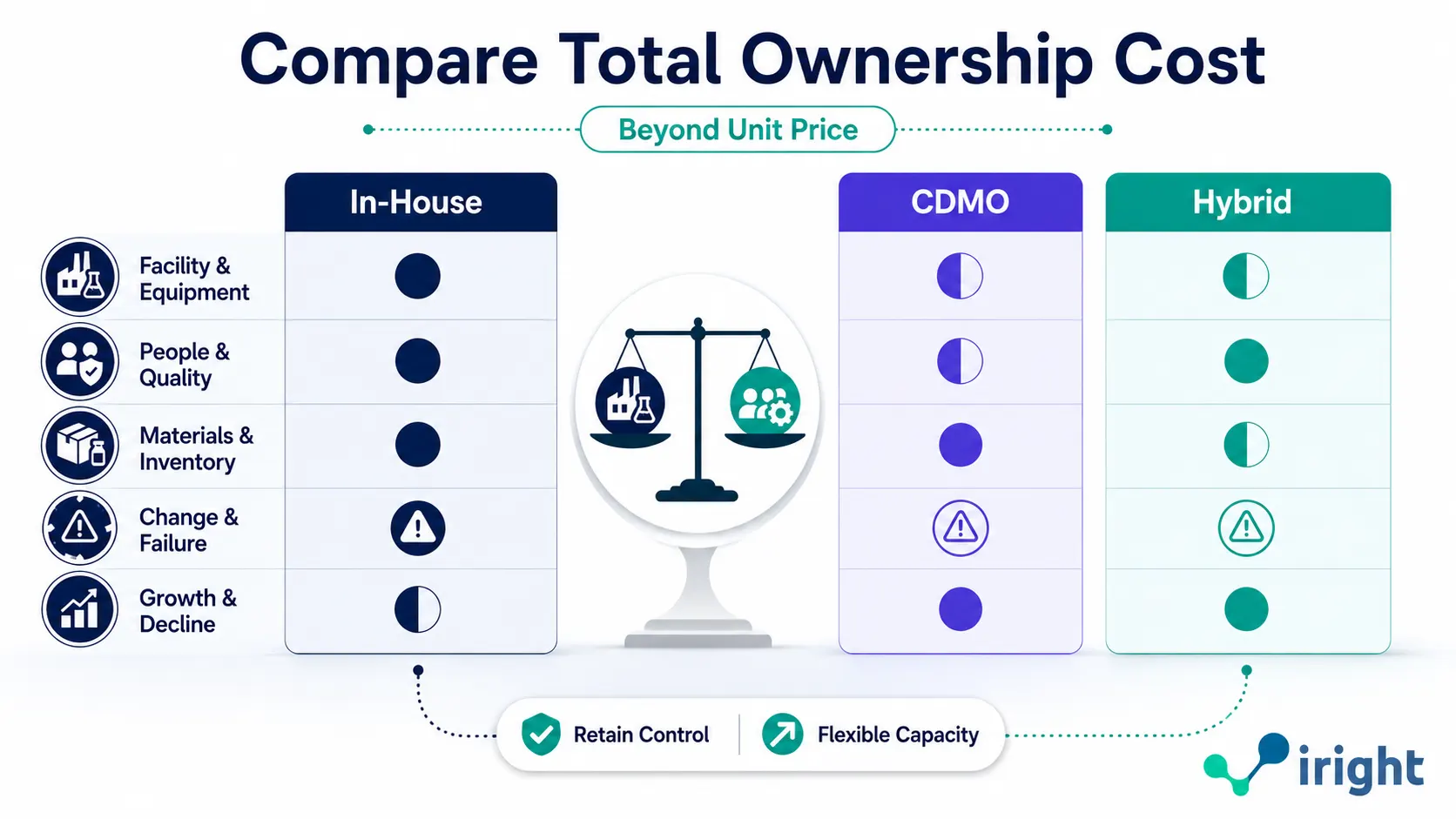
Cost or risk area | In-house model | CDMO model | Question to normalize |
Facility and equipment | Build-out, qualification, maintenance, calibration, and idle capacity | Transfer, setup, reservation, and possible dedicated-equipment charges | What capacity is available, qualified, and paid for in each demand case? |
People and quality | Manufacturing, engineering, quality, validation, planning, and supplier-management staff | Sponsor oversight, batch review, investigations, audits, and contract governance | Which work remains yours even after outsourcing? |
Materials and inventory | Purchasing leverage, safety stock, expiry, scrap, and storage | Pass-through pricing, handling fees, MOQ exposure, and client-owned stock | Who owns inventory and obsolescence at each stage? |
Change and failure | Internal downtime, rework, investigation, and revalidation | Change-order fees, repeat runs, queue delay, investigation support, and transfer-out effort | Who pays, who decides, and how quickly can work resume? |
Growth and decline | Expansion capital or underused fixed capacity | Surge premiums, reserved slots, rescheduling limits, or minimum commitments | How does the model behave above and below forecast? |
A hybrid model may give you a better answer than a permanent binary choice. You might retain formulation, analytical methods, reference standards, and critical supplier approvals while outsourcing routine bulk preparation, filling, labeling, or surge volume. You might use a CDMO for launch, then internalize after the process and forecast stabilize. You might keep a qualified external route as continuity capacity rather than as the base-load source.
Whatever structure you choose, define governance as part of the cost. Set review cadence, forecast updates, quality metrics, change-control routing, escalation paths, and transfer-package maintenance. A model that appears inexpensive but demands constant intervention may consume more internal capacity than your spreadsheet shows. A model with a higher quoted cost may be more economical if it shortens a facility build, absorbs volatile demand, or reduces duplicated infrastructure—but only when the contract makes those benefits usable.
Choose the Model You Can Govern
You do not need to predict every future batch to make a sound manufacturing choice. You need a model that fits your current product stage, makes capacity commitments visible, transfers the process with evidence, assigns quality responsibilities clearly, and preserves control of critical inputs. Compare in-house, CDMO, and hybrid options under the same demand and failure scenarios, then revisit the decision as your process and forecast mature. Iright can help you compare OEM/CDMO RFQs, critical raw-material sources, and alternative suppliers so you can reduce procurement uncertainty during IVD scale-up.