Article
Integrated vs Modular Urinalysis Systems: How Should Clinical Labs Compare Workflow Cost and Capacity?
By Iri · · Updated

Choosing a urinalysis platform is not simply a choice between two analyzers. You are deciding how urine chemistry, microscopy, reflex rules, manual review, quality control, data transfer, service, and consumables will work as one operating system. A lower instrument price can therefore create a higher cost per reportable result, while a more integrated platform can simplify handoffs but concentrate operational risk. The useful comparison starts with your specimen path and workload, then tests each architecture against capacity, resilience, and total ownership cost. That approach gives you an RFQ that suppliers can answer consistently and your laboratory can defend after implementation.
Why Analyzer Price Is the Wrong Starting Point
Beckman Coulter announced the US launch of the DxU 1800 automated urinalysis system in July 2026. The vendor describes the system as a unified configuration combining the DxU 1800c urine chemistry analyzer, associated consumables, and DxU Iris microscopy. It also states that the chemistry analyzer can operate independently at up to 300 samples per hour and that creatinine and microalbumin assays are planned additions.
Those details are useful because they illustrate the questions now appearing in urinalysis procurement: Do you want chemistry and microscopy managed as one workflow, or do you want each function sized and operated independently? How much capacity do you need today, and how much menu or automation expansion should your contract anticipate?
You should keep the evidence boundary visible. The throughput figure is a vendor-announced analyzer specification, not a guarantee of your laboratory's sustained reportable-result rate. Planned assays are not the same as a currently available, validated menu. Your achievable throughput will also depend on specimen mix, reflex frequency, review rules, staffing, maintenance, reruns, and information-system performance.
Procurement principle: Compare the complete path from received specimen to released result. Use analyzer price and headline throughput as inputs, not as the decision itself.
Once you make that distinction, the architecture discussion becomes more practical. You can evaluate where work waits, where an operator intervenes, and what happens when one component is unavailable.
Map the Chemistry-to-Microscopy Path Before You Compare Architectures
Your first comparison document should be a process map, not a price sheet. Follow representative specimens through the path below and record who owns each decision, what data move between systems, and which exceptions require touch time.
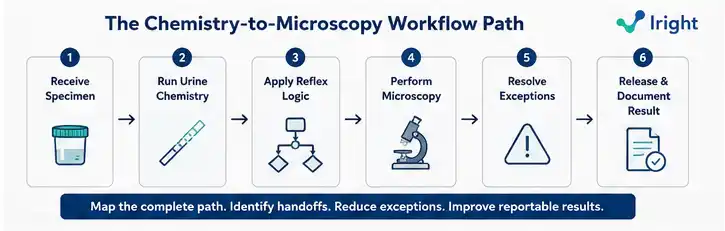
1. Receive and identify the specimen. Confirm the container, minimum volume, labeling rules, acceptance criteria, and whether an aliquot or transfer is required before loading.
2. Run urine chemistry. Record loading steps, test-strip or reagent handling, calibration and QC requirements, result flags, repeats, and rules that prevent automatic release.
3. Apply reflex logic. Define which chemistry findings, patient categories, orders, or local rules trigger microscopy. Separate rules that the middleware can execute from rules that still require operator judgment.
4. Perform microscopy. Capture how the specimen reaches the microscopy module, how particles are classified, and which images or classifications require review.
5. Resolve exceptions. Track insufficient volume, barcode failures, clots or debris, instrument flags, discordant findings, manual microscopy, dilutions, and recollection requests.
6. Release and document the result. Confirm how results, images, comments, audit trails, and QC status reach your LIS and how corrected reports are handled.
This map exposes workload that a specification sheet can hide. An integrated system may reduce physical transfer and synchronize reflex routing, yet your laboratory can still accumulate a queue at manual review. A modular system may require more coordination, yet it may let you direct chemistry-negative specimens away from microscopy or preserve access to one function while the other is serviced.
Use more than an average-day scenario. Map a routine shift, a peak arrival period, a maintenance interval, and a downtime event. You will then compare architectures against the conditions that shape staffing and turnaround, not only against a nominal instrument rate.
Where Integration Can Reduce Handoffs—and Create New Dependencies
Integration can create value when it removes repeated identification, transfer, routing, and data-reconciliation steps. You may gain a clearer work queue, more consistent application of reflex rules, and a smaller number of interfaces for operators to monitor. Those gains matter most when a high proportion of your specimens move from chemistry to microscopy and when manual transfers are a persistent source of delay or rework.
Fewer physical handoffs. You may reduce aliquoting, rack movement, barcode rescanning, and the need to match chemistry and microscopy records manually. You should confirm exactly which specimens remain on the automated path and which exceptions leave it.
Unified review. A shared workstation may present chemistry findings, particle images, and flags in one place. You should test whether this actually shortens review for your common cases and whether reviewers can distinguish auto-released, edited, and manually confirmed findings.
Consistent reflex execution. A connected workflow may apply approved rules without waiting for an operator to interpret a chemistry result. You still need governance for rule changes, validation, access permissions, and audit trails.
Integration also concentrates dependencies. If chemistry, microscopy, middleware, consumables, and service operate as one platform, a failure or supply interruption can affect more of your testing path. You should ask which functions remain available during maintenance, whether specimens can be diverted, how results are reconciled after downtime, and whether a software or interface issue can block both analytical components.
The right question is therefore not whether integration is inherently more efficient. You need to know which handoffs disappear, which new dependencies appear, and whether the resulting trade is acceptable for your workload and backup plan.
When Modular Chemistry and Microscopy May Be the Better Fit
A modular design can be the stronger operating choice when you need independent sizing, phased investment, or resilience across separate analytical functions. It can also preserve the value of equipment and interfaces that your team already knows. The comparison should be made by scenario rather than by a universal preference.
Your operating condition | Integrated architecture may fit when | Modular architecture may fit when |
Specimen routing | A large, predictable share of chemistry results proceeds to microscopy | Reflex rates vary, or many chemistry specimens do not need microscopy |
Capacity profile | Chemistry and microscopy volumes grow together | One function needs substantially more capacity than the other |
Space and staffing | You want one coordinated footprint and review environment | Separate benches, shifts, or specialist teams already work effectively |
Downtime strategy | You have a validated backup path outside the platform | You want one module to remain usable while the other is unavailable |
Budget timing | You can fund and validate the combined workflow as one project | You need to replace or expand one component before the other |
Existing systems | Your LIS, middleware, and automation can support the unified design | Existing analyzers, interfaces, and competency programs still have useful life |
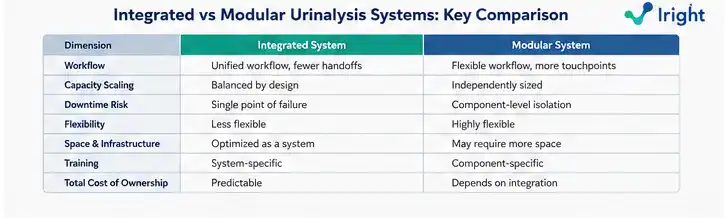
Do not treat modularity as a synonym for manual work. Two standalone analyzers may still exchange orders and results through middleware, share racks or standardized containers, and operate under automated reflex logic. Conversely, do not assume an integrated label eliminates every manual step. Your acceptance testing should measure the actual path for routine specimens and the exceptions that consume the most staff time.
This scenario matrix gives you the basis for a controlled shortlist. You can now ask each supplier for the same operating evidence instead of accepting a demonstration built around its preferred specimen mix.
Put Six Operating Variables Into the RFQ
Your RFQ should require suppliers to describe the full operating package. Keep the questions architecture-neutral so that an integrated platform and a modular proposal can be compared on the same basis.
1. Consumable and reagent burden. Request every routine and periodic SKU, pack size, onboard stability, storage condition, minimum order quantity, waste assumption, and stated compatibility. Include collection, transfer, analyzer, cleaning, maintenance, and disposal supplies.
2. QC and calibration workflow. Ask which materials are required, how often they are run, how failures are handled, and whether chemistry and microscopy controls are managed separately. Require the supplier to identify materials that are included, optional, third-party, or locally sourced.
3. Reflex and review rules. Provide your representative rules and ask the supplier to show how they are configured, approved, versioned, audited, and validated. Request a count of operator touches for routine, flagged, and manual-review cases.
4. Data interfaces. Define bidirectional orders, results, images, comments, QC status, user access, audit trails, downtime queues, and corrected-result workflows. State who owns interface configuration, testing, and future changes.
5. Service and continuity. Request uptime definitions, preventive-maintenance windows, response targets, remote support boundaries, parts availability, escalation routes, loaner or backup options, and a documented manual or alternative workflow.
6. Expansion path. Ask how you add capacity, assays, review stations, interfaces, or a second analytical module. Separate currently available capability from roadmap statements and require a commercial assumption for each expansion option.
Your supporting bill of materials can include collection and handling products as well as analyzer-specific supplies. Examples listed in the catalog include the Thermo Scientific Samco UrineGARD Urine Collection Container 303500, Samco Wide Mouth Bio-Tite 120 mL Specimen Container 010181, and Capitol Vial Single Specimen Urine Collection Kit 90111TS. You should verify sterility, additives, closure, volume, labeling, transport, and analyzer compatibility before treating any item as approved for your clinical workflow.
When suppliers answer these six variables, you can distinguish a low equipment quote from a complete operating proposal. You also create a record that quality, IT, operations, and purchasing can review before commercial terms are finalized.
Compare Cost per Reportable Result, Not Cost per Analyzer
Your final comparison should put cost, labor, and downtime into one model. You do not need invented prices or a false level of precision. Use your own volumes and staffing assumptions, require suppliers to state their inputs, and test a base case alongside peak-volume and downtime cases.
Cost component | What you should include | Why architecture changes the result |
Acquisition and implementation | Instruments, automation, workstations, middleware, interfaces, site work, validation, and training | One combined project may simplify implementation, while phased modules may spread cost and validation work |
Routine consumables | Reagents or strips, cuvettes or carriers, collection and transfer supplies, cleaning materials, and waste | Pack sizes, open stability, reflex volume, and proprietary consumables can change cost per completed specimen |
QC and maintenance | Controls, calibrators, preventive maintenance, service contracts, parts, and repeat testing after interventions | Separate modules may duplicate some activities; a unified platform may concentrate service dependency |
Labor | Loading, transfer, review, result reconciliation, exception handling, inventory control, and competency work | Integration may remove touches, but review rules and exception rates determine whether labor is actually reduced |
Downtime and recovery | Backup testing, referral, manual microscopy, overtime, delayed reports, and post-recovery reconciliation | A shared failure can affect more of the path; independent modules can preserve partial capacity but require coordination |
Expansion and replacement | Added modules, menu changes, software, interfaces, space, revalidation, and end-of-life transition | Modular growth can target one bottleneck; integrated growth may be simpler only when both functions scale together |
Calculate annual ownership cost for the same number of reportable results, then divide by that volume. Run a second calculation using your peak-period mix and a third using a defined downtime event. The difference between those scenarios is often more informative than the difference between acquisition prices.
You should also keep capacity and cost connected. If a proposal meets average demand but creates an unsustainable review queue at peak times, its apparent cost per result is incomplete. If a higher-capacity configuration leaves most capacity unused but reduces a critical downtime exposure, document that benefit explicitly rather than hiding it inside a vague preference.
Iright can help you compare urinalysis instruments, consumables, QC materials, and sample-handling supplies, then build an actionable RFQ around your throughput and lead-time requirements.
An integrated urinalysis system can be valuable when it removes meaningful handoffs and aligns chemistry, microscopy, rules, and review. A modular design can be stronger when you need independent capacity, phased replacement, or partial operation during downtime. You can make the choice defensible by mapping the specimen path, testing normal and exception workflows, asking every supplier the same six operating questions, and comparing ownership cost per reportable result. That method keeps vendor specifications in their proper place: useful evidence inside a broader decision about your laboratory's workload, resilience, and future capacity.