Article
What Labs Need to Add When Bringing Capillary Sampling Into an Existing Core Lab Workflow
By Iri ·

Adding capillary sampling to an established core laboratory can look deceptively simple: keep the analyzer, change the collection device, and begin testing smaller specimens. In practice, you are adding a new preanalytical route to a system designed around venous tubes, familiar volumes, and predictable automation. Your purchasing plan therefore has to connect collection, identification, transport, centrifugation, aliquoting, analyzer presentation, quality control, and validation. If you map that chain before requesting quotes, you can separate essential additions from convenient extras, identify compatibility questions early, and avoid discovering during validation that a low-volume sample cannot move through your existing workflow as expected.
Why Capillary Claims Change More Than the Collection Step
The immediate signal comes from Siemens Healthineers' July 23, 2026 announcement. After receiving CE marking, the company introduced 24 capillary blood testing claims for Atellica CH, IM, and CI analyzers. The stated menu includes common testing needs associated with comprehensive metabolic, lipid, thyroid, Vitamin D, and HbA1c testing. Siemens framed the expansion as a way for laboratories to use infrastructure they already operate rather than build a separate testing platform.
That is important, but you should read “existing infrastructure” as an analyzer opportunity, not as proof that the surrounding workflow remains unchanged. Siemens also notes that collection method can affect sample quality and result accuracy. Its announcement says the CE-marked claims are validated on the named Atellica analyzers and carries a U.S. availability limitation, so you still need to confirm the exact assay, specimen type, geography, software, and instructions for use that apply to your site.
Procurement implication: An on-label capillary claim can reduce uncertainty at the analyzer-assay boundary. It does not automatically validate your collection device, remote site, transport interval, centrifugation practice, sample identification process, or local acceptance criteria.
You are therefore buying a controlled route into the core lab, not merely a smaller tube. That route has more handoffs than the venous pathway it joins, and every handoff can change the volume available, the sample condition, or the ability of automation to recognize and aspirate the specimen.
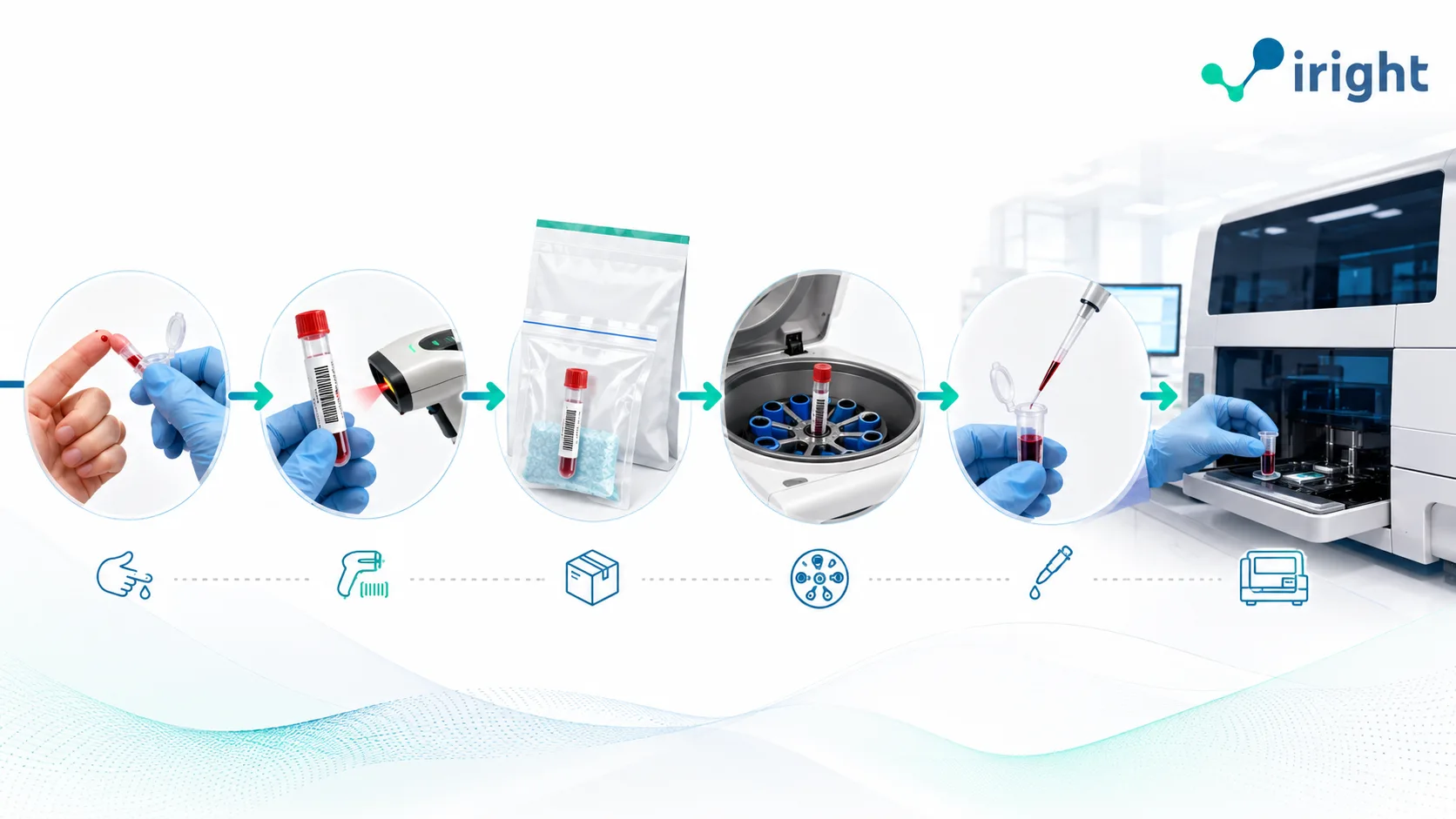
Map the Capillary Sample Journey Before Building the Purchase List
Start by following one specimen from the patient to the result. The map should show who performs each action, which container holds the specimen, how long the step may take, and where the sample changes form. A compact workflow table gives procurement, laboratory operations, phlebotomy, and quality teams one shared reference.
Workflow point | What you need to define | Purchasing consequence |
Patient and collection site | Patient identification, puncture site, collector competency, and required specimen type | Single-use lancets or incision devices, approved microcollection containers, labels, and site-specific collection kits |
Fill and mix | Target volume, fill limits, additive, mixing sequence, clotting interval, and rejection rules | Container variants, fill-volume aids, timers, racks, and training materials |
Identification | Label size, barcode format, print location, and positive patient/specimen matching | Compact labels, compatible printers, scanners, and middleware or accessioning changes |
Packaging and transport | Upright or protected position, temperature, maximum interval, leakage control, and courier handoff | Transport bags, absorbent material, rigid carriers, temperature monitoring, and route-specific packaging |
Receipt and preparation | Accessioning, inspection, centrifugation, decapping, aliquoting, and exception handling | Tube adapters, compatible rotors, low-volume transfer tools, secondary tubes, and dedicated racks |
Analyzer presentation | Primary-tube or cup loading, dead volume, probe reach, sample identification, and reflex testing | Sample cups, inserts, racks, validated tube geometry, and additional volume planning |
Retention and disposal | Storage duration, add-on testing, traceability, and biohazard disposal | Capped storage tubes, barcode tracking, freezer or refrigerator capacity, and waste containers |
CLSI GP42 treats capillary collection as a process made up of sequential procedures and includes requirements for disposable collection, processing, and transfer devices. That process view is useful for your purchasing work: it prevents a collection team from choosing a convenient device that the receiving laboratory cannot centrifuge, scan, load, or retain.
Your map should also include the failure path. Decide what happens when a container is underfilled, clotted, hemolyzed, leaking, delayed, mislabeled, or too low in volume for the ordered menu. You may need a recollection rule, a reduced test menu, or a documented priority order. Those decisions affect the number and type of containers you buy, the volume you reserve, and whether you need a venous fallback.
The Added Supplies Your Existing Core Lab May Need
Once the journey is visible, you can build the capillary-specific bill of materials. You should keep the collection system and the downstream handling system together in the same evaluation, because a low-volume advantage can disappear if multiple transfers or dead-volume requirements consume the specimen.
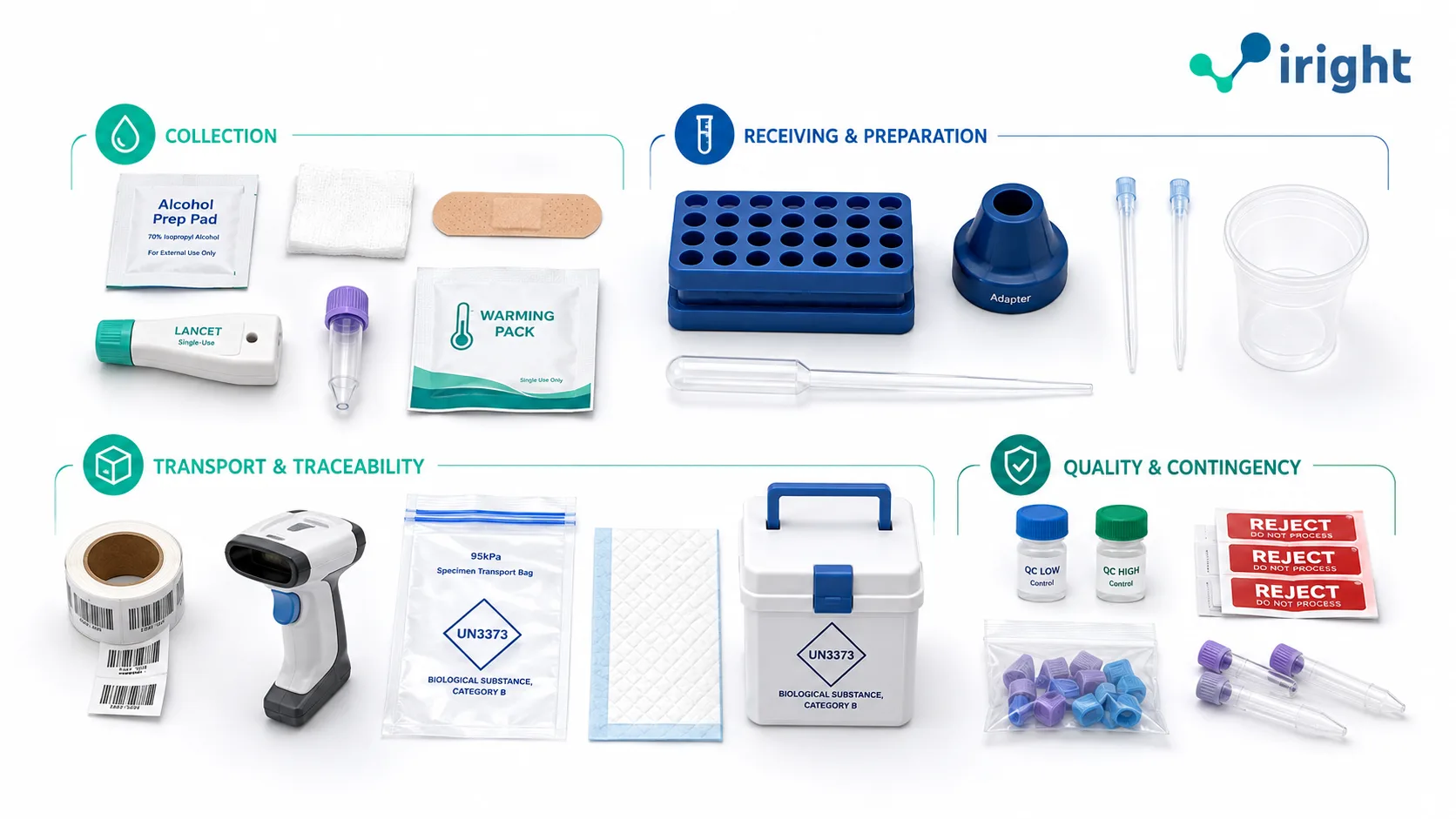
Collection and patient-facing supplies may include a single-use puncture device matched to the intended patient population, a microcollection container with the required additive or separator, skin-preparation materials, gauze, bandages, warming supplies where your procedure permits them, and a compact label that remains readable on the container. You should buy the collection device and container as a controlled combination when the manufacturer or assay instructions require it.
Receiving and preparation supplies may include racks for short or narrow tubes, centrifuge adapters, balance tubes, caps, low-retention pipette tips, transfer pipettes, sample cups, and cup inserts. If your analyzer can aspirate from the validated primary container, you may reduce transfer steps. If it cannot, you need to define who transfers the specimen, how identity is preserved, and how much usable volume remains after preparation.
Transport and traceability supplies may include secondary packaging, absorbent material, tamper evidence, rigid carriers, temperature indicators, remote label printers, and barcode scanners. You should treat the remote site as part of the laboratory process, even if collection occurs in a clinic, pharmacy, mobile unit, or outreach location.
Quality and contingency supplies may include assay-appropriate controls, proficiency or comparison materials where available, retained venous comparator supplies, and backup consumables for recollection. You may also need dedicated rejection labels or electronic reason codes so preanalytical failures can be trended rather than hidden inside a generic cancellation category.
Three filters will keep the list disciplined:
· Required for the claimed workflow: an item specified by the assay, analyzer, collection-device, or local validated procedure.
· Required by your operating model: an item needed because specimens travel, originate remotely, or enter automation in a particular way.
· Convenience only: an item that improves speed or ergonomics but does not close a defined workflow or quality gap.
Use those labels in the RFQ. They make it easier to compare suppliers without allowing optional accessories to obscure the cost of the validated core configuration.
Check Analyzer Compatibility and Validation Boundaries Before You Buy
Your compatibility review should move through six gates. A “yes” at the first gate does not carry forward automatically to the next one.
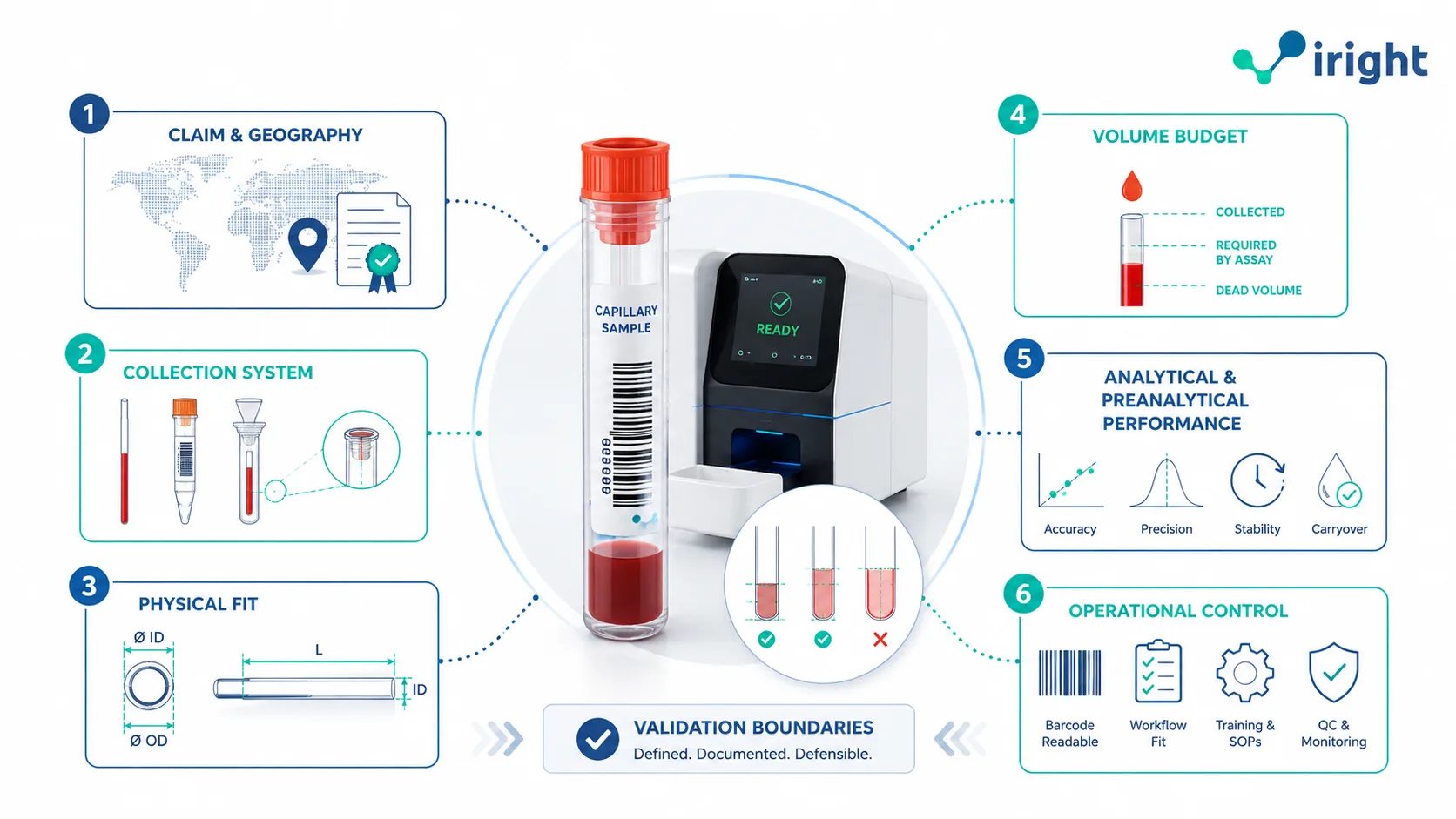
1. Claim and geography. Confirm that the exact assay has a capillary claim in your jurisdiction and on your analyzer model. Record the approved specimen matrix and any restrictions rather than relying on a portfolio-level announcement.
2. Collection system. Confirm the permitted collection device, additive, separator, fill range, mixing, clotting, and handling instructions. Capillary blood is not a universal substitute for venous serum, plasma, or whole blood.
3. Physical fit. Check tube dimensions, cap or closure, rack position, barcode visibility, centrifuge support, decapping, sample-probe access, and primary-tube loading. A chemically acceptable specimen can still fail because the container geometry does not fit the process.
4. Volume budget. Calculate collection target, processing loss, dead volume, aspiration volume, repeats, dilutions, reflex tests, and retained volume. The published equivalence work supporting routine capillary testing used miniaturized assays and specific collection and processing approaches; you should not assume the same volume performance for a different configuration.
5. Analytical and preanalytical performance. Define how you will assess agreement, precision, reportable range, interference or sample-quality flags, carryover, stability, rejection rates, and repeatability of collection. Your plan should reflect the intended menu and patient population, not a generic laboratory validation template.
6. Operational control. Approve procedures, staff competency, lot acceptance, change notification, QC response, downtime handling, and post-launch monitoring. Track capillary-specific recollection and rejection causes so you can distinguish collection problems from analyzer problems.
The practical boundary is simple: a manufacturer claim tells you what the manufacturer has established for a defined system. Your laboratory remains responsible for verifying that its implementation performs as required under applicable regulations, accreditation requirements, and local procedures. You should involve your laboratory director and quality lead before committing to large consumable volumes or remote-site expansion.
Decide What Can Stay on the Current Platform—and What Needs a Second Source
You do not need to replace an analyzer merely because you add a capillary pathway. You do need to decide which parts of the existing system are genuinely reusable and which parts introduce a single-source dependency. A decision matrix helps you make that distinction without turning every supply question into a platform question.
Decision | Keep the current configuration when... | Add or qualify another option when... |
Analyzer and assay | The exact claim, specimen matrix, menu, and local verification support your intended use | A required assay lacks the relevant claim, volume is insufficient, or the workflow needs a separately validated method |
Collection container | Instructions, fill range, additive, geometry, and transport conditions fit the full pathway | Remote collection, patient group, transport, or automation requires a different validated container |
Centrifugation and racks | Existing equipment supports the tube securely and achieves the specified processing conditions | Tube geometry requires adapters, a dedicated rotor, new balancing practice, or protected low-volume handling |
Transfer and presentation | The analyzer accepts the validated primary container with an adequate volume reserve | Secondary cups, inserts, or low-retention transfer tools are required to reach the probe safely |
Transport | Existing routes meet validated time, temperature, packaging, and traceability limits | Decentralized sites require a monitored carrier, new packaging, or a shorter route |
Supply continuity | Lead time, lot control, shelf life, and change notification are acceptable | One device or accessory can stop the route and a technically qualified alternate is available |
Your second source should have a defined role. It may be a commercially alternative item that still requires bridging, an emergency option used only after quality approval, or a fully qualified equivalent for a specific step. Do not label products interchangeable because their volume, additive color, or dimensions appear similar. For the collection container and assay interface, technical equivalence has to be demonstrated rather than assumed.
Representative products can help you ask sharper questions without implying analyzer compatibility. For example, an Eppendorf Microtainer adapter (5425716001) illustrates the need to match small-tube geometry to a rotor; Thermo Scientific ART Barrier Low-Retention Pipette Tips (2140-05PK) illustrate a transfer consumable for small liquid volumes; and Thermo Scientific Linear Barcoded Tubes (5001-0020) illustrate a traceable secondary-storage option. None of these examples should enter your approved workflow until you verify their intended use, physical fit, specimen-contact requirements, and local validation status.
Turn the Workflow Map Into a Validation-Ready RFQ
Your RFQ should ask suppliers to respond to the workflow you intend to validate, not simply quote “capillary supplies.” Include enough technical context for each bidder to state where its product fits and where it does not.
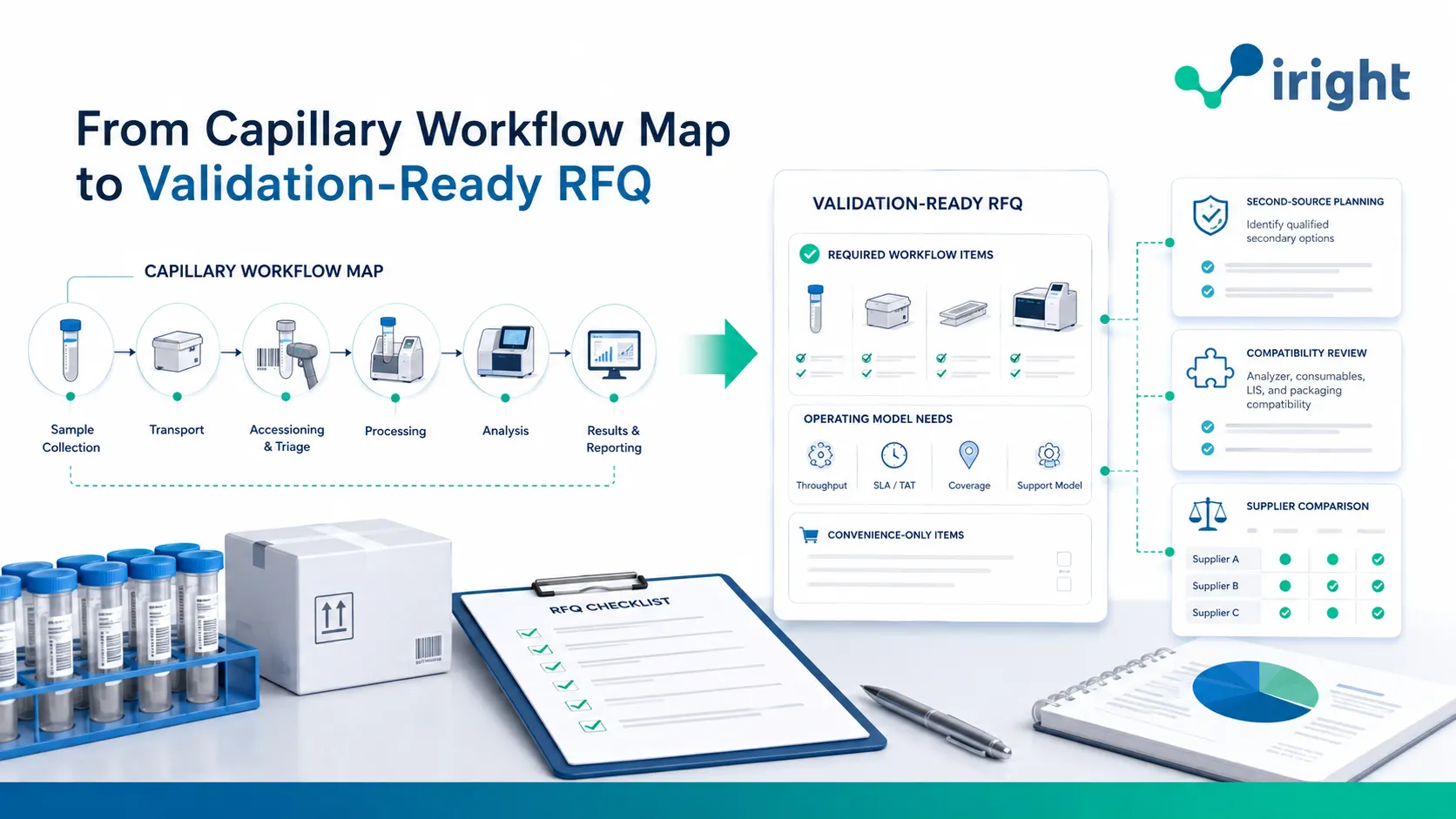
· Identify the analyzer model, software version, assays, specimen matrices, jurisdiction, and intended patient or collection settings.
· Specify the proposed collection device and container, target fill range, additives, separator, tube dimensions, and barcode requirements.
· Provide maximum transport time, temperature conditions, packaging needs, and expected weekly volume by site.
· Describe centrifugation, primary-tube loading, transfer steps, sample cups or inserts, dead-volume limit, and repeat or reflex requirements.
· Request instructions for use, regulatory status, lot documentation, shelf life, storage, change notification, complaint handling, training, and technical support.
· Ask for lead time, minimum order, pack size, regional availability, substitute policy, and second-source options.
· Require bidders to identify every claim that still needs confirmation instead of answering a compatibility question with a general product-category match.
If your lab is expanding into capillary-compatible workflows, Iright can help you map the added consumables, compatible options, and RFQ paths before validation starts.
The safest way to add capillary sampling is to treat it as a new specimen pathway connected to an existing analytical platform. When you map every handoff, budget the usable volume, confirm the claim boundary, and define acceptance evidence before buying, your team can preserve the value of current infrastructure without hiding new operational risk. You can then distinguish mandatory supplies from local conveniences, decide where a second source is realistic, and issue an RFQ that suppliers can answer precisely. That preparation does not replace validation; it makes validation more efficient by ensuring the materials, interfaces, and responsibilities have already been made visible.