Article
Performance and Substitutability Assessment of the Cytiva Pall™ Pegasus™ SV4 AB1USV47PH4 Virus-Removal Cartridge: An Evidence-Based Comparative Review
By Iri · · Updated

Article
By Iri · · Updated
AB1USV47PH4 is the 254 mm (10-inch) cartridge format in the Pegasus SV4 family. The membrane is hydrophilic modified polyvinylidene fluoride (PVDF); polyester is used for support and drainage; polypropylene is used for the core, cage and end caps; and the Code 7 end contains a reinforced ring with two silicone O-rings. The nominal filtration area is 2.25 m², unusually dense for a 10-inch pleated virus-filter cartridge. Cytiva attributes this density to a laid-over pleat geometry. The resulting engineering benefit is not higher intrinsic membrane flux, but fewer cartridges for a given installed area, with potentially lower skid footprint and hold-up volume.
The recommended operating differential pressure is 2.1–3.1 bar (30–45 psid). Cytiva lists 3.1 bar as the continuous maximum differential pressure and 6.2 bar for integrity testing; the maximum operating temperature is 40 °C. The cartridge can be autoclaved, and membrane integrity is checked by a diffusional forward-flow method. Users should apply the exact current instructions for use and validation guide for their lot and assembly, rather than infer limits from a family brochure.
The product family also supports scale-down. Publicly listed devices include the FTKSV4047 47 mm disc, KA02SV42FT Mini Kleenpak™ capsule, NP1LUSV4P1 0.25 m² capsule and 2.25 m² process formats. The existence of a vendor-defined scale-up chain is a practical advantage because filterability, viral-clearance and manufacturing studies can be connected using the same membrane grade.
Attribute | AB1USV47PH4 public specification | Practical significance |
|---|---|---|
Filter class | 20 nm nominal virus-removal filter | Intended for small non-enveloped virus and larger-virus removal; nominal pore rating is not a product-specific LRV guarantee |
Membrane | Hydrophilic modified PVDF | Relatively homogeneous depth morphology; chemically distinct from PES competitors |
Format | 10-inch Code 7 cartridge, double silicone O-ring, bayonet lock and fin | Fits a defined stainless-steel housing/interface; a cassette is not a mechanical drop-in |
Nominal area | 2.25 m² | High area density can reduce cartridge count and hold-up volume |
Virus-retention claim | >4 LRV PP7 by PDA TR41; >4 LRV typically expected for mammalian parvovirus | Supplier specification and lot-release framework, not a substitute for process-specific validation |
Recommended ΔP | 2.1–3.1 bar | Pressure, pauses, endpoint loading and flush must be represented in validation |
Integrity test | Diffusional forward flow; pre-/post-use capability | Supports non-destructive process control and deviation investigation |
Quality tests described by supplier | Fabrication integrity correlated with PP7 removal; PP7 lot release; water flow and protein transmission | A mature evidence package for procurement and validation review |
Sources: Cytiva product page and Pegasus SV4 technical data sheet.
Cytiva reports PPV experiments (n = 4) and PP7 experiments (n = 9) in 1 g/L bovine serum albumin at 3.1 bar, with results plotted through roughly 300 L/m² and a product claim above 4 LRV. The same brochure reports calculated flux profiles for a 25 g/L monoclonal antibody at 2.1 and 3.1 bar. These data are relevant because the challenge conditions, replicates and pressure are stated. They remain manufacturer-generated data and should not be assigned the same evidentiary weight as an independent, product-specific validation.
A separate Cytiva design-space guide for plasma derivatives reports that typical bacteriophage clearance in 1 g/L BSA remained above 4 logs from 2.1 to 3.1 bar. It also shows why operating conditions matter: water flux changed by more than 30% at 4 °C or 37 °C relative to 20 °C because of viscosity. For human polyclonal IgG, capacity did not change significantly between the two recommended pressures in the study, while protein concentration was product-dependent; 20–50 g/L was proposed as a useful development range. The guide recommends evaluating prefiltration when flux decay becomes material.
Billups and colleagues compared three highly purified mAbs using single layers of Viresolve NFP, Viresolve Pro and Pegasus SV4 membranes at a constant 30 psig. At 5 L/m², the measured fluxes were 156, 176 and 632 LMH for Viresolve Pro versus 0.7, 30 and 70 LMH for Pegasus SV4 for mAbs A, B and C, respectively. Clean-buffer flux was 800–1,200 LMH for the Viresolve membranes and 80–120 LMH for SV4, reflecting the latter’s relatively homogeneous small-pore depth. With mAb C, the immediate flux decline was only about 25% for SV4 versus 40% for Pro, yet mAb A caused extreme SV4 fouling. Nearly 90% of SV4’s clean-membrane flux recovered during a post-product buffer flush in that mAb A experiment, indicating a large reversible-fouling component. The central scientific conclusion is molecule dependence: no ranking is valid without testing the actual process intermediate. See Billups et al., Biotechnology Journal (2023), DOI 10.1002/biot.202300265.
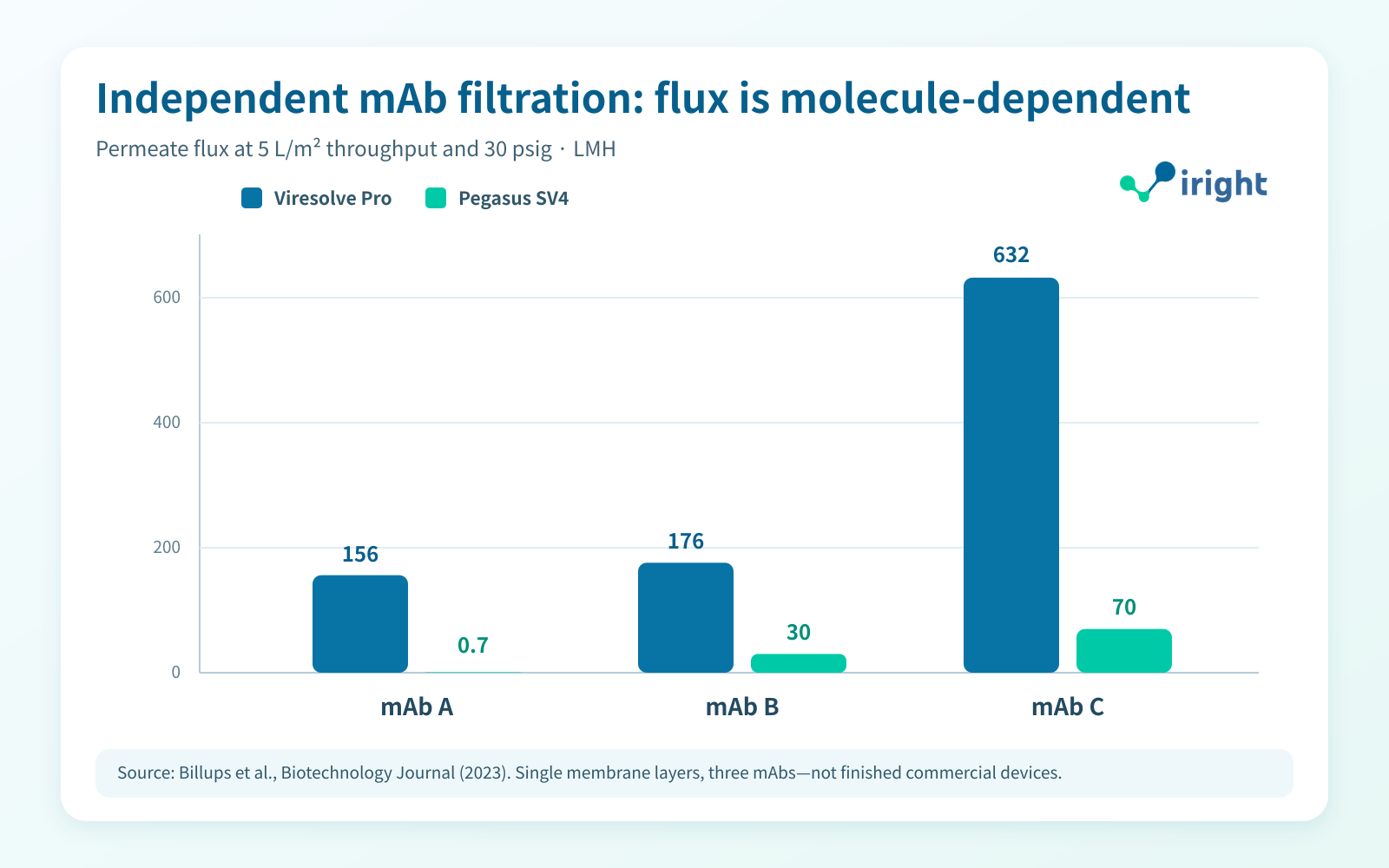
Figure 1. Permeate flux at 5 L/m² and 30 psig in the Billups study. These are single-layer membrane-coupon data, not finished-device specifications; they show molecule sensitivity rather than a universal commercial ranking.
Independent microscopy and pore-network analysis further explain the difference. Russell and colleagues used focused-ion-beam SEM and simulation to show that SV4 captured viruses across a significant fraction of its relatively homogeneous depth, whereas capture in the highly asymmetric Viresolve Pro membrane was concentrated near the small-pore exit region. This morphology can affect both hydraulic resistance and fouling behavior. See Russell et al., Journal of Membrane Science (2023).
Afzal and Zydney challenged a single layer taken from the commercial dual-layer Pegasus SV4 design with bacteriophage ΦX174. Adding 5 g/L human IgG reduced virus retention by more than 100-fold compared with protein-free solution; similar behavior appeared after pre-fouling. The authors used one layer specifically to make the mechanism interpretable, and they noted that a finished two-layer device should provide greater retention. The appropriate conclusion is therefore not that AB1USV47PH4 fails its specification, but that protein–membrane–virus interactions and fouling can alter margin, reinforcing the need for worst-case, product-specific validation. See Afzal & Zydney, Biotechnology and Bioengineering (2024), DOI 10.1002/bit.28607.
This conclusion aligns with a broader experimental study by Suh et al.: elevated protein concentration reduced virus-removal performance, and breakthrough was associated with membranes having a larger pore diameter in the retentive region. See Suh et al., Biotechnology and Bioengineering (2023), DOI 10.1002/bit.28407.
Product family | Architecture and public claim | Evidence-backed strength | Limitation in a direct comparison with AB1 |
|---|---|---|---|
Cytiva Pegasus SV4 / AB1USV47PH4 | Hydrophilic modified-PVDF pleated cartridge; 2.25 m²/10 in.; >4 LRV PP7 supplier specification | Highest practical differentiation is area density, Code 7 integration, integrity/lot-release package and scale-down continuity | Independent single-layer mAb data show lower intrinsic flux and strong molecule sensitivity in some conditions |
Merck Viresolve Pro | Dual-layer asymmetric PES device; ≥4 LRV MVM specification | Independent three-mAb study showed much higher flux than SV4 in the tested coupons; manufacturer study reported ≥5.8 LRV MVM at 60 psi after 90% flow decay and 20 L/m² flush | Prefiltration is generally recommended; device, sanitization and integrity-test workflow differ from AB1 |
Sartorius Virosart CPV / HC | Surface-modified double-layer 20 nm PES; cartridges/capsules; supplier claim ≥4 LRV PPV/MVM and ≥6 LRV MuLV | Cartridge formats may ease migration from existing housings; HC is positioned for high-blocking blood/plasma feeds | Public, independent AB1 head-to-head data are sparse; final selection remains molecule-specific |
Asahi Kasei Planova BioEX | Hydrophilized PVDF hollow-fiber device; 0.0003–4.0 m²; autoclave; TMP ≤343 kPa | Very different depth/hollow-fiber architecture; internal three-mAb matrix reported pool MVM LRV of 4.87 to ≥5.62 across pH/conductivity conditions | Not a cartridge drop-in; supplied wet and requires different equipment, hold-up and integrity-test strategy |
Sources: Viresolve Pro technical information, manufacturer 60 psi challenge, Virosart CPV, Virosart HC data sheet, and Planova BioEX specifications and data.
For broader context, a 2025 analysis of published and regulatory datasets reported a median parvovirus reduction factor of 5.8 (interquartile range 5.4–6.2) for the group of second-generation filters that included Planova BioEX, Viresolve Pro, Pegasus SV4 and Virosart HC. This pooled result supports the class, not equivalence between individual filters. The same review emphasizes that a filter change after approval requires structured comparability and change management. See Groner, “Post-Approval Change Management for Virus Filters” (2025).
Area and hardware density. At 2.25 m² per 10-inch element, AB1 can install substantial membrane area in a compact multi-cartridge housing. A lower-area cassette may match filtration function but require more parallel devices, a new holder and revised hold-up calculations.
Established process-control chain. Scale-down discs/capsules, production cartridges, diffusional-flow integrity testing, PP7-correlated fabrication integrity and PP7 lot release form a coherent supplier package. That lowers documentation friction when the platform is already qualified.
Validated interface. Code 7 geometry, O-ring material, housing, wetting, sterilization, pressure-drop model and automated integrity testing may already be embedded in SOPs, recipes and regulatory dossiers. Replacing only the membrane is therefore not the actual change; the surrounding process system changes with it.
Retention mechanism distributed through depth. Independent morphology work indicates that SV4 captures virus through a larger fraction of membrane depth than Viresolve Pro. This can be a robustness benefit in the right feed, although it also contributes to lower clean-water flux and does not prevent molecule-specific fouling.
Regulatory prior knowledge. When a manufacturer has product-specific historical data, deviations, viral-clearance studies and continued-process-verification trends for AB1, that internal knowledge has genuine value. It cannot be recreated by comparing nominal pore size and catalog LRV alone.
AB1USV47PH4 is not scientifically irreplaceable: multiple modern filters can achieve small-virus removal above 4 LRV under suitable conditions. It may nevertheless be operationally and regulatorily difficult to replace in an approved process.
The FDA’s current ICH Q5A(R2) guidance does not independently test or approve AB1USV47PH4 as a standalone product. Instead, it evaluates the sponsor’s manufacturing process and evidence package. The guidance identifies product and flush throughput, pressure/flow and interruptions as potentially important for small-virus filters. It also states that filter brand/model matters to virus reduction and robustness. If prior knowledge is used to claim parvovirus removal, at least one product-specific confirmatory run with parvovirus under worst-case conditions should be performed. Significant upstream or downstream changes should trigger re-evaluation.
Thus, the defensible “unreplaceability” is:
High for a no-change drop-in: none of the Chinese candidates below matches the 2.25 m² Code 7 cartridge architecture.
Moderate to high for an approved process: replacement can affect registered equipment, process parameters, integrity testing, extractables/leachables and the viral-clearance claim.
Low as a basic filtration function: alternative PES, PVDF and regenerated-cellulose products can perform the same unit operation.
Unknown until tested for a particular molecule: protein self-association, aggregates, concentration, temperature, pH, conductivity and prefilter choice can reverse a simple catalog ranking.
The strongest publicly documented domestic candidates found in this review are from Hangzhou Cobetter. The three production-scale catalog numbers below are searchable in the iRight Cobetter catalog.
Priority screening candidate | Production-scale part number | Small-scale part number | Public profile | Best-fit starting application |
|---|---|---|---|---|
Viruclear VF Plus | VFPESFL150N1P (1.5 m²) | VFPESDCN9P | Asymmetric PES, 20 nm nominal, PVDF cassette housing, ≥4 LRV model-virus supplier claim, non-sterile PES format | Standard mAbs, bispecifics, ADCs, recombinant proteins |
Viruclear VF Plus X | VFXESFL150N1P (1.5 m²) | VFXESDCN9P | PES variant positioned for aggregate-rich or low-stability feeds; 20 nm nominal; supplier notes a water-flux trade-off | Difficult-to-filter/high-fouling antibody intermediates |
Viruclear RC H | VFHRCNB3N1P (1.5 m²; no deflector) | VFHRCDSN9P | Regenerated-cellulose cassette; 20 nm nominal; supplier recommends RC for blood products, high concentration, lower purity or poor protein stability | IVIG/plasma derivatives and challenging high-concentration proteins |
An RC H 1.5 m² cassette with deflector is also listed as VFHRCDB3N1P. Because iRight currently exposes these items through a consolidated catalog rather than verified individual indexed pages, the article links each part number to the same catalog page instead of inventing product-specific URLs.
Cobetter reports a VF Plus small-scale challenge using 12 g/L and 1 g/L mAb feeds, 7.2 log PFU of MVM, 10/30/60 psi, 1,500 L/m² target load, a 30-minute zero-pressure pause and 20 L/m² buffer flush. MVM in filtrates was reported below the plaque assay’s quantitation limit at all three pressures. See the Cobetter PES worst-case study.
For RC H, Cobetter reports a 50 g/L IVIG/PPV study at 15 and 50 psi with a 160 L/m² load, a 30-minute pause, ten pressure cycles, a 12-hour pause and a 30 L/m² flush; PPV was below quantitation. A second 10 g/L mAb/MVM experiment used up to 320 L/m² and a 10-hour pause and likewise reported MVM below quantitation. See the Cobetter RC worst-case study.
These are useful, unusually detailed supplier case studies, but they are not independent AB1 comparisons and they use syringe-scale filters. A third-party distributor summarizes customer cases with protein recoveries of 97.3–99.8% for selected erythropoietin and high-concentration protein feeds; because the underlying work is customer/supplier case data rather than peer-reviewed head-to-head testing, it should be treated as an adoption signal only. See CoPure’s Viruclear case summary.
Independent evidence on Viruclear remains limited. A 2026 peer-reviewed study from WuXi Biologics included Viruclear VF Plus among commercial virus filters evaluated for endotoxin, not virus, removal. The reported 88–99% endotoxin reductions with >95% protein recovery applied to Planova BioEX and Valpha PES under the specified low-endotoxin conditions; they do not establish viral-clearance equivalence for Viruclear or AB1. This distinction is important when secondary sources overgeneralize “tested in a paper” into “proven equivalent.” See Wang et al., Biotechnology Progress (2026), DOI 10.1002/btpr.88526.
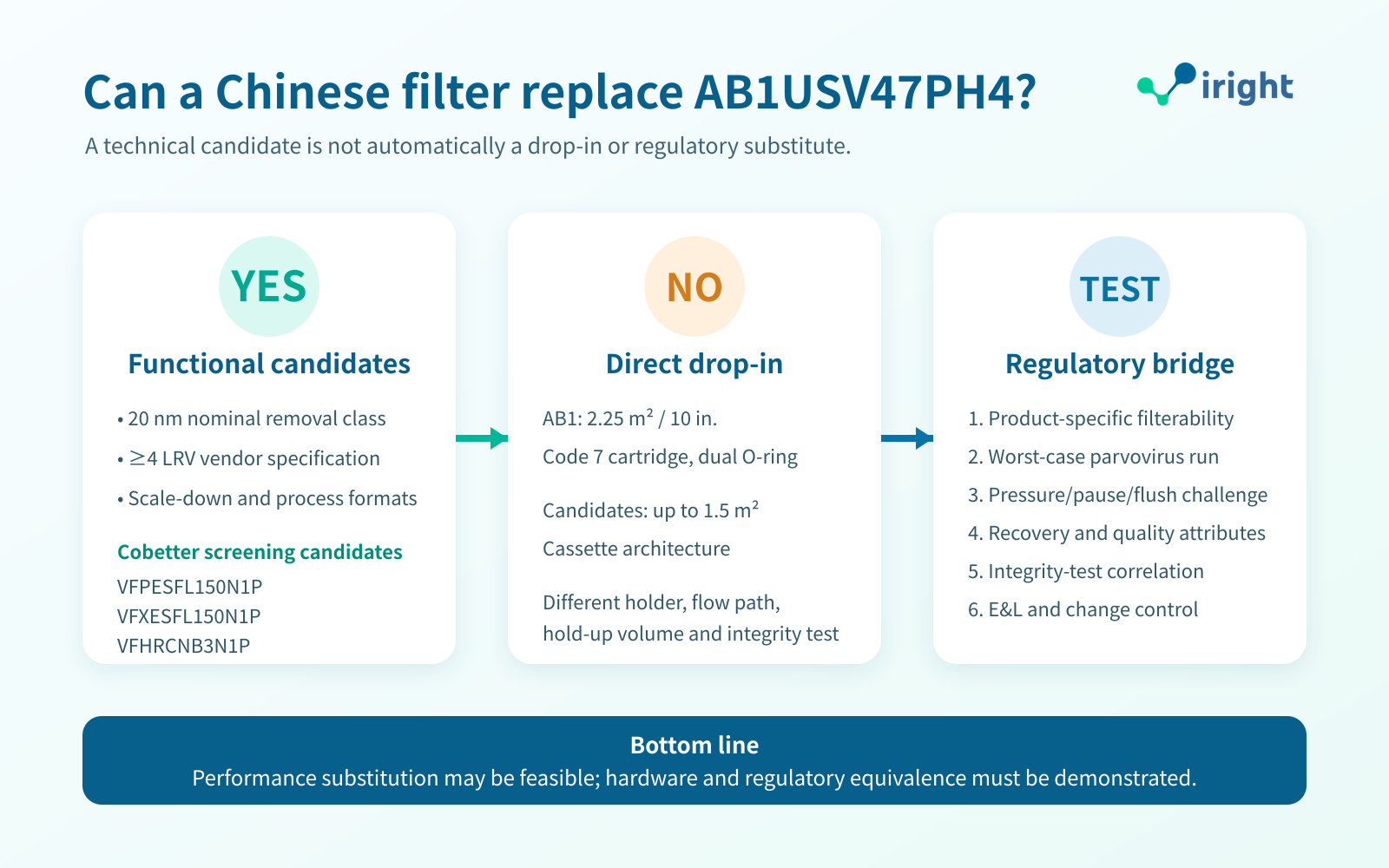
Figure 2. Domestic filters may be functional candidates, but they are not physical drop-ins and cannot inherit AB1’s process-validation claim.
AB1USV47PH4 is a mature, high-area, 20 nm PVDF virus-removal cartridge with a strong engineering and validation ecosystem. Its strongest case is compact Code 7 integration and accumulated process knowledge—not universal flux leadership. Independent data show that membrane morphology and the therapeutic molecule can change both flux and retention behavior, so a catalog-only comparison is scientifically inadequate.
Cobetter VF Plus VFPESFL150N1P, VF Plus X VFXESFL150N1P and RC H VFHRCNB3N1P are reasonable first domestic candidates for a structured screening program. Current public evidence supports feasibility, not equivalence. A change becomes defensible only after product-specific filterability, quality, integrity, worst-case parvovirus and engineering comparability data close the gap between “similar specification” and “validated replacement.”
This review is based on publicly accessible information retrieved through 4 September 2026. Supplier data are identified as such. No public, independent, production-scale head-to-head virus-clearance study of AB1USV47PH4 versus the three Cobetter production formats was located. Anonymous e-commerce ratings were excluded because they do not report sample composition, pressure, loading, assay limit or device lot. Product availability, part numbers and instructions for use should be reconfirmed before procurement. This article is technical information, not a regulatory filing or a substitute for process validation.
Choosing between in-house and outsourced IVD reagent manufacturing is not a one-time make-or-buy calculation. You are choosing where process knowledge lives, who absorbs demand volatility, how quickl…
Chinese chromatography resins can replace imported products in many development and manufacturing settings, but substitution is not a property printed on a datasheet. It is a conclusion earned at thr…
Artificial intelligence can accelerate chromatography resin selection, but it cannot infer a universally “best resin” from catalog specifications. The practical route is a closed evidence loop: gener…