Article
Chinese vs Imported Resins: What Counts as a True Substitute?
By Iri ·
Article
By Iri ·
Artificial intelligence can accelerate chromatography resin selection, but it cannot infer a universally “best resin” from catalog specifications. The practical route is a closed evidence loop: gener…
AAV, plasmid DNA and mRNA cannot be purified by simply shrinking or enlarging a monoclonal-antibody platform. Their size, surface charge, topology, shear sensitivity and product-related impurities ch…
Chinese chromatography resins can replace imported products in many development and manufacturing settings, but substitution is not a property printed on a datasheet. It is a conclusion earned at three levels: functional substitution under defined test conditions, process substitution in the intended unit operation, and—when an approved biologic is affected—regulatory comparability of the pre-change and post-change product.
This tenth article in ResinFrontiers · iRight Bioprocess Chromatography Intelligence Series converts that distinction into a qualification framework. It builds on the general resin-selection framework, the Protein A benchmarking guide, the IEX polishing guide, the mixed-mode review, and the resin-lifetime guide. The answer is intentionally conditional: a Chinese resin may be a strong candidate, yet only product- and process-specific data can establish replacement.
The business case for a domestic second source is real. A local supplier may shorten replenishment time, reduce exposure to cross-border freight and allocation, simplify technical visits, and make small evaluation quantities easier to obtain. Competitive pricing can matter, but the larger economic value may be continuity: a qualified alternative can protect production schedules when a single-source resin is delayed.
These risks are not hypothetical. A multi-company article in Pharmaceutical Engineering described pandemic-era delays and allocation constraints for filters and chromatography resins and proposed a characterization pathway for alternative Protein A media in approved biologics. The authors—industry practitioners from multiple biopharmaceutical companies—emphasized product/process knowledge, scale-down characterization, cleaning and reuse studies, extractables/leachables assessment, ligand-leach measurement, and confirmatory at-scale data (Rhee et al., 2023). This is an industry implementation proposal, not a universal regulatory ruling, but it shows why supply security and technical qualification must be planned together.
Localization, however, does not demonstrate chromatographic equivalence. Country of manufacture cannot predict selectivity, mass transfer, compressibility or cleanability. A lower bottle price also says little about cost per gram of product if the candidate requires more resin, a longer residence time, more buffer, extra polishing, or earlier replacement.
The procurement question should therefore be reframed:
Can the candidate deliver the required product quality and process performance, within a justified operating range and lifecycle, with an acceptable supplier-control package?
That question can be answered experimentally. “Is it domestic?” cannot.
Two media can both be labelled strong cation exchangers and still behave differently. “Protein A,” “Q,” “SP,” “phenyl” and “mixed mode” identify a broad interaction mechanism; they do not define the complete material.
For ion exchange, apparent similarity can hide differences in spacer chemistry, ionic capacity, ligand accessibility, pore environment and nonspecific interaction. For Protein A, the ligand domain, orientation, coupling chemistry and base matrix affect affinity, elution pH, impurity co-elution, alkali stability and leakage. For HIC and mixed mode, ligand density and local surface hydration can change selectivity even when the nominal ligand family is familiar.
This is why a catalog cross-reference should be treated as a candidate map, not an interchangeability certificate. A practical screen may place an imported reference such as MabSelect PrismA (Cytiva 17549803) or MabSelect SuRe LX (Cytiva 17547401) beside one or more Chinese Protein A candidates. For polishing, Capto S ImpAct (Cytiva 17371703), Capto Q ImpRes (Cytiva 17547005) and Capto MMC ImpRes (Cytiva 17371601) can serve as well-characterized reference chemistries. Their presence in the panel does not predetermine the winner; it anchors the comparison.
Five design variables deserve attention before any column is packed.
Cross-linked agarose is hydrophilic and widely used for bioprocess capture and polishing. Methacrylate and polystyrene–divinylbenzene matrices can provide greater mechanical rigidity and support high linear velocity, but surface chemistry and pore design influence nonspecific binding and mass transfer. Ceramic or inorganic matrices introduce another pressure, pore and chemical-resistance profile.
In a peer-reviewed evaluation at Biogen Idec, McCaw and colleagues compared a methacrylate Protein A resin with agarose-based references using multiple mAbs and an Fc-fusion protein. Their study measured DBC over approximately 0.5–6 minutes for most molecules, process selectivity, Protein A leakage, alkaline exposure and pressure–flow behavior. The important result for replacement programs is methodological: matrix chemistry was evaluated through a multidimensional process package, not a single capacity number (McCaw et al., 2014).
Smaller particles generally shorten diffusion distance and can improve efficiency, but they also increase pressure drop. A narrow distribution can improve bed homogeneity; fines can disproportionately affect permeability. Mean particle size alone is insufficient—distribution tails and lot consistency matter.
Pore size and connectivity determine accessible surface area and intraparticle transport. A resin that performs well with IgG may rank differently for an Fc fusion, fragment, virus particle or plasmid. DBC measured at a long residence time can conceal slow diffusion that becomes limiting during intensified operation.
Higher ligand density may raise apparent capacity while also changing salt sensitivity, elution volume or impurity binding. Protein A variants can differ in Fc-domain selectivity, alkali tolerance and leakage. Mixed-mode ligands can alter electrostatic and hydrophobic contributions in opposite directions as pH or salt changes.
Bed compression changes interstitial porosity and pressure. A candidate that looks attractive in a short laboratory column may require a different packing factor or fail to deliver the same flow at production bed height. Hydraulic behavior is therefore part of substitution, not an engineering detail to check later.
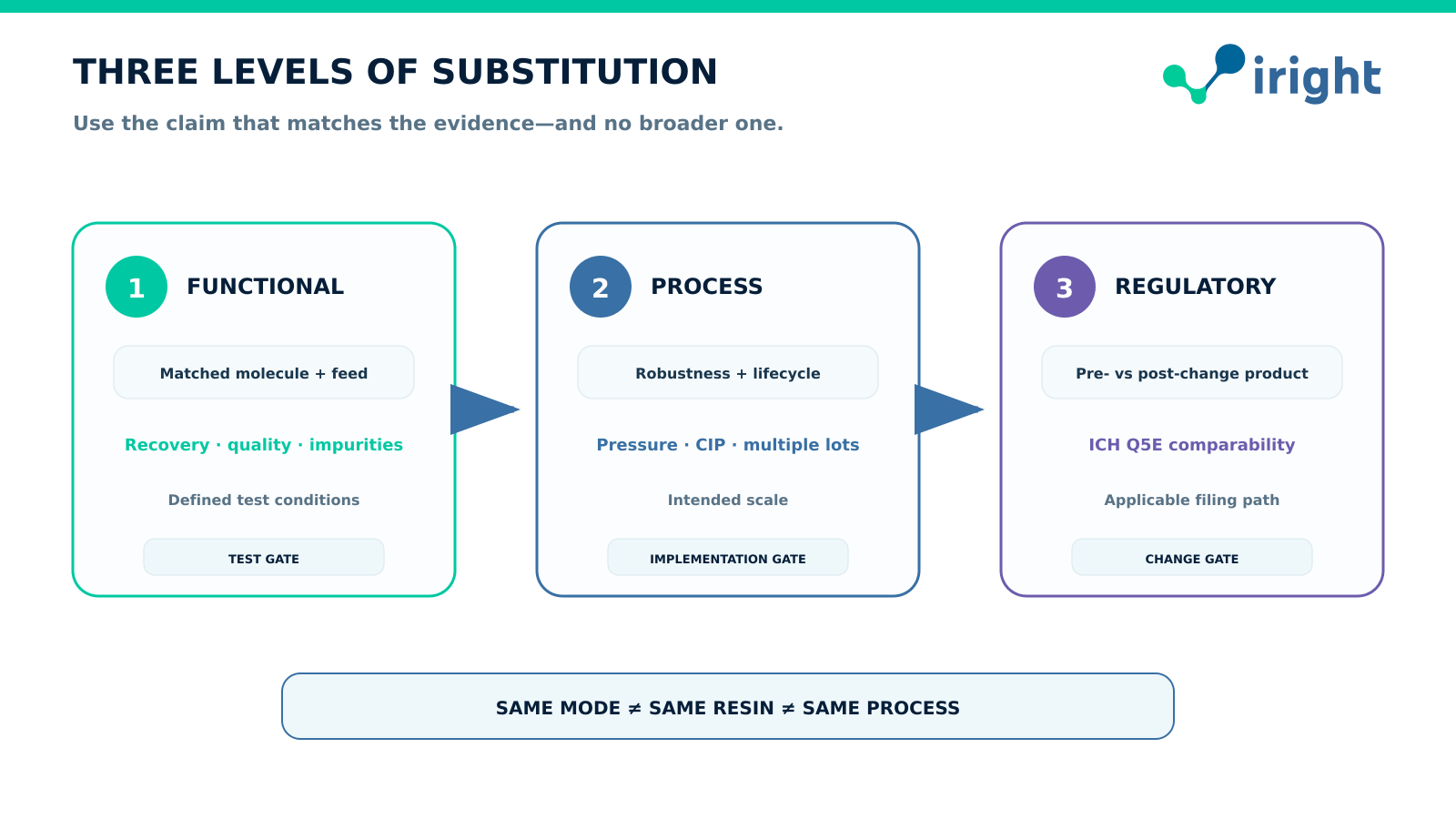
“Comparable binding” is only the first gate. Process performance and, where applicable, product comparability require progressively broader evidence.
A useful head-to-head study begins with a written hypothesis and predefined acceptance criteria. It should not be designed after seeing which candidate produced the highest DBC.
Define the unit-operation job first. A capture step may prioritize recovery, concentration, initial HCP reduction and cycle productivity. A polishing step may prioritize aggregate, charge-variant, DNA, endotoxin, virus or residual Protein A clearance at high product recovery. Then translate that job into a matched study.
Recommended design elements include:
at least three lots of each shortlisted resin when lot consistency is decision-critical;
one common feed lot for the primary comparison, followed by representative feed variability;
the same column hardware, diameter and target bed height where physically appropriate;
matched residence time rather than merely matched volumetric flow;
identical load density or a defined load series;
common buffer stocks and analytical methods;
randomized run order and system controls;
replicated center-point conditions; and
predefined rules for pooling, mass balance, outliers and candidate advancement.
Use supplier-recommended conditions only as a separate optimization arm. If every resin is tested exclusively at its own preferred pH, salt and load, the study can identify an individually optimized process but cannot isolate material differences. Conversely, a common-condition screen alone may unfairly exclude a chemistry with a shifted optimum. The strongest design has two stages: matched conditions for comparability, then bounded optimization for each finalist.
The AI and high-throughput resin-selection guide explains how 96-well and miniature-column stages can reduce the candidate set without confusing static partitioning with dynamic process performance.
Several common comparison errors can reverse the apparent ranking.
Flow rate in mL/min is not comparable across different column volumes. Use residence time—bed volume divided by volumetric flow—and report it with bed height, diameter, temperature and feed concentration. Measure DBC at more than one residence time because the slope of DBC versus residence time reveals mass-transfer limitations.
Purified IgG is useful for mechanistic DBC, but it does not reproduce HCP, DNA, aggregate, media and protease competition. Final ranking should use the real process stream or a justified representative model. Retain feed aliquots and control their freeze–thaw and hold history.
Keep bed height and column diameter constant for the main comparison when resin mechanics allow it. Subtract system pressure and characterize extra-column volume. Use a qualified scale-down model if the study will support a manufacturing decision.
Chinn and colleagues from Genentech and Roche evaluated RoboColumn performance under target and off-target conditions and concluded that miniature columns can support validation-oriented work when their scale-down relevance is demonstrated rather than assumed (Chinn et al., 2023). That discipline is especially important when comparing matrices with different compressibility.
A substitution scorecard should preserve separate responses rather than collapse everything into one weighted number too early.
Evidence domain | Minimum measurements | Why it can change the decision |
|---|---|---|
Binding and recovery | DBC10% at multiple residence times; breakthrough shape; step recovery; mass balance | Separates equilibrium capacity from usable dynamic capacity |
Product quality | Monomer, aggregate, charge variants, fragments and potency as relevant | A high-capacity resin can change product-related impurity distribution |
Process impurities | HCP, DNA, endotoxin, residual Protein A and virus clearance where applicable | Selectivity may differ even when target recovery is similar |
Hydraulics | Pressure–flow curve, compressibility, HETP and asymmetry | Determines packability, throughput and scale feasibility |
Cleaning and lifetime | Capacity retention, pool quality, carryover, leakage, bioburden/endotoxin and pressure over loaded cycles | Establishes usable cycle life rather than fresh-resin performance |
Economics | Resin volume, cycles, buffer, time, yield loss, analytical burden and disposal | Converts purchase price into cost per batch or cost per gram |
Report uncertainty. For each critical response, show the number of lots, columns and runs; means and variability; analytical precision; and a predefined equivalence, non-inferiority or acceptance interval. “No significant difference” is not evidence of equivalence when a study is underpowered.
Lifecycle testing should use loaded cycles for the final claim. Blank caustic exposure can isolate chemical stability, but it does not reproduce fouling, protease exposure, precipitate formation or carryover. If viral clearance is assigned to the step, include a justified strategy for naïve versus cycled resin. A 2025 BioPhorum multi-company review revisited the earlier retrospective dataset after ICH Q5A(R2). It notes that Q5A(R2) does not require used-resin viral-clearance studies for Protein A under the guideline’s stated conditions, while used-resin evaluation remains relevant for other chromatography steps. This supports a differentiated, risk-based strategy—not a blanket waiver of process-specific assessment (Anderson et al., 2025).
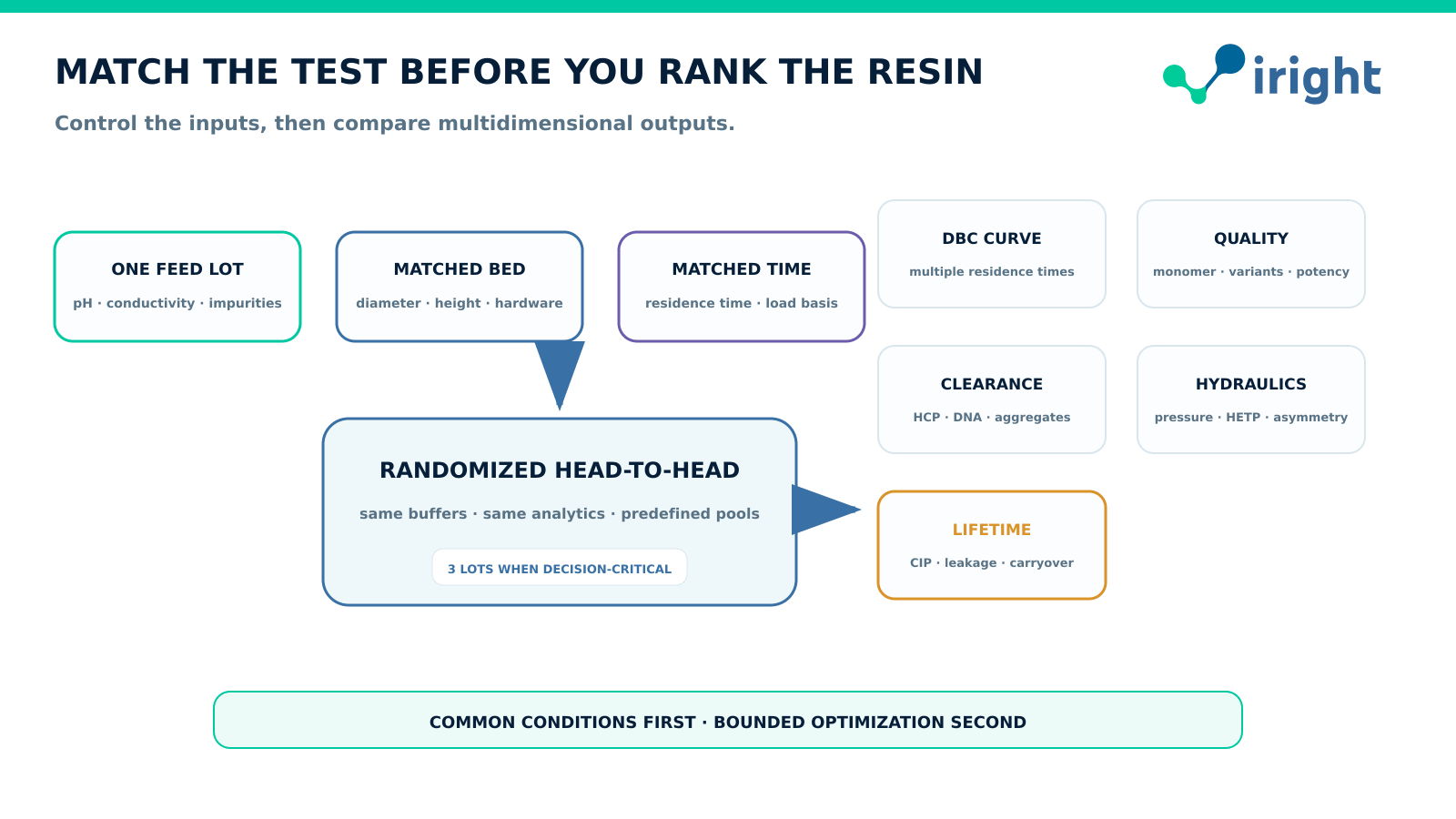
A fair comparison holds the feed, geometry and time basis constant, then measures product quality, impurity clearance, hydraulics and lifecycle in parallel.
The most useful openly available example involving a Chinese resin is narrowly defined—and valuable precisely because its boundary is clear.
Zhang Shengwei and colleagues at WuXi Biologics compared Bestchrom Diamond MMC Mustang with Cytiva Capto MMC ImpRes for intermediate purification of two WuXiBody bispecific antibodies. At a 5-minute residence time, the reported DBC values were 123 and 94 mg/mL for Diamond MMC Mustang and 111 and 71 mg/mL for Capto MMC ImpRes for the two molecules, respectively. The authors also reported comparable resolution and batch consistency in their evaluated process context (Zhang et al., 2021).
This is legitimate peer-reviewed head-to-head evidence that a Chinese mixed-mode medium can compete with an imported benchmark under the tested conditions. It is not proof that Diamond MMC Mustang is universally equivalent to Capto MMC ImpRes for every antibody, impurity profile, pH, conductivity or scale. The correct procurement conclusion is: it deserves inclusion in a molecule-specific shortlist. Teams can request a matched Diamond MMC Mustang and Capto MMC ImpRes screen through iRight.
The scarcity of similar public, peer-reviewed comparisons is itself decision-relevant. Supplier application notes may define testable hypotheses, but they cannot establish broad equivalence. For NanoMicro and Bio-Link candidates, the present public record is stronger for portfolio definition and vendor-reported specifications than for multi-molecule, third-party head-to-head qualification. The right response is not to dismiss those products; it is to budget the missing evidence into the screening plan.
Resin replacement transfers part of the process risk to a new material and supplier system. The audit should therefore cover more than whether a certificate of analysis exists.
Request and evaluate:
manufacturing-site identity and backup capacity;
critical raw-material and ligand supply chains;
release tests, methods and lot acceptance limits;
particle-size and pore controls, functional capacity and bioburden/endotoxin limits;
traceability, deviation handling and complaint history;
advance-change-notification terms and notification period;
extractables/leachables and animal-origin/TSE-BSE documentation as applicable;
shelf life, shipping excursion and storage data;
regulatory support file availability; and
technical support for packing, cleaning, scale-up and investigations.
ICH Q10 places ultimate responsibility for purchased-material control on the pharmaceutical company and calls for risk-based supplier assessment, defined quality responsibilities, performance monitoring and assurance that materials come from approved sources (ICH Q10, §2.7). A lower-cost product without enforceable change notification or traceable critical-material controls may carry a higher lifecycle risk.
Toro and colleagues provided a cautionary user-side case. A supplier changed the cotton-linter source for a cellulose IEX medium. Three new-material lots were comparable with the pre-change control in small-scale chromatography, and the two lots examined in pressure–flow testing were also comparable. Yet 20-L radial-column packing of three lots revealed differences: one pack failed the asymmetry criterion, and increasing target pressure 1.8-fold did not reproduce historical packing behavior. The lesson is direct: a material can meet supplier specification and pass a small axial-column screen while still changing manufacturing-scale packing (Toro et al., 2010).
Chromatography media are product-contact materials. Qualification should address chemical species that may enter the process stream, not only separation performance.
For Protein A, the specific ligand matters analytically. Carter-Franklin and colleagues at Genentech showed that intact Protein A and ligand fragments can leach during capture; fragments larger than approximately 6 kDa were measurable by ELISA and could be harder to remove by CEX than intact ligand (Carter-Franklin et al., 2007). USP General Chapter <130> states that Protein A leaching can increase as the medium ages and emphasizes ligand/resin quality, raw-material qualification and column-lifetime studies (USP <130>).
Accordingly, a Protein A replacement should use an assay demonstrated to detect the specific candidate ligand; assuming that an ELISA calibrated for another ligand gives unbiased recovery is unsafe. Measure leakage across the lifecycle, not only on virgin resin.
For all resin classes, assess the vendor’s extractables study against the actual process: contact solution, pH, temperature, time, resin age and surface-area-to-volume ratio. Leachables are process-specific and may require targeted confirmation. Cleaning and storage studies should track carryover, total organic carbon where appropriate, bioburden, endotoxin, pressure, recovery and pool quality. If the replacement changes the CIP concentration or contact time, treat that as part of the process change.
For an early development program, domestic media can be designed into the process from the beginning. The team can screen multiple brands, define the operating space around the winner and establish lifecycle data before the control strategy is locked. The cost of changing direction is comparatively low.
For a validated or approved process, the incumbent resin is embedded in process characterization, cleaning validation, viral clearance, hold-time logic, scale-up history and regulatory filings. A replacement may affect more than one module of evidence. Even when the new resin meets the same release specification, the product impurity profile, step robustness or downstream load can change.
The development sequence should therefore differ:
New program: choose on technical merit, supply strategy and total cost; generate process knowledge around the selected material.
Late-stage program: use a formal change-risk assessment and a qualified scale-down model; define comparability before implementation.
Commercial product: integrate product comparability, validation, filing strategy and confirmatory at-scale data with the technical study.
Rhee et al. propose that an alternative Protein A package for an approved process include product-quality comparability, acceptable parameter ranges, cleaning/reuse, E&L and ligand leakage, applicable viral clearance and confirmatory at-scale yield, purity and process-control data. The proposed US reporting pathway is context-specific; consult the relevant authority and current regional requirements rather than treating one publication as legal advice.
ICH Q5E provides the central principle for a biologic affected by a manufacturing change: collect relevant technical information showing that the change does not adversely affect product quality, safety or efficacy. “Comparable” does not mean identical. It means the pre-change and post-change products are highly similar and that any observed differences have no adverse impact, based on the totality of relevant evidence (ICH Q5E, §§1.1 and 1.4).
For a resin change, that has four practical consequences.
First, vendor specifications are not enough. Q5E explicitly notes that release specifications alone are generally inadequate to assess a manufacturing-process change because they are designed for routine quality, not full characterization.
Second, test where a difference is most detectable. That may include the chromatography pool, subsequent intermediates, drug substance and, when justified, drug product.
Third, predefined acceptance criteria should integrate process data and product attributes. Relevant evidence may include routine batch analysis, in-process controls, process evaluation/validation, characterization and stability.
Fourth, the extent of additional nonclinical or clinical evidence depends on what the analytical and biological comparison can resolve. The objective is not to “validate the new resin” in isolation; it is to demonstrate that the changed process remains capable and the resulting product remains comparable.
ICH Q12 adds tools for lifecycle management, including established conditions and post-approval change management protocols (ICH Q12). Regional implementation differs, so the filing strategy must be confirmed for the markets involved.
Viral-clearance strategy should also reflect the current ICH Q5A(R2) framework rather than applying a single rule to every reused chromatography medium. The 2025 post-Q5A(R2) BioPhorum review distinguishes Protein A from other chromatography steps and should be read together with the product- and process-comparability assessment above (Anderson et al., 2025).
Use precise language in technical reports and purchasing decisions.
Claim | Minimum support | What it does not prove |
|---|---|---|
Screenable alternative | Same broad mechanism; plausible material and operating range; documentation available | That it will meet the process target |
Functional substitute | Predefined matched-condition tests meet recovery, quality, impurity and hydraulic gates for the stated molecule/feed | Full lifecycle, scale or regulatory comparability |
Process substitute | Qualified scale-down model, robustness, cleaning/lifetime, multiple lots and scale bridge meet process acceptance criteria | Approval for an already licensed process |
Regulatory replacement | Product comparability and change package accepted/implemented under applicable regional requirements | Universal equivalence for other products or processes |
The word “equivalent” should always carry its domain: equivalent for what function, under which conditions, on which molecule, over how many cycles, and at what scale?
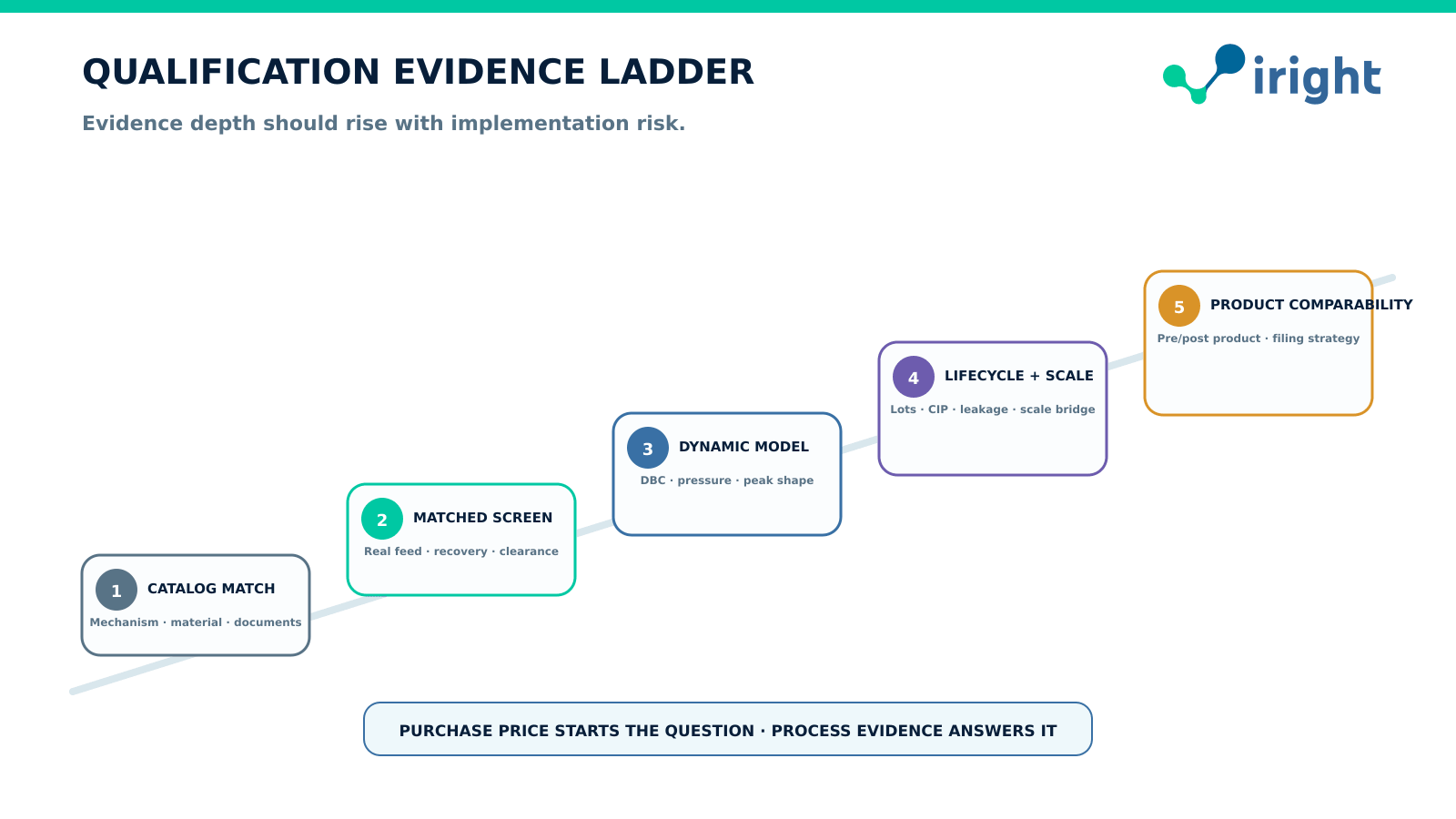
Evidence should grow with decision risk: catalog matching starts the screen; lifecycle, scale and product comparability support implementation.
The following ranking is a portfolio-based procurement starting order, not a declaration of universal performance. Supplier pages define available technologies and support claims; only the cited peer-reviewed study provides a public Chinese-versus-imported head-to-head result in this article.
Priority and supplier | Best fit for initial evaluation | Public evidence boundary | Recommended procurement action |
|---|---|---|---|
1 — Bestchrom | Broad domestic portfolio across affinity, IEX, mixed mode, HIC and SEC; suitable when one supplier must support several downstream steps | Supplier lists seven resin categories and bioprocess-scale capability; peer-reviewed Diamond MMC Mustang comparison is specific to two WuXiBody bispecifics | Use as the primary full-portfolio candidate; include Diamond MMC Mustang when the impurity problem fits its chemistry |
2 — NanoMicro | Rigid polymer matrices, high-flow Protein A and high-resolution HIC/IEX; useful where pressure–flow and short residence time are central | Supplier-reported UniMab EXE uses a PMMA/dextran architecture and reports DBC under specified conditions; no broad third-party equivalence claim is made here | Include in high-flow or rigid-matrix screens and demand molecule-specific pressure, leakage and lifecycle data |
3 — Bio-Link | Scale supply, multiple matrix families, engineering support and broader bioprocess integration | Supplier announced agarose, dextran and hydroxyapatite matrices, six chromatography modes and expanded annual capacity; these are vendor claims, not comparative performance evidence | Evaluate when local scale, audit access and lifecycle/engineering service are major decision variables |
Bestchrom’s portfolio page lists affinity, IEX, mixed-mode, HIC, SEC, pre-activated and reversed-phase products. NanoMicro’s product catalog lists agarose and rigid polymer options across Protein A, IEX, HIC, SEC, multimodal and nucleic-acid affinity. Bio-Link’s manufacturing announcement announces agarose, dextran and hydroxyapatite matrices, six modes and planned total annual capacity of 120,000 L. All three pages were accessed in October 2026 and should be treated as supplier-originated information.
For an initial panel, request Chinese and imported reference resins in matched pack sizes. The RFQ should specify feed type, target operation, required documentation, evaluation volume and delivery window.
Define the replacement claim. Screening candidate, functional substitute, process substitute or approved-process replacement.
Map material differences. Matrix, particle-size distribution, pore architecture, ligand, ionic capacity, compressibility, CIP and storage.
Secure documentation and lots. Obtain support files, change-notification terms and at least three representative lots for critical decisions.
Run the matched screen. Same feed, geometry, residence time, buffers, load basis, pool rule and analytics.
Optimize finalists. Explore each resin’s bounded operating region without changing the critical quality target.
Confirm dynamics and robustness. DBC at multiple residence times, pressure–flow, HETP/asymmetry, impurities, recovery and quality.
Establish lifecycle. Loaded cycles, CIP, leakage, carryover, microbial control and economic endpoint.
Bridge scale. Qualify the small-scale model and confirm scale-sensitive parameters.
Assess product comparability. For late-stage or commercial change, compare pre- and post-change intermediates and product attributes under ICH Q5E principles.
Decide on total risk-adjusted value. Include resin, buffer, time, yield, analytics, validation, filing, supply and failure cost.
Choose a Chinese resin when it meets predefined product-quality and process-performance criteria, remains capable over the intended lifecycle and scale, and is supported by a supplier system that can control change. Keep the imported reference—or dual-source strategy—when uncertainty in selectivity, lifecycle, scale or comparability costs more than the expected saving.
This article ranks evidence by decision value. ICH documents define comparability and quality-system principles. Peer-reviewed studies support resin/material behavior and the cited mixed-mode head-to-head result. The ISPE and BioProcess International articles are practitioner case studies and implementation proposals, not regulatory guidance. Supplier pages are used only to define portfolios, reported capacity and candidate specifications; they do not prove equivalence. No FDA, ICH or pharmacopeial source ranks Chinese or imported resin brands. Product availability and regional change requirements should be confirmed for the actual project.
ResinFrontiers · iRight Bioprocess Chromatography Intelligence Series
The least expensive chromatography resin is not the resin with the lowest price per liter. It is the resin–process combination that delivers the lowest cost per accepted batch or per gram of released…