Article
AI-Guided Resin Selection: From Screening to Scale
By Iri ·

Article
By Iri ·
AAV, plasmid DNA and mRNA cannot be purified by simply shrinking or enlarging a monoclonal-antibody platform. Their size, surface charge, topology, shear sensitivity and product-related impurities ch…
Moving from batch chromatography to periodic counter-current chromatography (PCC) changes the resin-selection question. The best batch resin is not automatically the best continuous resin: the rankin…
Artificial intelligence can accelerate chromatography resin selection, but it cannot infer a universally “best resin” from catalog specifications. The practical route is a closed evidence loop: generate a chemically diverse candidate set, screen it with structured high-throughput experiments, use DoE and models to learn the response surface, then challenge the prediction in dynamic columns and at the intended scale.
This ninth article in ResinFrontiers · iRight Bioprocess Chromatography Intelligence Series extends the molecule- and impurity-driven logic in Chromatography Resin Selection: A Bioprocessing Framework, the condition-sensitive selectivity discussed in Mixed-Mode Chromatography Resins, and the residence-time discipline in Continuous Chromatography. Its central argument is deliberately conservative: AI should rank experiments and quantify uncertainty; experimental data should decide whether a resin is fit for the process.
Traditional resin development often begins with a familiar product, followed by sequential adjustment of pH, salt, load and gradient. This approach can eventually produce an acceptable method, but it is poorly suited to a large design space. Five resins tested at six pH values, four conductivity levels and three additive conditions already create 360 combinations before residence time, load, wash and elution are considered. Running those conditions one by one encourages early commitment to the first workable result rather than a defensible comparison.
The deeper problem is not simply experiment count. Chromatography responses are interactive. The effect of salt can reverse when pH moves across the protein’s charge distribution; an additive can improve aggregate removal while lowering recovery; a mixed-mode ligand may strengthen hydrophobic interaction as electrostatic attraction weakens. One-factor-at-a-time experiments cannot efficiently estimate these interactions and can misidentify a local optimum as a robust operating window.
High-throughput process development changes the unit of work. Instead of asking one large column to answer every question, it allocates different questions to different formats:
equilibrium plates identify whether binding or partitioning is plausible;
replicated batch experiments estimate variability and adsorption trends;
miniature packed columns test flow, breakthrough, wash and elution behavior; and
bench columns confirm pressure, chromatographic efficiency and scale translation.
The classic Wyeth series led by Coffman and Kelley demonstrated that parallel resin-plate methods could generate useful separation information for HIC, IEX and other modes and could compare favorably with column steps when resin volume, mixing, carryover and contact time were controlled (Coffman et al., 2008; Kelley et al., 2008). The lesson remains current: miniaturization accelerates learning only when the small-scale experiment preserves the mechanism relevant to the decision.
Time saved should therefore be measured as decision speed, not plate throughput. Useful program metrics include experiments completed per week, material consumed per condition, percentage of candidates eliminated at each stage, time to a stable shortlist, and the fraction of predicted winners that pass dynamic-column confirmation.
The three most common high-throughput formats are complementary, not interchangeable.
Format | Primary information | Main strength | Main limitation |
|---|---|---|---|
96-well resin plate | Equilibrium binding, recovery after wash/elution, impurity partitioning | Highest parallelization; low feed and buffer demand | No realistic packed-bed flow, breakthrough curve or plate-height information |
Repeated batch binding | Uptake kinetics, isotherms, competition and condition response | Flexible mechanistic parameter estimation | Mixing and phase separation differ from a packed bed |
Miniature prepacked column | Breakthrough, DBC, pressure, gradient response, peak shape and pool quality | Closest high-throughput representation of column operation | Lower parallelization; sensitive to liquid-delivery and extra-column effects |
PreDictor-type plates typically contain defined resin volumes and support static binding, wash and elution screens; Cytiva’s format-selection guide describes these formats and their intended development roles. A product such as PreDictor MabSelect SuRe 96-well plates (Cytiva 28925825) is useful when the question concerns Protein A condition screening. It should not be used to claim a process-scale DBC because a static well does not reproduce the convective and diffusive sequence of a moving breakthrough front.
Bergander and colleagues at GE Healthcare showed that microtiter filter plates could be used to estimate dynamic binding capacity through controlled multi-addition experiments rather than treating the plate as a simple endpoint assay (Bergander et al., 2008). That is a useful bridge, but the result remains model dependent and must be checked in a flowing bed.
RoboColumn and related microcolumn formats place approximately tens to hundreds of microlitres of resin between frits. They can reproduce load, wash and elution sequences and can be arranged in a 96-position array; Repligen’s OPUS RoboColumn page defines the currently marketed format. Welsh and colleagues at Merck described a standardized mini-column workflow for antibody purification development (Welsh et al., 2014). Evans and colleagues at MedImmune later showed chromatographic profiles and product-quality results from an optimized microscale tool that were comparable with bench and clinical manufacturing processes for tested monoclonal antibodies (Evans et al., 2017).
However, a miniature column is not automatically a scale-down model. The liquid handler can introduce pulsed flow, excessive dwell volume, gradient distortion and fraction-timing error. AstraZeneca’s Rezvani et al. showed that improving liquid delivery produced highly linear conductivity gradients and better agreement with bench-scale gradient separations than discontinuous delivery (Rezvani et al., 2023). Genentech and Roche authors subsequently evaluated RoboColumn performance under target and off-target conditions and concluded that the format can support process validation and characterization when scale-down comparability is demonstrated rather than assumed (Chinn et al., 2023).
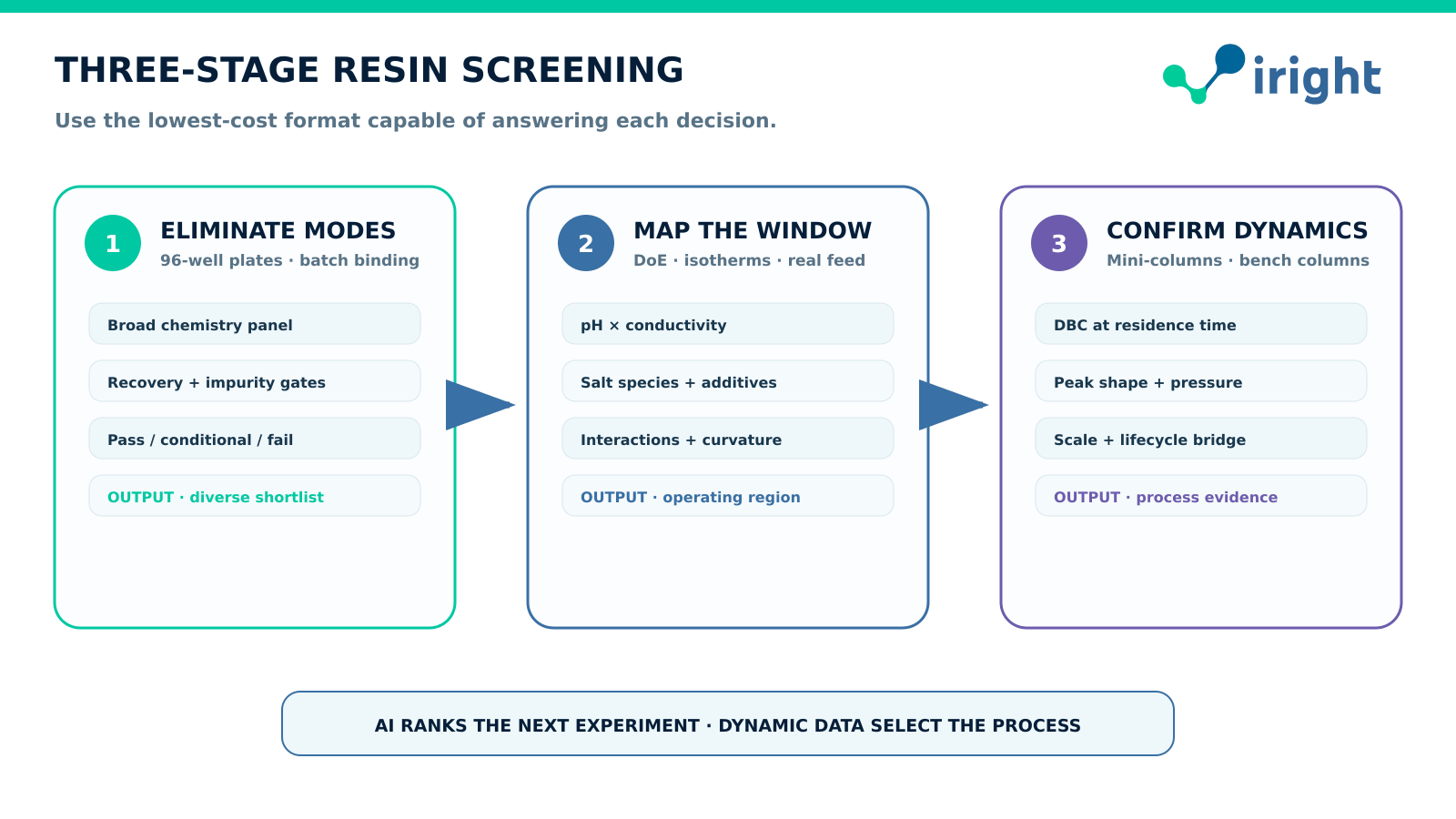
Each format answers a different question: plates eliminate, structured batch studies explain, and miniature columns confirm dynamic performance before scale-up.
The first stage should be broad, cheap and intentionally unforgiving. Its purpose is not to optimize every resin; it is to eliminate modes that cannot meet the minimum quality target.
Begin with the molecule and impurity map. For a bind-and-elute step, define the target recovery, acceptable load, product stability and the impurities that must separate. For a flow-through step, define product recovery and the required reduction of HCP, DNA, virus, aggregate or other contaminant. The response variable should be aligned with that job. “Percent bound” alone is rarely enough.
A sensible Stage 1 panel includes chemically diverse mechanisms rather than ten products with near-identical ligands. Depending on the process position, the panel may contain strong and weak CEX, strong and weak AEX, HIC ligands spanning hydrophobicity, an anionic and a cationic mixed-mode medium, plus affinity or SEC only when the molecule and unit-operation objective justify them. Use common starting conditions and replicate controls. Keep enough resin and feed from the same lots for later confirmation.
Set hard gates before seeing the data. Examples include:
capture recovery of at least the project-defined threshold;
monomer recovery and aggregate reduction achieved simultaneously;
no unacceptable loss of potency or structural integrity;
pressure and viscosity compatible with the intended device; and
a plausible cleaning and scale-up route.
The hit rate should be reported as:
Candidate hit rate = candidates meeting every mandatory gate ÷ candidates tested.
This prevents a resin that excels in one metric from advancing despite failure in another. It also produces clean labels for later modeling: pass, conditional pass or fail under a precisely recorded condition.
Stage 2 asks whether each surviving chemistry has a usable operating window. pH and conductivity are almost always central, but salt species, buffer identity, temperature, protein load and additives may matter as much as their nominal values.
For IEX, pH changes protein charge and often impurity co-binding. Conductivity screens electrostatic strength, but equal conductivity does not make acetate, chloride, sulfate and citrate chemically equivalent. For HIC, salt type and concentration affect both protein hydration and ligand interaction. For mixed mode, the same change can weaken electrostatics while strengthening hydrophobic interaction. This is why mixed-mode screening benefits disproportionately from multivariate design and why catalog pH ranges are not predictive operating windows.
Use the real feed where possible. Purified model protein can identify intrinsic binding, but HCP, DNA, aggregates, media components and upstream variability alter competition. If material is scarce, start with purified product to eliminate obvious failures, then repeat the finalists with clarified or partially purified process feed before ranking them.
At this stage, internal product links should serve procurement, not substitute for evidence. For a balanced reference panel, iRight lists Capto S ImpAct (Cytiva 17371703), Capto Q ImpRes (Cytiva 17547005) and Capto MMC ImpRes (Cytiva 17371601). They represent high-resolution CEX, AEX and multimodal CEX starting points—not automatic winners. A pre-filled iRight screening inquiry can request matched pack sizes and availability for the initial screen.
The final shortlist must enter a flowing column. This stage measures the variables that equilibrium wells cannot provide:
DBC at multiple residence times and a defined breakthrough point;
recovery and pool purity at realistic load density;
peak width, tailing, fronting and resolution;
HETP and asymmetry using an appropriate tracer;
pressure–flow relationship and compressibility;
gradient accuracy, system delay and fraction timing; and
cleanability and performance after repeated cycles when lifecycle matters.
Do not rank DBC at only one residence time. A diffusion-limited resin may lead at a long supplier-standard residence time and fall behind in an intensified process. Report DBC10% or another defined breakthrough criterion together with residence time, feed concentration, temperature, bed height and column geometry.
Peak shape also matters. A high-capacity medium can create a broad pool that increases buffer volume and dilutes product, or a tail that overlaps an impurity. For polishing, resolution and acceptable-product recovery can dominate binding capacity. For flow-through operation, impurity breakthrough and product loss are more informative than product DBC.
Benner and colleagues at Merck combined mini-column experiments with mechanistic modeling to predict lab- and manufacturing-scale chromatography performance (Benner et al., 2019). The important principle is not that a model eliminates scale-up experiments; it is that a qualified small-scale model can transfer knowledge across scales while exposing which parameters remain uncertain.
Design of experiments is not a synonym for “run fewer conditions.” It is a statistical plan that estimates main effects and interactions with known structure and uncertainty.
A practical sequence is:
Screening design: use fractional factorial, definitive screening or another suitable design to identify influential factors across a broad range.
Response-surface design: use central composite, Box–Behnken or an appropriate optimal design to model curvature around the promising region.
Confirmation: run predicted optimum and edge-of-operating-space conditions with independent replicates.
Choose responses before the design. Recovery, monomer purity, HCP, DNA, aggregate, pool volume and productivity often need separate models. A composite desirability score can support ranking, but the underlying responses must remain visible because two candidates can receive the same composite score for very different reasons.
ICH Q8(R2) defines design space as the multidimensional combination and interaction of material attributes and process parameters demonstrated to assure quality. It also states that a small- or pilot-scale design space must be justified for relevance to production scale (FDA/ICH Q8(R2)). FDA’s Q8/Q9/Q10 implementation points further emphasize sample distribution, variable selection, fit and prediction ability, internal and external model validation, lifecycle verification and scale-up (FDA, 2012). These documents do not endorse a particular algorithm. They reinforce a more important rule: the model must be fit for its intended decision and remain verified.
The terms are often blended, but they solve different problems.
Model type | Typical inputs | Best use | Principal limitation |
|---|---|---|---|
Mechanistic model | Isotherm parameters, porosity, dispersion, mass transfer, flow and column geometry | Predict breakthrough or elution profiles; simulate scale and robustness | Requires calibrated parameters and valid physical assumptions |
QSPR/QSAR | Sequence- or structure-derived molecular descriptors, resin descriptors and mobile-phase variables | Predict partitioning or relative binding for related molecules and conditions | Limited by descriptor quality and applicability domain |
Statistical DoE model | Controlled factor levels and measured responses | Quantify local effects, interactions and curvature | Reliable mainly inside the studied design region |
Machine-learning surrogate | Structured historical experiments, molecule/resin/condition features and outcomes | Rank candidates, detect nonlinear patterns and propose next experiments | Can learn supplier, assay and project bias; extrapolation may be unsafe |
Mechanistic models describe transport and adsorption explicitly. QSPR links molecular descriptors to chromatographic behavior. Machine learning can act as a flexible surrogate when sufficient standardized data exist. Hybrid models combine physical structure with data-driven residual correction or parameter estimation.
The best published examples do not ask AI to guess a winning commercial product from a datasheet. Altern and collaborators from Rensselaer Polytechnic Institute, Genentech, Merck, the University of Delaware and partner organizations generated high-throughput batch isotherms, fitted an extended steric mass-action model, predicted eight RoboColumn profiles and confirmed optimized Capto MMC processes with two feedstocks. Both confirmed processes achieved greater than 85% monomer yield and removed about 50% of aggregate; pH was the most influential parameter, followed by resin ionic capacity (Altern et al., 2024).
Maier and colleagues at Genentech trained QSPR models on 97 mAbs across five resins, two salt systems and ranges of pH and salt. Their held-out test performance was substantially better for charge-dominated conditions: test-set Q² exceeded 0.85 for IEX and multimodal modes in sodium acetate, while hydrophobicity-dominated modes in sodium sulfate exceeded 0.43 and showed a larger training–test gap (Maier et al., 2025). That contrast is more informative than a single headline accuracy because it defines where the model is more likely to generalize.
Hartmann and colleagues at Merck reported a QSAR model trained on more than 8,000 internal HTS datapoints covering 29 therapeutic proteins and 44 resins. The model used mobile-phase descriptors, resin parameters and protein biophysical properties; it reported regression R² of 0.92 and classification accuracy of 95% for elution conditions and 93% for strong-binding conditions (Hartmann et al., 2025). This is strong evidence that historical data can shrink experimental space. It is not evidence that the same model will rank an unseen modality, resin chemistry or assay without recalibration.
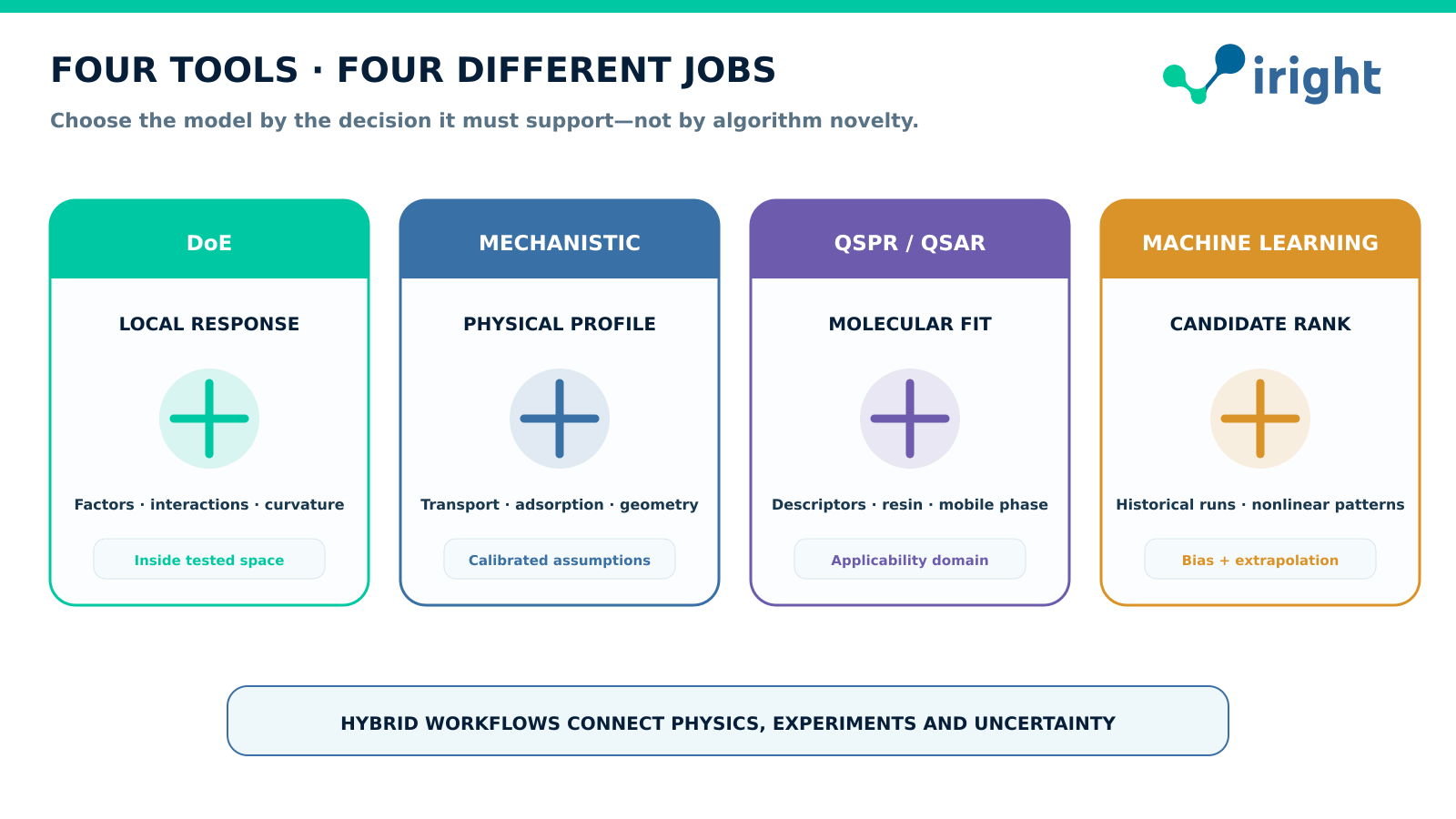
DoE maps a local experimental region, mechanistic models represent transport and adsorption, QSPR links molecular descriptors to behavior, and ML prioritizes candidates within its data domain.
AI readiness is a data-governance problem before it is an algorithm problem. Each observation should connect five entities: molecule, feed, resin, method and outcome.
Record modality, sequence or construct, molecular weight, pI, charge distribution, hydrophobicity descriptors, aggregation propensity, glycosylation or conjugation state, known stability limits and the batch used. For non-protein products, replace protein descriptors with relevant size, topology, genome, poly(A), capsid or particle attributes.
Record host and expression system, upstream process, harvest or prior-step identity, product concentration, HCP, DNA, aggregate, conductivity, pH, turbidity, viscosity, additives and hold history. A “same molecule” dataset can behave differently when the feed matrix changes.
Do not store only brand and product name. Include base matrix, particle size distribution, pore architecture, ligand chemistry, ligand density when available, ionic capacity, hydrophobicity, lot, age, prior cycles, storage history and supplier. Proprietary descriptors may be incomplete; missingness itself should be explicit rather than silently imputed from a similar product.
Record plate or column format, actual resin volume, packing method, bed height, residence time, load density, flow interruptions, buffer recipes, temperature, mixing, incubation, wash, gradient, pool rule, instrument, dwell volume and cleaning history. A model trained on batch partition coefficients should not be asked to predict HETP unless dynamic evidence connects those targets.
Store mass balance, recovery, purity, HCP, DNA, aggregate, charge variants, potency, DBC, breakthrough shape, pressure, HETP, asymmetry and buffer consumption as separate values with units. Retain replicate-level data, limit of quantification, censoring, analytical method and uncertainty. Never replace “below quantification” with zero.
Version everything: raw data, preprocessing, feature generation, train/test split, model code, hyperparameters and acceptance criteria. Without lineage, an attractive prediction cannot be audited or reproduced.
The iRight Resin Selector should be used at the beginning of the workflow, not as the final decision engine. Its job is to convert the process question into an auditable candidate library.
A useful query should include:
target modality and molecular size;
process position: capture, intermediate purification or polishing;
bind-and-elute or flow-through mode;
target pI, expected pH and conductivity window;
unresolved impurity and required clearance;
residence-time, pressure and scale constraints;
CIP requirement and planned cycle life; and
required regional supply or secondary-source strategy.
Export a deliberately balanced shortlist: multiple mechanisms, at least one established reference, and where technically appropriate at least one Chinese candidate. Then lock product identity, pack size and lot before screening. Candidate generation should be separate from outcome modeling; otherwise availability or catalog prominence can be mistaken for scientific suitability.
Liu and colleagues at University College London and MedImmune demonstrated how this candidate-generation layer can be made quantitative. Their multiobjective optimization framework processed microscale HTS data for an industrial recombinant Fc-fusion purification case containing two chromatography steps with eight and three candidate resins, respectively, and selected combinations against process metrics such as yield and purity (Liu et al., 2017). The framework ranks the measured candidate space; it does not remove the need to generate comparable experiments or confirm the selected sequence dynamically.
An RFQ should therefore request comparable screening quantities, documentation and lead time—not ask suppliers to nominate their own “best” product under different conditions. After the plate screen, send only the finalists to iRight RFQ with the intended molecule, mode, pack size and evaluation window.
An AI-ranked candidate should pass four independent gates.
Test molecules, resin lots or conditions that were not used in training or hyperparameter selection. Report prediction error by mechanism, not only pooled average. Use molecule-level splits when multiple conditions from one molecule exist; random row-level splits can leak near-duplicate information into both training and test sets.
Recommended metrics include mean absolute error for continuous responses, Q² or another held-out coefficient of determination, sensitivity and specificity for pass/fail gates, calibration of predicted probabilities, and candidate hit rate among the top-ranked suggestions.
Confirm recovery, impurity clearance, DBC, peak shape and pressure at more than one residence time. Use the actual feed or a justified representative model. A batch-binding success is not sufficient evidence for gradient resolution or manufacturing productivity.
Challenge pH, conductivity, load, temperature, feed composition and flow within realistic ranges. Compare miniature and bench-scale results, then verify the scale-dependent parameters in the intended production geometry. ICH Q8 allows models and small-scale knowledge to support design space, but requires the scale relationship to be justified.
Evaluate multiple resin lots, cleaning exposure and age when the model will inform a late-stage or commercial process. A model built on pristine screening resin may not predict a compressed bed after repeated CIP. Monitor drift and define retraining triggers.
The model should abstain when a new molecule, resin or condition lies outside its applicability domain. “Insufficient evidence—run these three experiments” is a higher-quality output than a confident but unsupported rank.
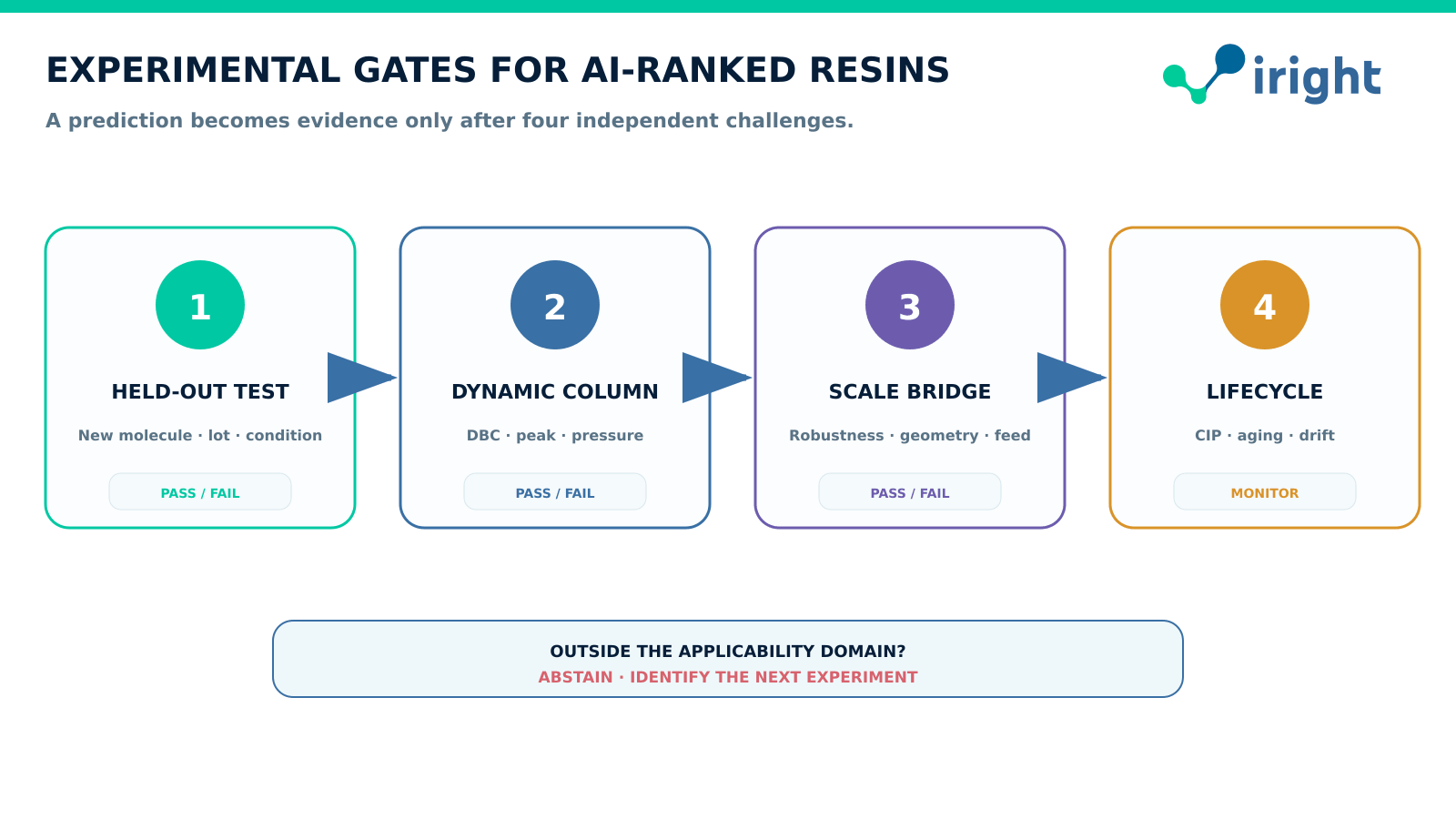
A prediction becomes process evidence only after held-out testing, dynamic-column confirmation, scale translation and lifecycle checks.
The largest resin datasets are not neutral samples of the commercial market. Imported products often have longer publication histories, more application notes, more prepacked formats and more standardized metadata. A model trained on document count, citation count or completeness may learn brand visibility rather than performance.
Bias can enter through at least six routes:
Coverage bias: established global brands appear in more experiments.
Condition bias: supplier-recommended windows are tested more often than unfavorable or edge conditions.
Outcome bias: successful case studies are published; failed screens remain internal.
Format bias: products available in plates or RoboColumns generate more structured data.
Assay bias: historical projects use different analytics, limits and pool rules.
Procurement bias: lead time, pack size or availability affects which candidates reach the lab.
Corrective actions are practical. Use a common experimental protocol across brands; include supplier as a covariate but never as a proxy for chemistry; weight or stratify evaluation by mechanism and brand; publish missing-data patterns; and reserve entire product families or suppliers for external validation. Ranking should combine measured performance, uncertainty, supply fit and documentation—not the volume of web content.
Bernau and colleagues at Fraunhofer reviewed predictive chromatography models and emphasized that hybrid and data-driven approaches depend strongly on experimental quality, parameter identifiability and validation (Bernau et al., 2022). The 2026 multimodal review from University College London and Instituto Superior Técnico similarly treats QSPR, molecular descriptors, mechanistic understanding and high-throughput experiments as an integrated selection framework rather than substitutes for each other (Javidanbardan et al., 2026).
Brand neutrality does not mean hiding brand identity. It means giving technically comparable candidates the same opportunity and applying the same acceptance rules.
Chinese suppliers now offer broad resin portfolios. Bestchrom lists affinity, IEX, HIC, mixed-mode, SEC and other families, including rigid-agarose Diamond products (Bestchrom portfolio). NanoMicro lists rigid polymer and agarose-based affinity, IEX, HIC, SEC and multimodal products, including UniGel, NanoGel and UniHR families (NanoMicro portfolio). Bio-Link lists MaXtar, ChromaX and MonoPS families across IEX, HIC, affinity and multimodal modes (Bio-Link portfolio). These pages establish candidate availability; they do not establish equivalence to an imported reference.
A balanced screening library should be assembled by chemistry and intended use:
Screening block | Imported reference | Chinese candidate class | Fair comparison requirement |
|---|---|---|---|
High-resolution CEX | Capto S ImpAct or another qualified reference | Rigid polymer or high-rigidity agarose SP/S candidate | Same feed, bed height, residence times, load and aggregate/charge-variant analytics |
AEX flow-through | Capto Q ImpRes or another qualified reference | Q candidate with comparable particle and pore architecture | Same conductivity, load, HCP/DNA panel and product-loss limit |
Mixed-mode polishing | Capto MMC ImpRes or appropriate anionic mixed mode | Chinese MMC/MIX candidate matched by interaction class | Same pH–salt–additive DoE, recovery, aggregate/HCP and elution window |
Protein A capture | Established Protein A reference | Domestic alkali-stable Protein A candidate | Multiple residence-time DBC, HCP/HMW, leached ligand, pressure and lifecycle |
The data gap is itself a development variable. If a domestic product lacks standardized descriptors or mini-column formats, the program can generate them: particle-size measurement, pressure–flow testing, static and dynamic capacity, pore-accessibility probes, ligand-density or ionic-capacity testing, and repeated-cycle performance. The result improves both procurement confidence and model fairness.
Do not “correct” brand imbalance by forcing equal model scores. Correct it by creating comparable evidence. A Chinese resin should advance because it passes the same molecule-specific gates, not because the algorithm has been instructed to prefer domestic supply. Conversely, it should not be excluded because the imported reference has twenty years of application notes.
Use AI to decide what to test next—not to declare the final resin.
Advance a candidate only when:
it meets every mandatory recovery and impurity gate in held-out experiments;
the prediction lies inside a defined applicability domain;
dynamic data confirm performance at relevant residence time and load;
the small-scale model has a justified bridge to the intended scale;
pressure, cleaning, lot consistency and supply fit are acceptable; and
the conclusion remains true when all brands are evaluated by the same protocol.
The most valuable model output is a ranked experiment plan with uncertainty: which resin–condition combinations are most promising, which measurements would reduce uncertainty, and which regions should be avoided. The endpoint remains a robust process supported by chromatograms, analytics, mass balance and lifecycle evidence.
This article prioritizes peer-reviewed primary studies for quantitative claims, identifies author institutions where provenance materially affects interpretation, and uses FDA/ICH documents for regulatory and model-validation context. Supplier pages define formats and candidate portfolios only; they are not treated as independent performance comparisons. Reported model accuracy applies to the stated datasets, chemistries, molecules and validation schemes and must not be generalized to unseen modalities without experimental confirmation. FDA does not test, rank or endorse the chromatography products discussed here.
ResinFrontiers · iRight Bioprocess Chromatography Intelligence Series
Selecting a chromatography resin is not a catalog-matching exercise. It is a separation-design problem: the target molecule, the impurities that must be removed, the operating window and the bioproce…