Article
Continuous Chromatography: Resin Selection for Multicolumn Processing
By Iri ·
Article
By Iri ·
Artificial intelligence can accelerate chromatography resin selection, but it cannot infer a universally “best resin” from catalog specifications. The practical route is a closed evidence loop: gener…
AAV, plasmid DNA and mRNA cannot be purified by simply shrinking or enlarging a monoclonal-antibody platform. Their size, surface charge, topology, shear sensitivity and product-related impurities ch…
Moving from batch chromatography to periodic counter-current chromatography (PCC) changes the resin-selection question. The best batch resin is not automatically the best continuous resin: the ranking can change when residence time falls, columns switch repeatedly, breakthrough is deliberately transferred, and cleaning cycles accumulate much faster.
Continuous and semi-continuous manufacturing are no longer merely equipment concepts. The FDA’s final ICH Q13 guidance explicitly covers therapeutic proteins and identifies process chromatography among the unit operations that can participate in an integrated continuous manufacturing strategy. Q13 does not endorse a particular system or resin; it asks manufacturers to define the operating strategy, material traceability, diversion logic, process dynamics, validation approach and lifecycle controls for the actual process (FDA/ICH Q13, 2023).
This sixth article in ResinFrontiers · iRight Bioprocess Chromatography Intelligence Series extends the molecule- and impurity-driven framework in Chromatography Resin Selection: A Bioprocessing Framework and the lifecycle analysis in Protein A Resin Comparison: Beyond DBC10%. It focuses on what changes when a chromatographic step becomes cyclic, interconnected and control-dependent.
Multicolumn chromatography overlaps operations across two or more columns so that one column can load while another washes, elutes, regenerates or equilibrates. In a PCC arrangement, the breakthrough from a lead column is directed to a second column instead of being discarded or pooled with product. The lead column can therefore be loaded beyond the conservative breakthrough limit normally used in batch capture.
“Continuous” requires precision. A cyclic twin- or three-column process may accept feed continuously even though each individual column still executes discrete load, wash, elute and CIP phases. A multicolumn system used for several hours is not automatically an integrated continuous process, and a continuously fed capture step does not make the entire facility continuous. The unit-operation boundaries, material pools and state transitions must be defined.
Design question | Single-column batch | PCC / multicolumn |
|---|---|---|
Loading endpoint | Usually stops before unacceptable breakthrough | Breakthrough is transferred to the next column for capture |
Resin volume | Sized for batch mass and conservative usable capacity | Distributed across smaller columns and reused more frequently |
Residence time | Often selected near a vendor test condition | Frequently shorter; may vary between interconnected and disconnected loading |
Critical control | Load volume or UV endpoint | Breakthrough threshold, valve timing, column state and synchronization |
Failure impact | Usually contained within one batch step | Can propagate across columns or connected unit operations |
Lifecycle | Fewer, longer cycles | More cycles per day; CIP and valve exposure accumulate rapidly |
Godawat and colleagues at Genzyme/Sanofi demonstrated the operating logic with two recombinant enzymes and one monoclonal antibody. Their experimental and modeling work found greater capacity utilization and lower buffer consumption than batch operation and indicated that capture-column volume could be reduced by one to two orders of magnitude in the studied cases (Godawat et al., 2012). That is a condition-specific result, not a universal reduction factor: feed titer, breakthrough shape, cycle schedule, cleaning time and system dead volume determine whether the advantage is realized.
Warikoo and colleagues at Genzyme/Sanofi later connected perfusion culture to four-column PCC and subsequent purification operations, demonstrating an end-to-end strategy that reduced intermediate holds and equipment footprint (Warikoo et al., 2012). The lesson for resin selection is simple: the resin is now part of a timed network. A medium that binds well but washes, elutes or regenerates too slowly can become the scheduling bottleneck.
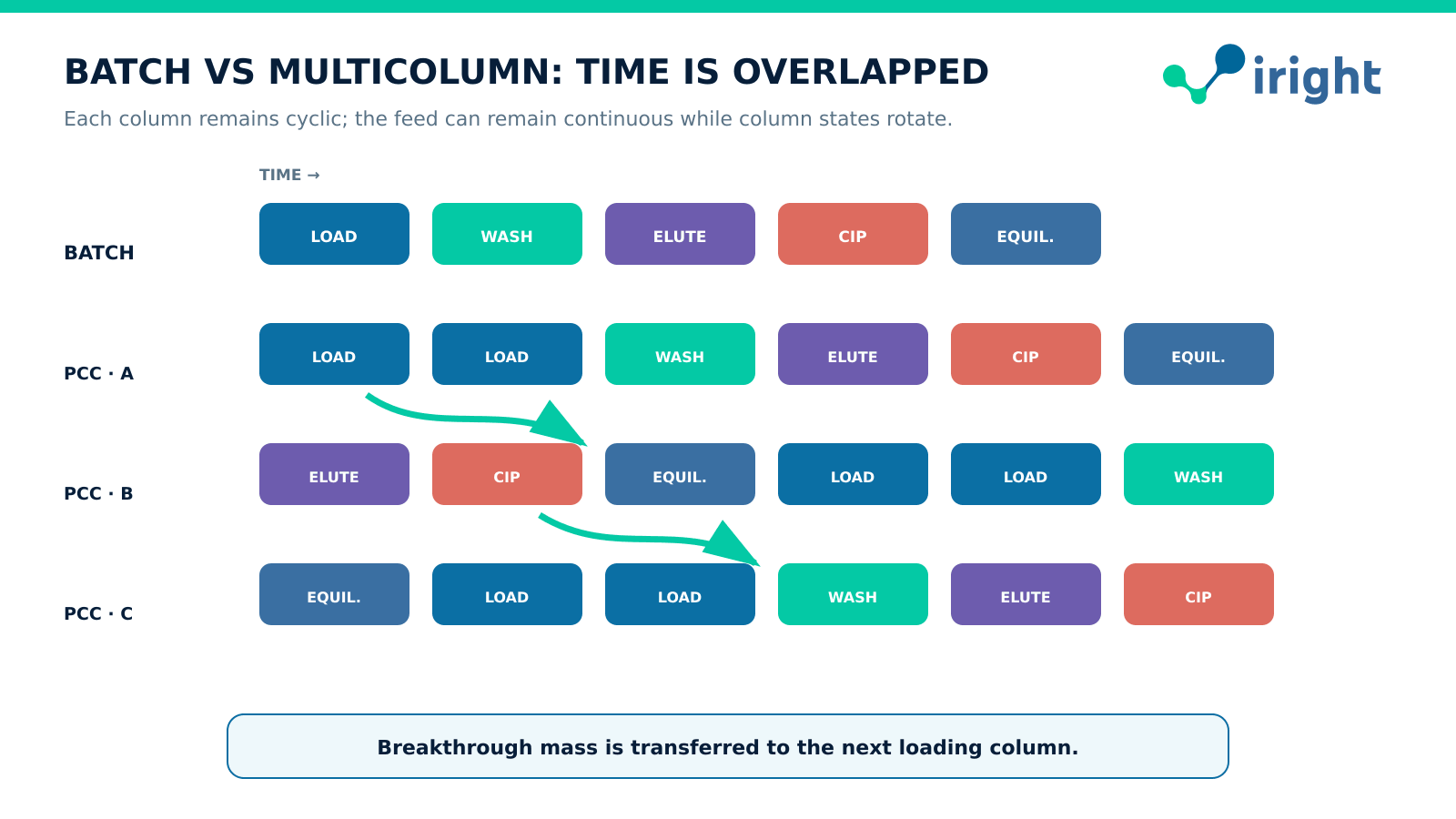
Multicolumn operation gains time by overlapping column states; the slowest load, wash, elution, regeneration or CIP phase can constrain the entire cycle.
The gain comes from capturing the mass that would break through a batch column, not from increasing the resin’s equilibrium capacity. A batch process commonly stops loading at a defined breakthrough level to protect yield. At that point, the inlet region of the bed may be near saturation while the outlet region remains underused. PCC sends the lead-column effluent to a capture column and moves each column through the sequence.
The apparent benefit depends on three linked shapes:
the single-column breakthrough curve at the intended feed concentration and residence time;
the cycle schedule, including connection and disconnection times; and
the wash, elution, regeneration and CIP durations that determine whether a cleaned column is ready when needed.
Angarita and colleagues from ETH Zurich, ChromaCon and JSR Micro N.V. developed the twin-column CaptureSMB process and reported superior productivity and capacity utilization relative to the batch comparator under their study conditions (Angarita et al., 2015). Baur and colleagues from ChromaCon and ETH Zurich subsequently compared batch and multicolumn Protein A capture designs and showed that the optimal number of columns depends on resin and process characteristics rather than a fixed “more columns is better” rule (Baur et al., 2016). Additional columns add valves, hold-up volume, control states, packing operations and failure modes.
Capacity utilization should therefore be defined explicitly. A practical project definition is:
Resin utilization = captured mass per cycle ÷ (reference DBC × total installed resin volume).
The reference DBC must state the breakthrough criterion, residence time, feed and concentration. Without that denominator, two suppliers can report “90% utilization” against different capacities. Guo and colleagues in Teva Pharmaceutical Global R&D modeled high-titer capture and reported more than 90% utilization for their optimized multicolumn design—16 percentage points above the super-batch comparator at 15 g/L feed—but that number belongs to their modeled operating window, not every PCC installation (Guo et al., 2020).
Continuous capture usually intensifies the exact condition at which mass transfer becomes limiting: high feed concentration at short residence time. A DBC10% measured at six minutes with purified human IgG may not predict performance at 45–90 seconds with clarified harvest.
Natarajan and Zydney showed experimentally with ProSep Ultra Plus that Protein A DBC decreased as monoclonal-antibody concentration increased at short residence times. PubMed lists EMD Millipore Corporation as the paper’s sole study affiliation; a university repository record should not be treated as an additional paper affiliation. Their model attributed the loss to non-equilibrium transport within porous particles (Natarajan & Zydney, 2013). Hahn and colleagues at the University of Natural Resources and Life Sciences Vienna also showed that Protein A media can rank differently as residence time changes because diffusion and pore access differ by matrix (Hahn et al., 2003).
The minimum useful screen is not one DBC number. It is a breakthrough family:
test the real clarified feed at, for example, 0.5, 1, 2 and 4 minutes;
report DBC at the same breakthrough criteria—preferably 1%, 5% and 10%;
measure pressure at the same bed height and temperature;
repeat at the low and high feed titers expected during the run; and
fit or interpolate the curves only inside the experimentally supported range.
Chen and colleagues from Yamaguchi University and Japan’s Manufacturing Technology Association of Biologics compared three Protein A resins over residence time and feed concentrations of 1.5–4 g/L, then used those data to predict multicolumn utilization and buffer demand (Chen et al., 2021). The important method is not the identity of the winner; it is the use of resin-specific breakthrough data under process-relevant conditions.
For an iRight shortlist, compare a high-capacity agarose medium such as MabSelect PrismA, 1 L (Cytiva 17549803), a high-flow polymeric medium such as POROS MabCapture A, 10 mL (Thermo Fisher 4374732), and a polymeric hydrophilic medium such as Eshmuno A (Merck 1.25160.0001). MabSelect SuRe PCC (Cytiva 17549103) is also a relevant process-intensification candidate. These links identify catalog records; they do not predict ranking. Rank the media with the same feed, bed height, breakthrough criterion and short residence times.
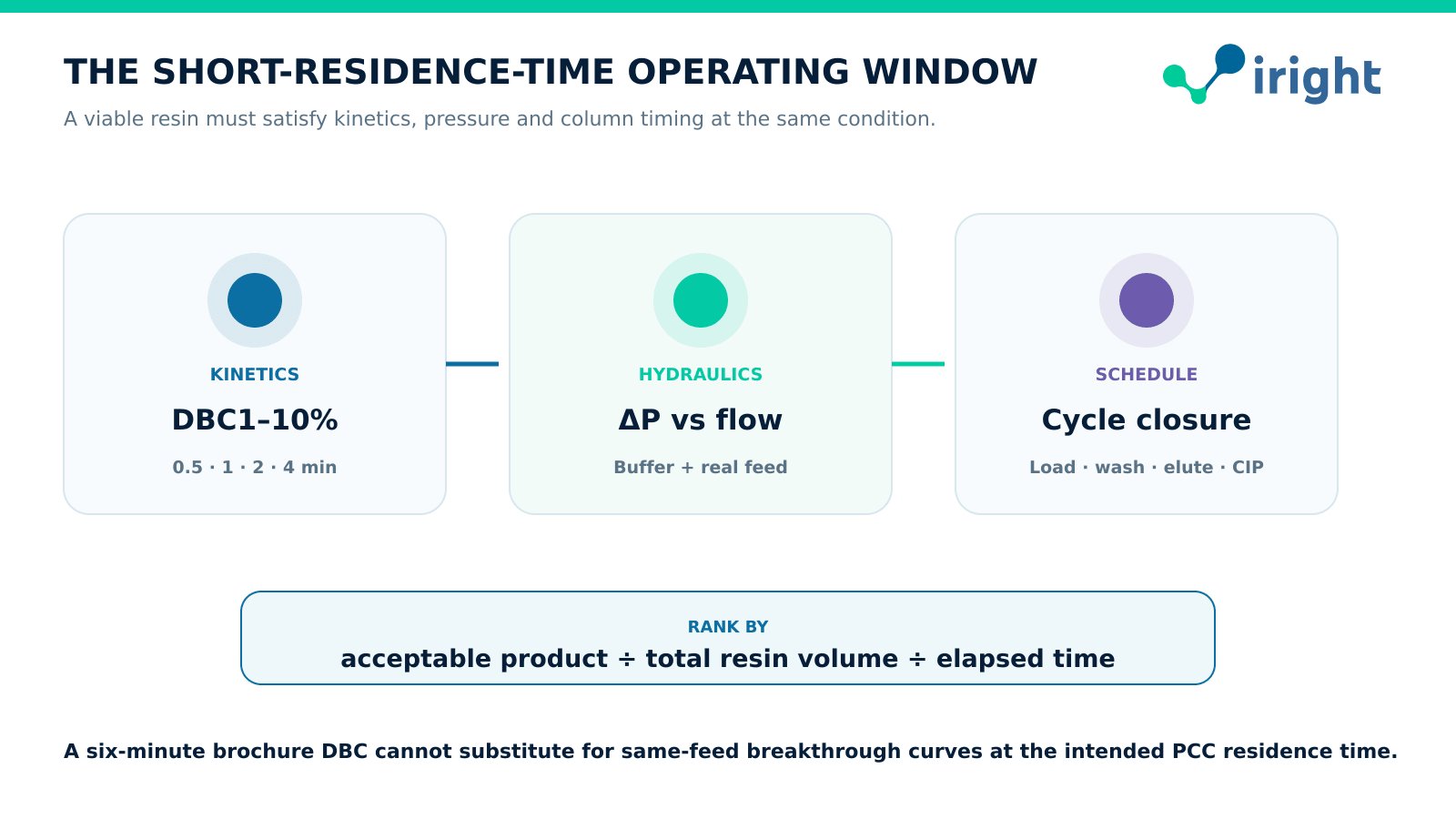
A continuous-process resin must stay inside a three-dimensional operating window: sufficient DBC at short residence time, acceptable pressure and a cycle fast enough to synchronize with the other columns.
The resin must move mass rapidly without generating prohibitive pressure or losing mechanical integrity across repeated cycles. Four architectural variables matter:
Bead rigidity. A rigid polymer or highly cross-linked agarose bead can tolerate higher linear velocity and taller beds, but chemistry, compressibility and wall effects must be evaluated in the intended column.
Particle size and distribution. Smaller particles can improve mass transfer and efficiency but increase pressure. A narrow distribution can improve packing reproducibility.
Pore accessibility. Large pores may reduce steric restriction for antibodies, while ligand density and pore diffusion determine how much of the internal surface is usable at short residence time.
Surface and ligand chemistry. Nonspecific interactions can change HCP removal, wash behavior, elution volume and fouling even when DBC appears similar.
Do not compare supplier “maximum flow” values directly. Some are measured in water, at different bed heights, viscosities or pressure limits. Generate a pressure–flow curve in equilibration buffer and representative feed at the selected bed height. Record system pressure separately from bed pressure and include filters, valves and tubing. For a multicolumn skid, the allowed pressure during connected loading can differ from the pressure of an isolated column.
The most valuable architecture is not necessarily the one with the highest flow rating. A resin with very high permeability but steep short-residence-time DBC loss may need more volume. A high-capacity resin that requires long residence time may force larger columns or more columns. The optimization variable is acceptable product per unit time and installed resin volume.
A continuous capture column may experience several cycles per day, so chemical and mechanical aging accumulate on a calendar timescale that can surprise a batch platform. The relevant lifetime endpoint is not merely “capacity after 100 cycles.” It is the first cycle at which any critical attribute—capacity, yield, HCP clearance, aggregate control, ligand leakage, pressure or bioburden control—crosses its acceptance limit.
Zhang and colleagues at Biogen studied alkali-stable MabSelect SuRe and MabSelect SuRe LX and separated the effects of chemical degradation from fouling (Zhang et al., 2017). The work supports a broader lifecycle principle: unused ligand stability and feed-dependent fouling are different failure mechanisms, and a caustic-only soak cannot replace a cycled-feed lifetime study.
For continuous use, build the lifecycle sequence around the real process:
clarified feed exposure at target and worst-case load;
the complete wash and elution sequence;
the intended NaOH concentration, contact time and temperature;
storage or pause states expected during extended runs;
periodic sanitization or maintenance steps; and
representative column switching and depressurization.
Sample early, middle and late cycles. Trend DBC, pool volume, recovery, HCP, DNA, HMW, leached Protein A, pressure and microbial control. A resin that retains 95% DBC but loses HCP selectivity or develops rising pressure is not “95% healthy.” A dedicated candidate such as MabSelect PrismA X (Cytiva 17550103) can be included when extended alkaline stability is a design priority, but the process still needs its own lifetime acceptance criteria.
Use total installed resin volume and total elapsed operating time; otherwise multicolumn productivity can be overstated. A transparent volumetric productivity is:
Resin productivity = acceptable product mass ÷ (total installed resin volume × total elapsed operating time).
“Acceptable product mass” means recovered mass that meets the pool-quality criteria. “Total installed resin volume” is the sum of resin volumes in all columns, and “total elapsed operating time” includes the full repeating cycle. Report units such as g·L-resin⁻¹·h⁻¹. If “column productivity” is used, state whether the denominator is one column, total packed volume or skid occupancy time.
Also report:
specific buffer consumption: total buffer volume per mass of acceptable product;
resin consumption: installed resin volume divided by lifetime product mass;
cycle yield and integrated yield: including start-up, shutdown and diverted material;
system utilization: productive operating time divided by scheduled time; and
cost per acceptable gram: resin, buffer, consumables, labor, analytics and product loss.
Löfgren and colleagues from Lund University, KTH and Swedish Orphan Biovitrum tested an integrated continuous process with real-time control. Under their laboratory-scale conditions, control raised resin utilization from 71.4% to 87.9%, increased product output per cycle by 27%, and reduced specific buffer consumption by 21%; relative to their batch comparator, productivity rose 95% and yield 28% (Löfgren et al., 2021). These are valuable conditional data—not generic claims for all systems. They also show why the controller and disturbance response belong in a resin-productivity assessment.
Economic reviews reach the same caution from a different direction: smaller resin volume can be offset by more complex equipment, automation, development, sensors and downtime risk. Yang and colleagues reviewed batch and continuous antibody manufacturing economics and emphasized that process scale and operating assumptions govern the result (Yang et al., 2020). “Cheaper per liter of resin” and “cheaper per gram of released product” are different questions.
The switch decision must keep product loss and column utilization inside a validated window despite feed and resin variability. A fixed-time switch is simple but assumes stable titer, flow, DBC and detector response. UV-based breakthrough can adapt to changes, but clarified feed contains background absorbance and multiple proteins; the measured signal may not equal target breakthrough.
A robust control strategy defines:
the measured variable—UV, fluorescence, conductivity, pressure, at-line titer or a model-based estimate;
signal pretreatment, baseline correction and delay volume;
the switching threshold and hysteresis;
the action if the sensor drifts, saturates or fails;
the maximum allowed breakthrough and material-diversion path; and
column-state reconciliation after a pause or valve fault.
Shi and colleagues at Zhejiang University and the University of Cambridge fitted a twin-column model to experimental breakthrough curves across protein concentrations and residence times. Their work found distinct operating regions governed by interconnected residence time, breakthrough set point and disconnected feeding time (Shi et al., 2020). A model can reduce experiments, but it must be calibrated with the selected resin and feed.
PAT also supports lifecycle control. Ramakrishna and colleagues at the Indian Institute of Technology Delhi proposed online-data and hybrid-model approaches for predicting resin aging from chromatographic signals and performance indicators (Ramakrishna et al., 2024). That does not eliminate release or lifecycle testing; it provides an earlier warning that capacity, yield or purity may be drifting.
No. Capture is dominated by mass loading and breakthrough control; polishing is dominated by selectivity, impurity clearance and pool definition.
For continuous Protein A capture, prioritize short-residence-time DBC, permeability, elution concentration, alkaline cleaning stability and feed-dependent fouling. The system must capture target breakthrough while keeping each column synchronized. Product-quality metrics still matter: HCP, DNA, aggregate, leached ligand and low-pH exposure should be trended across column positions.
For bind-and-elute CEX polishing, resolution can be more important than DBC. Gradient creation and fraction routing are harder to synchronize continuously than capture. Candidate media such as Capto S ImpAct, 1 L (Cytiva 17371703) and Eshmuno CPX (Merck 1.25157.0001) should be compared for monomer/aggregate or charge-variant separation at the actual load and gradient slope. For flow-through AEX, the critical outputs are impurity breakthrough, viral clearance support, product recovery and capacity under feed conductivity—not product DBC. See the mode-selection logic in Ion Exchange Chromatography for Antibody Polishing.
Flow-through membranes and monoliths are legitimate comparators because convective transport can retain performance at very short residence times. Their capacity basis, pressure behavior, lifecycle and economics differ from bead resins, so normalize the comparison by acceptable product mass, device volume and total process time. A continuous train may combine multicolumn Protein A with a flow-through AEX device and virus filtration without requiring every step to use packed beads.
Steady-state performance is only part of a continuous process; start-up, shutdown and disturbances create distinct material that must remain traceable and controllable. ICH Q13 asks manufacturers to understand process dynamics, residence-time distribution (RTD), material traceability and diversion strategy. Its therapeutic-protein example explicitly includes continuous capture chromatography, viral inactivation, polishing, virus filtration and ultrafiltration/diafiltration.
The control plan should answer:
Which outlet material is collected before the columns reach the defined cyclic state?
How is material in tubing, surge vessels and interconnected columns assigned to a lot?
What happens to product during a high-pressure alarm, missed switch or sensor failure?
Can an affected time interval be isolated using validated RTD information?
How is column identity and cycle history maintained when columns rotate positions?
When is a column removed, repacked or replaced without compromising the remaining train?
Virus safety requires particular discipline. Q13 notes that extended operation may increase exposure to adventitious-agent risks and that viral-clearance validation should consider the continuous-process operating strategy. Chromatography resin lifetime, virus-filter throughput and continuous viral-inactivation controls need justified limits. The FDA’s Q5A(R2) guidance remains the core reference for viral safety evaluation; neither Q5A nor Q13 ranks commercial resins (FDA Q5A(R2), 2024).
Konoike and colleagues in Japan converted a batch mAb platform into an integrated continuous downstream process using two-column Protein A PCC, continuous low-pH viral inactivation and flow-through polishing (Konoike et al., 2024). Such studies demonstrate feasibility; each manufacturer must still establish molecule-specific viral safety, impurity clearance and diversion controls.
A fair benchmark preserves the feed, quality targets and process boundaries while allowing each format to operate near its own optimum. Copying the batch residence time into a multicolumn skid understates intensification; forcing every resin to the same velocity can penalize one architecture. Use a staged protocol.
Measure DBC1%, DBC5% and DBC10% at multiple residence times with the same clarified feed. Generate pressure–flow curves in buffer and feed. Record elution volume, peak concentration, recovery, HCP, DNA, HMW and leached ligand.
Run the complete load–wash–elute–CIP sequence. Verify mass balance and cycle time. Challenge high titer, high viscosity and low DBC. Conduct enough representative cycles to identify drift in selectivity, pressure and cleaning recovery.
Use the measured breakthrough model to select column number, connection time and switch threshold. Test fixed-time and adaptive control if applicable. Introduce controlled disturbances in titer, flow, sensor baseline and column capacity.
Demonstrate start-up, cyclic steady state, pause, restart, shutdown and material diversion. Quantify yield and quality for every state—not only the best steady-state interval. Confirm RTD and lot traceability through surge vessels and connected operations.
Compare total resin volume, cycles per campaign, expected lifetime product mass, buffer, disposables, labor, system occupancy, deviations and lost product. Present sensitivity to feed titer, run length, resin life and utilization.
Advance a candidate only when it passes hard gates for product quality, pressure, control and cleaning. Then optimize productivity and cost. To source a matched first-round screen, use the iRight Resin Selector or request a pre-filled continuous-chromatography shortlist.
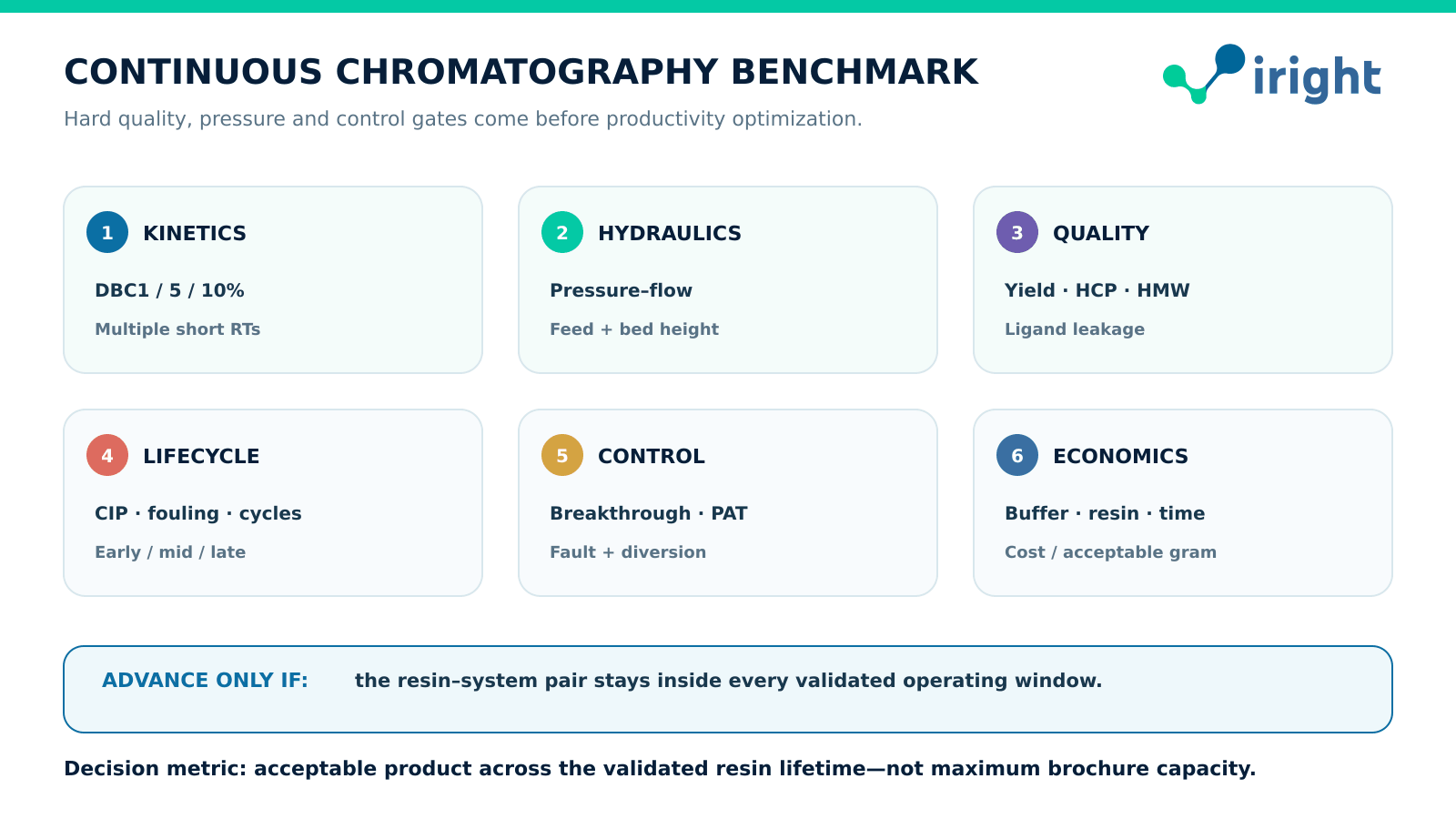
Capacity is one axis. A deployable multicolumn resin must also meet pressure, lifecycle, control, impurity-clearance and acceptable-product productivity gates.
China has credible candidates for high-flow Protein A and polishing screens, but public evidence does not yet justify a general claim of drop-in equivalence in PCC. The correct language is “candidate for matched testing,” not “replacement,” until the same feed and system demonstrate short-residence-time DBC, pressure, product quality, cycle stability and economics.
Supplier / candidate | Architecture and supplier-reported specification | Why it belongs in a screen | Evidence boundary |
|---|---|---|---|
NanoMicro UniMab EXE | Rigid PMMA core–shell Protein A resin; supplier reports DBC10% of 55–65 mg/mL at 4 min with 2.77 mg/mL human IgG, maximum backpressure 0.8 MPa and 0.1–0.5 M NaOH CIP | Strong first candidate when short residence time and pressure tolerance are priorities | Values are supplier-generated under stated test conditions; no peer-reviewed head-to-head PCC study against the above global products was identified |
Bestchrom Novo-A Diamond / Extrem A Diamond | High-rigidity agarose Protein A media; supplier reports ≥65 mg/mL and ≥75 mg/mL DBC respectively at 6 min and 100 cm/h, with 0.5 MPa maximum pressure and 0.5–1.0 M NaOH CIP | Full portfolio and process support make them relevant for capture screening and scale-up | Six-minute DBC cannot establish ranking at PCC residence times; require 0.5–2 min curves and cycled-feed data |
Bio-Link MaXtar ARPA | Agarose Protein A resin; supplier materials report >60 mg/mL DBC and compatibility with 0.5 M NaOH; an application note reports >90% initial DBC after 200 cycles | Relevant secondary candidate where local supply, columns and integrated process support matter | Lifecycle result is supplier-generated; reproduce with the project feed, cleaning sequence and quality panel |
NanoMicro is the most technically distinctive first candidate for this topic because its UniMab EXE specification describes a rigid polymeric core–shell matrix and reports DBC at four minutes rather than only six minutes. The broader UniMab polymeric Protein A range provides additional flow and pressure options. Those features are mechanistically relevant to high flow; they are not proof of superior PCC productivity.
Bestchrom’s Novo-A Diamond and Extrem A Diamond are high-rigidity agarose candidates. Bio-Link’s MaXtar ARPA adds another domestic Protein A route with local system and column support. For polishing, Bestchrom and Bio-Link offer IEX and mixed-mode portfolios, while NanoMicro’s rigid polymer platform is relevant where high linear velocity is valuable.
A replacement decision should require five matched demonstrations:
equal or better DBC1–10% at the actual 0.5–2 minute residence-time window;
equal or better pressure–flow behavior at the production bed height and feed viscosity;
equivalent yield, HCP, DNA, HMW and leached-ligand performance;
no adverse drift across representative feed/CIP cycles; and
lower or acceptable cost per gram of acceptable product, including system and buffer effects.
The first procurement set can therefore include one rigid polymeric domestic medium, one high-rigidity agarose domestic medium and one established global comparator. Request a pre-filled domestic-versus-global PCC screen and specify feed titer, target residence time, bed height and intended CIP.
Choose the resin–system pair that produces the most acceptable product per unit time across its validated lifetime—not the resin with the highest six-minute DBC.
For capture, short-residence-time breakthrough, pressure, elution concentration, CIP stability and feed-dependent fouling determine whether the multicolumn schedule closes. For polishing, selectivity and impurity breakthrough may dominate capacity. In both cases, the controller, valves, sensors and material-diversion strategy are part of performance.
The most defensible sequence is:
establish the batch baseline with complete mass balance and quality data;
generate resin-specific short-residence-time breakthrough and pressure data;
model the column number and switching window, then confirm experimentally;
challenge disturbances, state transitions and representative lifecycle cycles;
compare cost per acceptable gram with all columns and non-steady-state losses included; and
freeze a control and lifecycle strategy that meets ICH Q13 expectations.
Continuous chromatography does not make resin selection less important. It exposes the resin’s kinetics, pressure behavior and aging mechanisms more clearly—and makes the consequences of a weak assumption propagate faster.
Peer-reviewed experimental studies are prioritized over reviews and supplier literature. Quantitative results are reported with their study conditions and are not presented as universal performance claims. Modeling studies are identified as such. Supplier specifications are used to define candidates, not to prove cross-brand equivalence. FDA/ICH guidance defines regulatory expectations and does not test, rank or endorse commercial resins. Author affiliations are stated for pivotal studies so readers can judge evidence provenance. No peer-reviewed, same-feed PCC comparison of NanoMicro, Bestchrom and Bio-Link Protein A candidates against the listed global products was identified in the sources reviewed; any substitution claim therefore requires a project-specific bridge study.
ResinFrontiers · iRight Bioprocess Chromatography Intelligence Series
This article proposes a practical benchmark for modern antibody manufacturing. It distinguishes peer-reviewed studies, a biopharma-authored industry case study, regulatory guidance and supplier speci…