Article
Resin Selection for AAV and Nucleic Acids
By Iri ·
Article
By Iri ·
Artificial intelligence can accelerate chromatography resin selection, but it cannot infer a universally “best resin” from catalog specifications. The practical route is a closed evidence loop: gener…
Moving from batch chromatography to periodic counter-current chromatography (PCC) changes the resin-selection question. The best batch resin is not automatically the best continuous resin: the rankin…
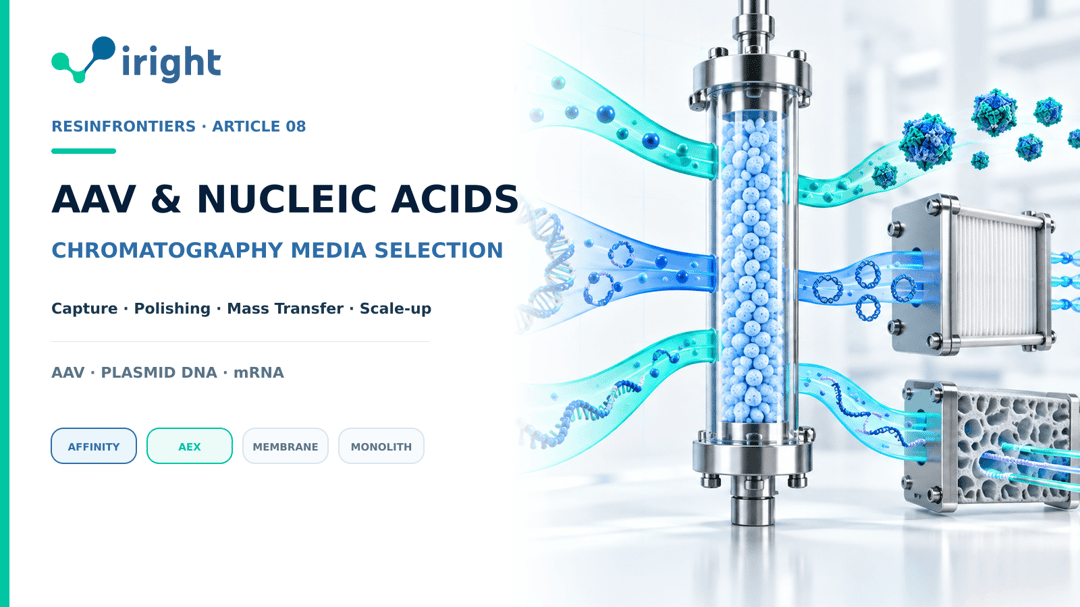
AAV, plasmid DNA and mRNA cannot be purified by simply shrinking or enlarging a monoclonal-antibody platform. Their size, surface charge, topology, shear sensitivity and product-related impurities change both the separation mechanism and the preferred stationary-phase architecture. The right question is therefore not “Which resin has the highest capacity?” but “Which medium resolves the critical quality attribute at the required recovery, pressure and processing time?”
This eighth article in ResinFrontiers · iRight Bioprocess Chromatography Intelligence Series extends the selection logic introduced in Chromatography Resin Selection: A Bioprocessing Framework and the mass-transfer discussion in Continuous Chromatography: Resin Selection for Multicolumn Processing. It compares packed beads, membranes and monoliths for viral vectors and nucleic acids, separates AAV capture from full/empty polishing, and distinguishes poly(A) capture from dsRNA removal.
A conventional IgG is a soluble protein of roughly 150 kDa. An AAV particle is a nanoscale protein shell containing DNA; a plasmid is a long, topologically variable polyanion; and mRNA is a flexible, degradation-prone polyanion with sequence-dependent secondary structure. Those differences change transport, binding and damage mechanisms.
Protein A capture succeeds because the Fc region offers a conserved, high-affinity handle. AAV affinity capture instead recognizes a capsid epitope that can vary with serotype or capsid engineering. Plasmid DNA has no equivalent universal tag: separation must exploit charge, hydrophobicity, topology or a selective thiophilic interaction. Oligo-dT media can provide an affinity handle for polyadenylated mRNA, but that handle reports the poly(A) tail—not transcript integrity, correct capping or absence of dsRNA.
The impurity map also changes. In addition to HCP, host-cell DNA, endotoxin and process additives, AAV processing must address empty, partial and mispackaged capsids, aggregates and potentially replication-competent virus. Plasmid processes must distinguish supercoiled, open-circular, linear and denatured forms while removing genomic DNA, RNA, protein and endotoxin. IVT mRNA processes must remove template DNA, enzymes, free nucleotides, abortive or truncated RNA, uncapped RNA and dsRNA.
FDA’s January 2020 gene-therapy CMC guidance does not prescribe a chromatography brand or resin. It asks sponsors to provide sufficient information to support safety, identity, quality, purity and strength—including potency—and to characterize product- and process-related impurities (FDA, 2020). The practical consequence is important: a resin is acceptable because the process and analytics control the relevant quality attributes, not because the medium is marketed for gene therapy.
No single chromatographic mode covers every product and impurity. The useful boundaries are summarized below.
Mode | Best-defined role | Main strength | Main limitation |
|---|---|---|---|
Affinity | AAV capture; poly(A)+ mRNA capture | High selectivity and concentration from dilute feed | Ligand epitope or poly(A) dependence; does not automatically resolve product variants |
AEX | AAV full/empty polishing; pDNA capture or polishing; RNA fractionation | Exploits charge differences and can remove DNA, RNA, endotoxin and acidic impurities | Conductivity-sensitive; selectivity depends on pH, salt species, genome and molecular conformation |
SEC | Desalting, aggregate removal and size-based polishing at modest load | Mild mobile phase and no binding/elution chemistry | Low capacity, dilution and limited resolution for species with similar hydrodynamic size |
Mixed mode / thiophilic | pDNA topology-selective polishing; difficult nucleic-acid impurity separations | Adds orthogonal selectivity beyond charge alone | Development space is broader and elution windows may be narrow |
For AAV, affinity is usually a capture decision; full/empty enrichment is usually a polishing decision. For plasmid DNA, AEX often performs bulk capture while HIC, thiophilic or another orthogonal step resolves topology. For mRNA, oligo-dT can capture polyadenylated molecules, but a second, orthogonal operation may still be required for dsRNA, truncated polyadenylated transcripts or closely related RNA species.
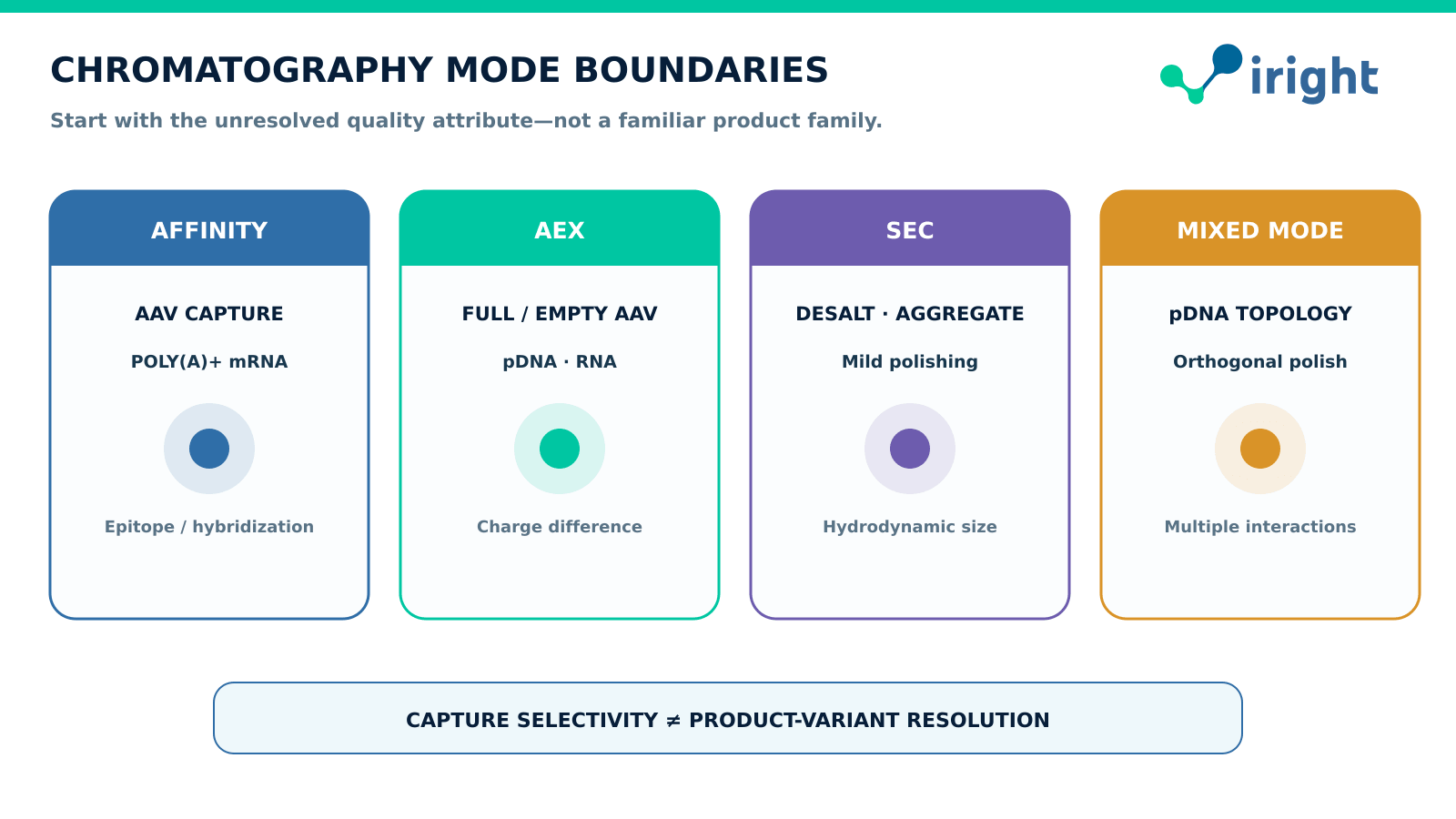
Mode selection starts with the unresolved quality attribute: capture selectivity, capsid content, plasmid topology and dsRNA clearance are four different separation problems.
An affinity column can deliver high AAV recovery and purity while leaving the full/empty ratio largely unchanged. This is not a failure of affinity capture; empty and full capsids usually display the same external epitope. The polishing step must exploit a smaller physicochemical difference, most commonly charge.
Florea and colleagues at Massachusetts Eye and Ear, Harvard and collaborating institutions tested POROS CaptureSelect AAVX across 15 divergent AAV capsids. After method optimization, the reported overall efficiency was 65%–80% across the tested scales and serotypes. AAVX-purified material contained a higher fraction of empty capsids than iodixanol-purified material, although in-vitro and in-vivo potency was comparable in their experiments (Florea et al., 2022). The study supports broad capture utility; it does not support using AAVX as the sole full/empty separation.
AEX can distinguish capsids because packaged genomes alter net charge and surface behavior even though particle size is nearly unchanged. Qu and colleagues demonstrated preparative AEX separation of AAV2 empty particles from genome-containing vectors (Qu et al., 2007). In the AVB-plus-AEX platform reported by Nass and colleagues, the AAV1 empty-capsid fraction fell from about 90% before AEX to 19% after AEX; the same paper emphasized that affinity recovery and ion-exchange conditions remained serotype dependent (Nass et al., 2018).
The 2025 Lund University review by Lorek, Isaksson and Nilsson summarizes published AEX studies reporting recoveries as high as 94% and full-capsid enrichment above 90%, but it also identifies stationary phase, serotype, genome size, salt and surface charge as ranking variables (Lorek et al., 2025). These maxima are not transferable specifications. A fair benchmark must report starting full percentage, analytical method, loading density, gradient shape, pooling rule and vector-genome recovery.
The correct process logic is therefore:
AAV capture success = total capsid or vector-genome recovery + HCP/DNA reduction + infectivity retention.
AAV polishing success = full-capsid enrichment + vector-genome recovery + infectivity retention + aggregate control.
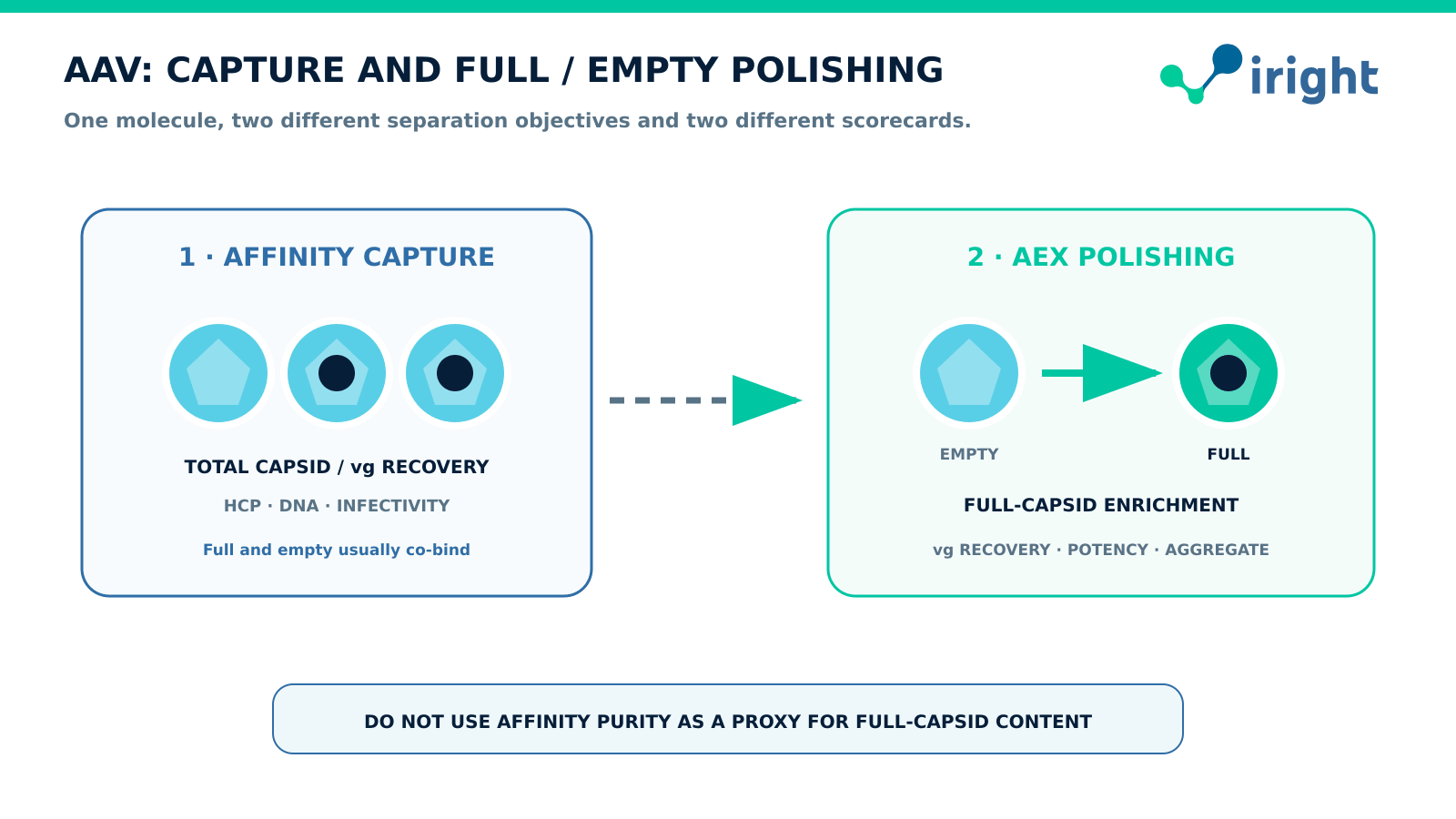
Affinity capture removes process impurities and concentrates capsids; AEX then uses small charge differences to enrich genome-containing particles. Each step needs its own success criteria.
“Broad-serotype” is a screening advantage, not a waiver from molecule-specific validation. The affinity ligand recognizes a surface epitope. A different natural serotype, engineered peptide insertion or even a local amino-acid change can alter accessibility and binding.
AVB Sepharose was an important platform medium for multiple natural serotypes, but Nass et al. found that serotype-specific affinity ligands could improve recovery and that a nonbinding capsid could be converted through epitope engineering. AAVX was developed for wider coverage; Florea et al. demonstrated capture across 15 divergent capsids, including AAV2, AAV8, AAV9, PHP.B and Anc80. More recent structural work from the University of Florida and the University of Helsinki mapped the AAVX binding footprint on AAV8, reinforcing that binding is a molecular epitope interaction—not an abstract property of all AAVs (Mietzsch et al., 2024).
This has three development consequences:
Measure static binding only as a first screen; confirm dynamic recovery at realistic residence time and feed composition.
Include capsid infectivity or potency after low-pH affinity elution. Genome titer alone cannot detect functional damage.
Re-screen affinity capture when the capsid sequence changes. A platform method can shorten development, but a new engineered capsid is not automatically covered by the previous binding claim.
For procurement, POROS CaptureSelect AAVX (A36740, 25 mL) and Capto AVB (17372202, 100 mL) are useful global reference candidates. Thermo Fisher states that AAVX has demonstrated reactivity to AAV1–AAV8, AAVrh10 and synthetic serotypes, but that statement remains supplier-generated product information (Thermo Fisher AAVX product page). For matched pricing and supply checks, request POROS CaptureSelect AAVX A36740 and Capto AVB 17372202 under the same screening specification.
Supercoiled, open-circular and linear plasmids have the same sequence but different three-dimensional compactness. A purification step that removes protein, RNA and endotoxin may still fail if it cannot resolve those topological forms.
AEX is effective for binding the highly anionic phosphate backbone and is commonly used early in a plasmid process. Yet topological variants can be difficult to resolve by charge alone, especially when genomic DNA and RNA fragments broaden the load distribution. Orthogonal HIC or thiophilic selectivity can exploit differences in exposed bases, compactness and hydrophobic interaction.
Smrekar and colleagues at BIA Separations described a two-monolith pDNA process using AEX and HIC. In their study, the HIC monolith separated supercoiled pDNA from open-circular pDNA, genomic DNA and endotoxin at tested flow velocities up to 380 cm/h; the reported dynamic binding capacity reached 4 mg pDNA/mL of support (Smrekar et al., 2010). Those values belong to that plasmid, feed and monolith chemistry, but they illustrate why convective media are attractive for very large nucleic acids.
The benchmark should not report only “total pDNA recovery.” It should include:
supercoiled fraction and supercoiled-mass recovery;
open-circular, linear, denatured and high-molecular-weight DNA;
residual RNA, genomic DNA, HCP and endotoxin;
plasmid size, concentration, viscosity and shear history; and
transfection or biological activity when relevant.
Supplier portfolios provide useful candidate definitions. Bio-Link describes MaXtar PlasmidCap HR as a rigid, thiophilic aromatic resin intended to bind closed-loop supercoiled pDNA preferentially over open-loop pDNA (Bio-Link PlasmidCap HR); Bestchrom describes Plasmid Cap Mustang using a related 2-mercaptopyridine chemistry (Bestchrom Plasmid Cap Mustang). These are supplier claims, not an independent head-to-head comparison. A pre-filled iRight plasmid-media inquiry can request the representative 25 mL formats—MaXtar PlasmidCap HR 1031-1821 and Plasmid Cap Mustang AA0211—under one matched test specification.
“RNA purity” is not one attribute. An IVT reaction may contain template DNA, polymerase, free nucleotides, capping reagents, short abortive transcripts, long truncated transcripts, uncapped RNA and dsRNA. No single chromatographic signal proves that all have been removed.
SEC or TFF can efficiently remove small molecules and exchange buffer, but neither reliably discriminates full-length mRNA from a similar-size dsRNA or polyadenylated truncated transcript. AEX can provide scalable bulk capture and fractionation, yet long RNA species often share charge density. Reverse-phase or ion-pair chromatography can resolve transcription products with strong selectivity, but solvent use, temperature and scale must be assessed.
Karikó, Muramatsu, Ludwig and Weissman at the University of Pennsylvania demonstrated that HPLC purification removed immunostimulatory contaminants, including dsRNA, from nucleoside-modified IVT mRNA. In their cell systems, purified mRNA produced 10- to 1000-fold higher translation in primary cells and did not induce the measured type-I interferon and inflammatory cytokine responses (Karikó et al., 2011). This is important mechanistic evidence, but it does not mean every preparative RP-HPLC method will reproduce that range.
Baiersdörfer and colleagues at BioNTech developed an orthogonal cellulose method in which dsRNA binds under ethanol-containing conditions while desired ssRNA remains in the flow-through. They reported removal of at least 90% of dsRNA with greater than 65% mRNA recovery across tested lengths, sequences and nucleoside compositions; the optimized buffer contained 125 mM NaCl and 16% ethanol (Baiersdörfer et al., 2019). This provides a valuable benchmark for dsRNA-selective polishing, not a universal release method.
The mRNA test panel should include identity, concentration, intact-length percentage, cap status, poly(A) tail distribution, residual template DNA, dsRNA, residual protein/enzymes, bioburden and endotoxin, plus translation or potency. A dsRNA dot blot alone is insufficient when the assay’s epitope length and matrix response are not characterized.
Oligo-dT is an affinity capture for poly(A), not a universal mRNA quality filter. Immobilized thymidine hybridizes with the transcript’s poly(A) tail. Enzymes, template DNA, free nucleotides and non-polyadenylated RNA can flow through, enabling concentration and buffer exchange without organic solvent.
Mencin and colleagues at BIA Separations developed and scaled an oligo-dT monolith from 0.1 mL to at least 800 mL. They reported dynamic binding capacity up to 5 mg/mL at one-minute residence time and, in an 800 mL demonstration, loaded 1.5 g eGFP mRNA and recovered 87% in four column volumes (Mencin et al., 2023). The study also showed that residence time and binding-buffer composition strongly influenced capacity—exactly why a catalog DBC cannot be transferred across transcripts.
The limitation is equally important. A truncated transcript can retain its poly(A) tail and bind. Long dsRNA that contains or associates with a polyadenylated species may co-purify. Oligo-dT therefore does not replace intactness, cap, poly(A) distribution or dsRNA assays, and it may require a second polishing operation.
Chinese portfolios now include dedicated mRNA media. NanoMicro’s NanoGel dT20 uses a 50 μm PS/DVB matrix with a dT20 ligand and a supplier-stated mRNA DBC of approximately 2 mg/mL; the public page also states compatibility with 0.1 M NaOH CIP (NanoMicro NanoGel dT20). Bio-Link’s MonoPS Oligo dT(25) Pro uses a rigid PS/DVB matrix and a dT25 ligand (Bio-Link MonoPS Oligo dT(25) Pro). Those specifications justify screening; they do not establish equivalence to a monolith or another bead without matched transcript, residence time and assay conditions. Use an iRight oligo-dT media inquiry to compare representative screening formats: NanoGel dT20 17030-050150-2010, MonoPS Oligo dT(25) Pro 1235-1341 and CIMmultus Oligo dT18 BIA-904.1219-2.
For very large biomolecules, accessible surface area matters more than nominal surface area. A protein may diffuse deep into a porous bead; an AAV capsid or large nucleic acid may access only outer pores or move slowly enough that short residence time sharply reduces usable capacity.
Packed beads offer familiar columns, broad ligand chemistry and established scale-up. Their ranking depends on pore diameter, porosity, particle size, ligand location and matrix rigidity. A very small particle can improve resolution but increase pressure; a large pore can improve access but reduce internal surface area or mechanical strength. For pDNA and mRNA, viscosity and molecular entanglement add another transport penalty.
Membranes and monoliths rely primarily on convective flow through open channels. Their capacity is therefore less dependent on intraparticle diffusion, and high volumetric flow can shorten processing time. The tradeoff is that capacity, resolution and scale-up behavior depend on device geometry, residence-time distribution and ligand density rather than bead size alone.
Measure at the intended process time. A packed resin that leads at ten minutes may rank below a monolith at one minute. Report DBC or loading capacity with molecule length, feed concentration, residence time, breakthrough definition, conductivity and temperature. For AAV, capsids/mL and vector genomes/mL should not be interchanged. For mRNA and pDNA, mg/mL without molecular size and conformation is incomplete.
Format | Mass transfer | Best-fit examples | Main scale-up risk |
|---|---|---|---|
Porous beads | Diffusion plus convection between particles | High-selectivity affinity capture; established AEX or mixed-mode methods | Intraparticle access, pressure and long processing time for large species |
Membrane adsorber | Convective through pores | Rapid flow-through impurity removal; high-throughput AEX; disposable polishing | Lower binding inventory in some devices; device-specific flow distribution and breakthrough |
Monolith | Convective through interconnected channels | AAV and virus capture/polishing; pDNA topology separation; oligo-dT mRNA capture | Channel-size and device-geometry dependence; different scale-up logic from packed beds |
The decision should be based on total process performance, not a format hierarchy. A packed affinity bead may be ideal for AAV capture because ligand selectivity dominates; a QA monolith or AEX membrane may be better for rapid full/empty or DNA polishing; a monolithic oligo-dT device may deliver high mRNA productivity, while a bead-based oligo-dT resin may offer familiar packing and flexible scale.
Sartorius describes CIMmultus QA as a monolithic AEX device intended for viruses, AAV and VLPs, and CIMmultus Oligo dT as an affinity device for large nucleic acids. iRight product pages include CIMmultus QA 811.5113-2 and CIMmultus Oligo dT18 BIA-904.1219-2; supplier specifications are available for the corresponding product families (Sartorius CIMmultus QA; CIMmultus Oligo dT). Treat supplier pages as device definitions. The scientific comparison must come from matched loading, recovery, impurity and pressure data.
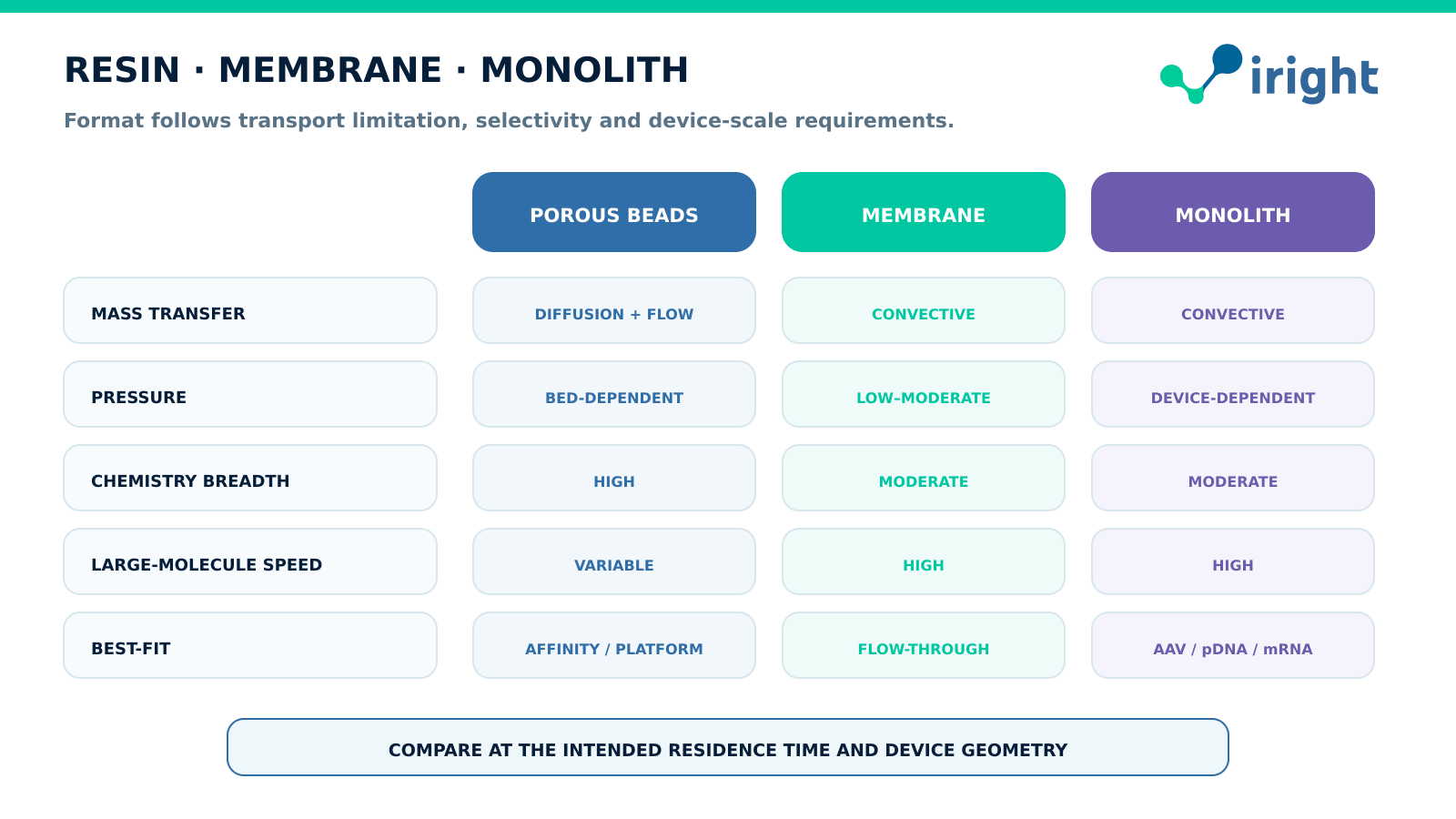
Convective formats often gain productivity with large particles and nucleic acids; packed beads retain advantages in chemistry breadth and familiar scale-up. The molecule and unresolved impurity decide the winner.
A scale-up is successful only when product quality and biological activity survive—not when the chromatogram merely looks similar. Large nucleic acids can be damaged by pumps, narrow valves, high recirculation, air–liquid interfaces and repeated filtration. AAV can aggregate or lose infectivity under low pH, high concentration or unfavorable salt transitions.
For AAV, track total capsid, vector genome, full/empty ratio, aggregate, HCP, residual DNA and infectivity at each step. Calculate recovery by both vector genome and infectious unit when the assay permits. A step can show high qPCR recovery while losing functional potency.
For plasmid DNA, minimize unnecessary high-shear recirculation and monitor topology before and after each unit operation. Pressure is a system signal, not a direct shear measurement; a low-pressure pump can still expose DNA to damaging local stress. For mRNA, control RNase exposure, temperature, hold time and repeated freeze–thaw, and assess integrity after the complete load–wash–elute sequence.
Scale by residence time or device loading only when transport mechanism is comparable. Preserve bed height and superficial velocity for packed columns where pressure allows; use manufacturer-qualified flow-distribution rules for membranes and monoliths. Confirm buffer preparation at scale because small conductivity or pH shifts can move an AAV full/empty cut or alter nucleic-acid binding.
Pool rules must be predetermined. Report peak start and stop by a measurable criterion—UV, conductivity, capsid assay, topology or fraction analytics—not by a visually selected chromatogram after the result is known. Include mass balance for load, flow-through, wash, elution and strip fractions.
How to design a fair comparison
A useful screen compares complete step outcomes at common conditions, then optimizes the finalists. Comparing each supplier at its own favorable method can identify possibility, but it cannot rank candidates fairly.
Use the same feed lot, pre-treatment, temperature, nominal residence time and analytical panel. Include at least three loading densities. For affinity, report dynamic recovery and breakthrough, not static binding alone. For AEX full/empty separation, use the same starting material and pooling target. For oligo-dT, use the same transcript length, poly(A) design and load concentration.
Optimize pH, salt species, conductivity, additives, gradient slope and residence time for the top candidates. This separates a weak medium from a poorly chosen first condition. Use DoE when interactions are likely, especially for AAV AEX and mixed-mode pDNA polishing.
Confirm pressure–flow, residence-time distribution, recovery and impurity clearance in the intended device geometry. Challenge pH, conductivity, load, hold time and feed variability. Evaluate at least multiple lots before claiming a replacement.
The scorecard should report:
AAV: total-capsid and vector-genome recovery, infectious recovery, full/empty/partial distribution, aggregate, HCP, residual DNA, endotoxin, pressure and cycle time;
pDNA: total and supercoiled-mass recovery, topology distribution, genomic DNA, RNA, HCP, endotoxin, pressure and shear-related change;
mRNA: total and intact-mRNA recovery, cap and poly(A) attributes, dsRNA, template DNA, residual protein, translation/potency, pressure and processing time; and
all products: buffer volume, cleanability, leachables where relevant, lot consistency, supply scale and change control.
Do not collapse these results into a single DBC rank. A medium with lower nominal capacity can be superior if it raises acceptable-product recovery, resolves the critical impurity or shortens the process.
China now has credible candidates for mRNA and plasmid purification, but public evidence is much stronger for product availability and supplier specifications than for independent head-to-head studies. That difference must be visible in the article.
Use case | Global reference candidates | Chinese candidates | Public evidence strength | Required substitution evidence |
|---|---|---|---|---|
AAV affinity capture | POROS CaptureSelect AAVX; Capto AVB | No product-specific Chinese AAV affinity medium was verified in the cited public portfolios | Peer-reviewed AAVX and AVB process studies; supplier specifications | Serotype/capsid recovery, infectivity, HCP/DNA, low-pH stability and lot consistency |
AAV AEX polishing | CIMmultus QA; AEX membranes; process AEX beads | NanoMicro AEX portfolio; Bio-Link and Bestchrom AEX or mixed-mode portfolios | Strong general AEX literature, limited public Chinese AAV head-to-head data | Full/empty/partial resolution, vg recovery, infectivity, aggregate, pressure and scale bridge |
pDNA topology | CIM DEAE plus HIC monoliths; established AEX/HIC platforms | Bio-Link MaXtar PlasmidCap HR; Bestchrom Plasmid Cap Mustang | Peer-reviewed monolith process; Chinese product claims are supplier-generated | Supercoiled-mass recovery, topology resolution, endotoxin/genomic DNA, shear and multi-lot data |
Poly(A)+ mRNA capture | CIMmultus Oligo dT; POROS Oligo(dT) and other global media | NanoMicro NanoGel dT20; Bio-Link MonoPS Oligo dT(25) Pro | Peer-reviewed monolith scale-up; Chinese pages provide specifications, not matched independent comparison | Transcript-length panel, DBC at matched residence time, intact recovery, dsRNA/template DNA and CIP lifetime |
NanoMicro is the most clearly documented Chinese entry point for this article because its public portfolio includes a dedicated mRNA affinity product and multiple rigid-polymer IEX formats. Bio-Link provides explicit mRNA and topology-selective pDNA candidates. Bestchrom provides a topology-selective plasmid product and broader chromatography modes. None should be called “equivalent” until the intended molecule passes a matched test.
The most defensible domestic-substitution program is use-case specific:
define the exact molecule, feed and critical impurity;
screen one established reference and two Chinese candidates under common conditions;
optimize finalists independently;
bridge device geometry and scale;
verify multiple lots, cleaning lifetime, change control and supply continuity.
Use the iRight Resin Selector to narrow chemistry and format, then create separate AAV, pDNA and mRNA RFQs. Combining all three into one undifferentiated “nucleic-acid resin” request produces quotations that cannot be technically compared.
Choose the medium that controls the hardest quality attribute with acceptable functional recovery at the intended scale.
For AAV capture, start with capsid-epitope coverage, dynamic recovery and infectivity—not full/empty claims.
For AAV polishing, rank full-capsid enrichment and vector-genome recovery together; include partial capsids and aggregates when the assay can resolve them.
For pDNA, rank supercoiled-mass recovery rather than total DNA recovery.
For mRNA capture, use oligo-dT when poly(A) selectivity solves the capture problem, but add orthogonal dsRNA and intactness control.
For format selection, prefer convective media when large-molecule transport limits productivity, but retain packed beads when ligand chemistry, capacity or established scale-up is decisive.
The winner is not universal. It is the resin, membrane or monolith whose operating window remains robust across feed variability, realistic residence time, pressure limits, cleaning and multiple lots.
This article prioritizes peer-reviewed experiments for performance conclusions, identifies author institutions where they materially help readers judge provenance, and uses FDA guidance only for regulatory context. Supplier pages define product chemistry, catalog scope and candidate specifications; they are not treated as independent comparative evidence. FDA does not test, rank or endorse the chromatography products discussed here.
ResinFrontiers · iRight Bioprocess Chromatography Intelligence Series
Selecting a chromatography resin is not a catalog-matching exercise. It is a separation-design problem: the target molecule, the impurities that must be removed, the operating window and the bioproce…