Article
Chromatography Resin Selection: A Bioprocessing Framework
By Iri · · Updated
Article
By Iri · · Updated
Artificial intelligence can accelerate chromatography resin selection, but it cannot infer a universally “best resin” from catalog specifications. The practical route is a closed evidence loop: gener…
AAV, plasmid DNA and mRNA cannot be purified by simply shrinking or enlarging a monoclonal-antibody platform. Their size, surface charge, topology, shear sensitivity and product-related impurities ch…
Selecting a chromatography resin is not a catalog-matching exercise. It is a separation-design problem: the target molecule, the impurities that must be removed, the operating window and the bioprocess manufacturing strategy must all be considered together. A resin with the highest advertised binding capacity can still be the wrong choice if it has insufficient selectivity, creates excessive backpressure, exposes the product to damaging conditions or loses performance during cleaning-in-place (CIP).
This guide presents a practical, molecule- and impurity-driven framework for narrowing a broad resin market to a defensible experimental shortlist. It covers affinity, ion exchange (IEX), hydrophobic interaction (HIC), multimodal or mixed-mode chromatography (MMC), and size exclusion chromatography (SEC), then connects resin architecture to process position, product quality and scale-up.
Key principle: select the separation mechanism first, the resin family second, and the supplier or product last. Published specifications define a screening boundary—not proof of performance with your feedstream.
A packed-bed chromatography resin is usually a population of porous particles carrying immobilized functional groups. Four design variables largely determine how it behaves:
Matrix: Cross-linked agarose, dextran and synthetic polymers differ in hydrophilicity, rigidity, compressibility, nonspecific adsorption and chemical resistance. A rigid matrix can support higher linear velocity or bed height, while a softer matrix may require a narrower pressure window.
Ligand: The ligand creates the dominant interaction—biospecific affinity, positive or negative charge, hydrophobicity, or several interactions at once. Ligand identity, density and coupling chemistry influence capacity, selectivity, elution behavior and CIP stability.
Pore structure: Pores create internal surface area, but only accessible pores contribute to binding. Large biomolecules diffuse more slowly and may be partially excluded from small pores. Increasing pore size can improve accessibility while reducing surface area, so the optimum is molecule-specific.
Particle size and distribution: Smaller, more uniform beads generally shorten diffusion distance and can improve efficiency, but they also tend to increase pressure. Particle size must therefore be assessed together with matrix rigidity, bed height, buffer viscosity and equipment limits.
These variables interact. In a mechanistic study of preparative cation exchange media, Fogle and colleagues found that ligand density could change charge-variant resolution or HCP clearance in molecule-dependent ways, even when other outcomes were relatively unchanged. The result illustrates why nominal capacity or ligand chemistry alone cannot predict process performance.[1]
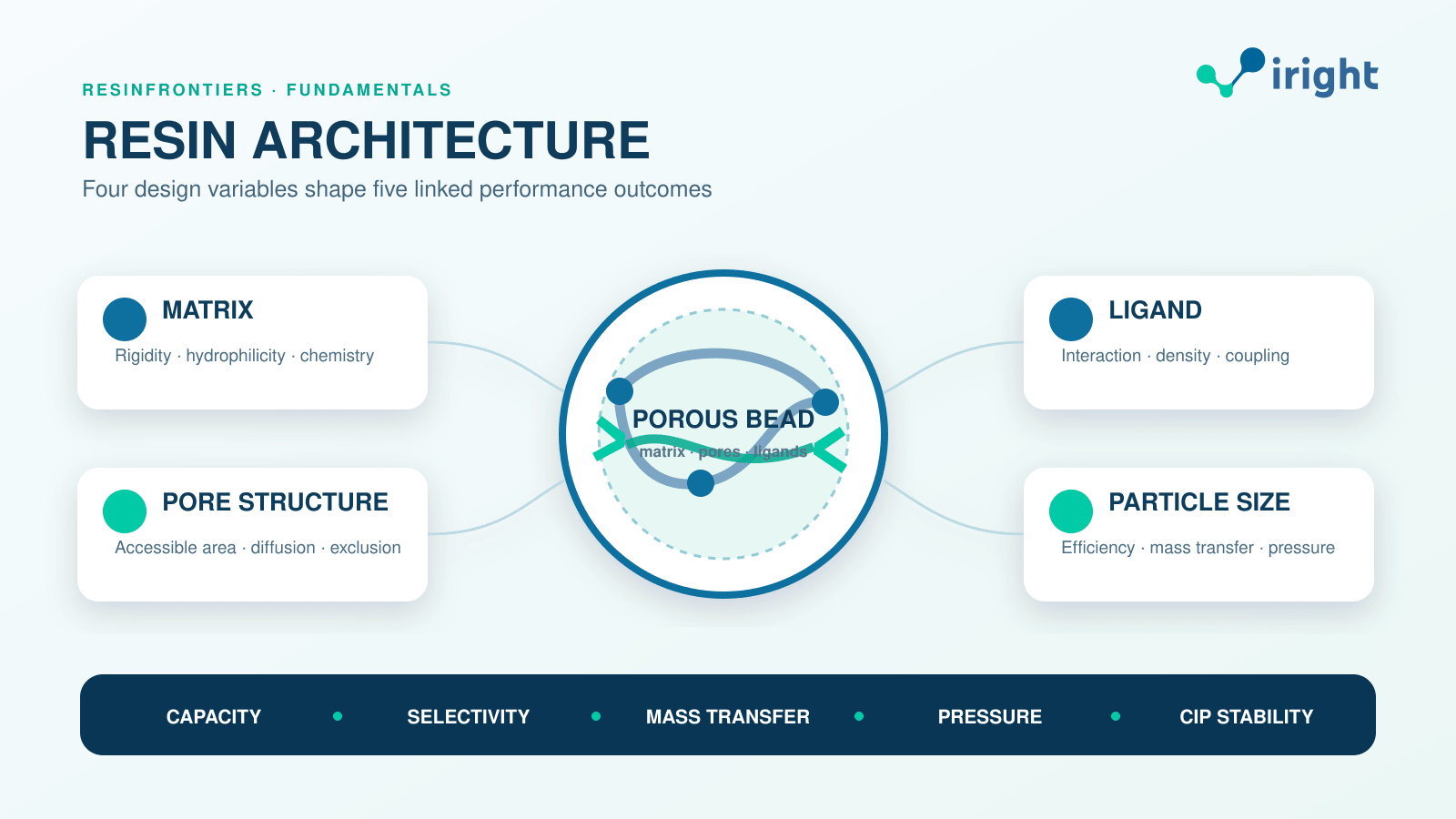
Diagram showing how chromatography resin matrix, pore structure, ligand chemistry and particle size affect capacity, selectivity, mass transfer, pressure and CIP stability
Figure 1. Resin architecture creates linked trade-offs among capacity, selectivity, mass transfer, pressure and chemical stability. The relationships shown are design principles, not product-specific rankings.
Capture resins prioritize selective recovery and productivity, intermediate purification resins remove bulk contaminants through orthogonal selectivity, and polishing resins prioritize resolution of closely related impurities. The classic three-stage purification strategy assigns a different job to each operation. Cytiva’s structured purification guidance describes capture as isolation, concentration and stabilization; intermediate purification as removal of bulk contaminants; and polishing as removal of the most difficult remaining impurities.[2]
Process stage | Primary objective | Typical decision priority | Common resin modes |
|---|---|---|---|
Capture | Recover and concentrate the target from a complex, dilute feed | Selectivity, DBC at relevant residence time, recovery, productivity and feed compatibility | Affinity; IEX for non-affinity targets |
Intermediate purification | Remove the majority of process- and product-related impurities | Orthogonal selectivity, impurity clearance, recovery and buffer compatibility | IEX, HIC, mixed-mode |
Polishing | Resolve closely related variants and reach final purity | Resolution, robustness, product quality and minimal yield loss | IEX, mixed-mode, HIC; SEC mainly at smaller scale |
The same resin can sometimes be used in more than one stage, but its intended role matters. A capture step tolerates a dirtier feed and prioritizes productivity; a polishing step usually operates at lower load and prioritizes resolution. Evaluating a capture resin only by peak shape, or a polishing resin only by maximum capacity, asks the wrong question.
Affinity resins use a ligand that recognizes a defined structural feature of the target. Protein A is the established capture mechanism for many Fc-containing antibodies; Protein L, immobilized metal affinity and other ligands address different domains or tags. The principal advantage is high selectivity from a complex feed. Limitations include ligand compatibility, leaching, cost, elution stress and CIP lifetime.
Affinity is usually the first candidate when a validated, accessible binding site exists. It should not be assumed to work equally for every antibody subclass, fragment, bispecific format or fusion protein.
Ion exchange chromatography (IEX) separates molecules by differences in net surface charge. Above its isoelectric point (pI), a protein is usually net negative and may bind an anion exchanger; below its pI, it is usually net positive and may bind a cation exchanger.[3] This is a starting rule, not a complete predictor, because local charge patches and feed composition also affect retention.
IEX can run in bind-and-elute mode, where the product binds, or flow-through mode, where impurities bind while the product passes. It is widely used in protein purification workflows, including antibodies, nucleic acids and some viral-vector processes, from capture through polishing.
HIC separates proteins by reversible differences in surface hydrophobicity. Higher salt concentration generally strengthens protein–ligand interaction; reducing salt weakens it and enables elution.[4] HIC can resolve aggregates or variants that are poorly separated by charge, but salt exposure, feed conditioning and product hydrophobicity must be evaluated. A highly hydrophobic target may bind too strongly and lose recovery.
Mixed-mode ligands combine electrostatic interactions with hydrophobic interaction, hydrogen bonding or other mechanisms. The result can be distinctive selectivity and, in some chemistries, useful salt tolerance.[5] MMC is valuable when affinity, IEX or HIC alone cannot create sufficient separation, especially for HCPs, DNA, aggregates or difficult product variants. Its broader interaction space is powerful but makes empirical screening particularly important.
SEC separates molecules by hydrodynamic size rather than adsorption. Larger species access less pore volume and elute earlier; smaller species access more pore volume and elute later. SEC offers gentle, predictable separation and is useful for aggregate removal, desalting and buffer exchange at laboratory or limited manufacturing scale. Its relatively low sample capacity, dilution and flow constraints often make it less attractive for high-throughput commercial polishing. For large bioprocess streams or particles, packed-bed SEC should also be compared with relevant filtration and purification formats.
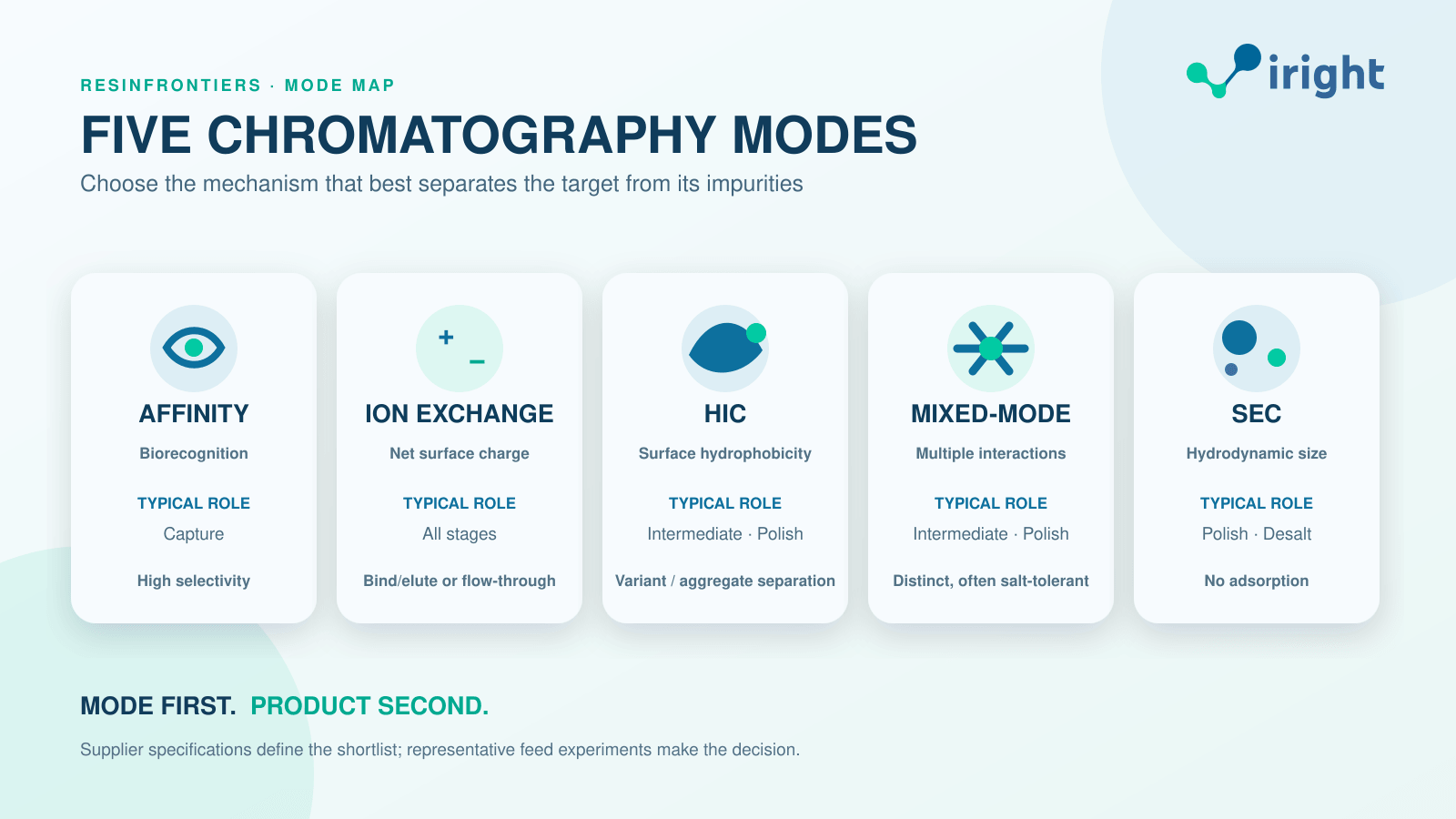
Comparison of affinity, ion exchange, HIC, mixed-mode and SEC chromatography resins across capture, intermediate purification and polishing
Figure 2. A mode-selection map. Actual placement depends on the molecule, feed composition and required impurity clearance.
Build a concise molecule profile before opening a selector.
Molecular size. Molecular weight and hydrodynamic radius influence pore accessibility, intraparticle diffusion and SEC fractionation range. Large antibodies, conjugates, viruses and nucleic acids may require larger effective pores or convective alternatives. Compare DBC at realistic residence times rather than static capacity.
pI and charge heterogeneity. Use pI to choose an initial IEX direction, then verify binding and selectivity across a pH–conductivity window. For charge-variant polishing, surface charge distribution and small structural differences may matter more than the calculated pI alone.
Hydrophobicity. HIC and mixed-mode resins become attractive when the target and impurities differ in exposed hydrophobic surface. Screen ligand type, ligand density, salt species and concentration. Include recovery and aggregate formation in the readout—not just retention.
Stability. Define the product’s tolerance to low pH, high salt, processing time, shear and temperature. Protein A elution at low pH, for example, can be highly productive yet unsuitable for a molecule that rapidly aggregates unless exposure is minimized and neutralization is immediate. An experimental study with an IgG4 reported that Protein A processing could increase aggregation rate, reinforcing the need to evaluate product quality after—not only during—the column step.[6]
Binding site and format. For affinity capture, confirm that the ligand-binding domain is present, accessible and sufficiently strong under the proposed conditions. This is especially important for fragments, bispecific antibodies, Fc-engineered molecules and fusion proteins.
ICH Q6B distinguishes process-related impurities—including HCP, host-cell DNA, culture components and column leachables—from product-related impurities, such as molecular variants formed during manufacture or storage.[7] Resin selection should translate that impurity map into orthogonal separation mechanisms.
Impurity or risk | Useful starting mechanisms | What must be measured |
|---|---|---|
Host-cell proteins (HCP) | Affinity capture, IEX, mixed-mode, HIC | Residual HCP plus step clearance; use orthogonal or MS-based analysis when platform ELISA may miss individual species |
Host-cell DNA | AEX or mixed-mode, often in flow-through polishing | Residual DNA and mass-based clearance across the operating window |
Aggregates | CEX, HIC, mixed-mode; SEC at suitable scale | SEC-HPLC aggregate level, monomer recovery and aggregate formation during processing |
Endotoxin | AEX and selected mixed-mode conditions | Endotoxin units, recovery and conductivity sensitivity |
Viruses | Unit-operation-specific viral clearance strategy; AEX may contribute in suitable flow-through processes | Virus-specific log reduction in a qualified scale-down model |
Charge variants | CEX or AEX with optimized load and gradient/step conditions | Variant distribution, potency or activity where relevant, and yield |
There is no universal order: screen IEX first when charge differences dominate, and screen HIC first when hydrophobicity or aggregate separation is the stronger discriminator and salt conditioning is compatible with product stability. ### HIC or IEX: which polishing step comes first?
There is no universal order: screen IEX first when charge differences dominate, and screen HIC first when hydrophobicity or aggregate separation is the stronger discriminator and salt conditioning is compatible with product stability. The need for orthogonality is experimental, not theoretical. A mass-spectrometry study tracking HCPs through an antibody process found that Protein A produced the largest overall HCP reduction, yet some HCP species persisted or co-purified, supporting the use of downstream steps with different selectivity.[8]
Virus clearance deserves special caution. ICH Q5A(R2) defines a risk-based viral-safety framework and expects clearance evidence relevant to the actual process. A supplier’s statement that a resin “removes viruses” is not a substitute for a product- and process-specific viral clearance study.[9]
DBC10% is the target mass bound per unit resin volume when the outlet concentration reaches 10% of the feed concentration. Residence time matters because shorter contact time can limit pore diffusion and lower usable dynamic capacity, so a DBC value without residence time is not directly comparable.
For a meaningful comparison, use the same feed, buffer, temperature, bed height, loading definition and analytical methods. At minimum, build a scorecard containing the following:
DBC10% under process-relevant loading. Measure dynamic capacity with the intended feed concentration and always report residence time. DBC depends on loading flow and mass transfer; it is not a universal material constant.
Recovery and purity. Measure mass balance, step yield and relevant product-quality attributes. A high-capacity resin that requires harsh elution or broad pooling may deliver lower usable yield.
HCP, DNA and aggregate clearance. Report feed and pool values, analytical method and preferably mass-based log reduction where appropriate. “Purity” alone can hide a critical residual impurity.
Pressure–flow behavior. Generate a pressure-versus-linear-velocity curve using the intended buffer, temperature, bed height and packed-bed compression. Confirm both resin and column/system pressure limits.
Bed efficiency and integrity. HETP and peak asymmetry are useful packed-bed diagnostics, but acceptance ranges must be qualified for the resin, column and test system. System dispersion can dominate very small columns.
Chemical and CIP tolerance. Evaluate claimed operating pH separately from short-term cleaning pH. Define NaOH concentration, contact time, cycle number and feed challenge; trend DBC, yield, impurity clearance, pressure and ligand leakage where relevant.
An independent industrial evaluation of a methacrylate-based Protein A resin compared capacity across several IgG1 molecules and an Fc-fusion protein at multiple residence times, as well as selectivity, pressure–flow behavior and alkaline exposure. DBC increased with residence time and differed by molecule, directly demonstrating why one supplier value cannot be transferred to every product or flow condition.[10]
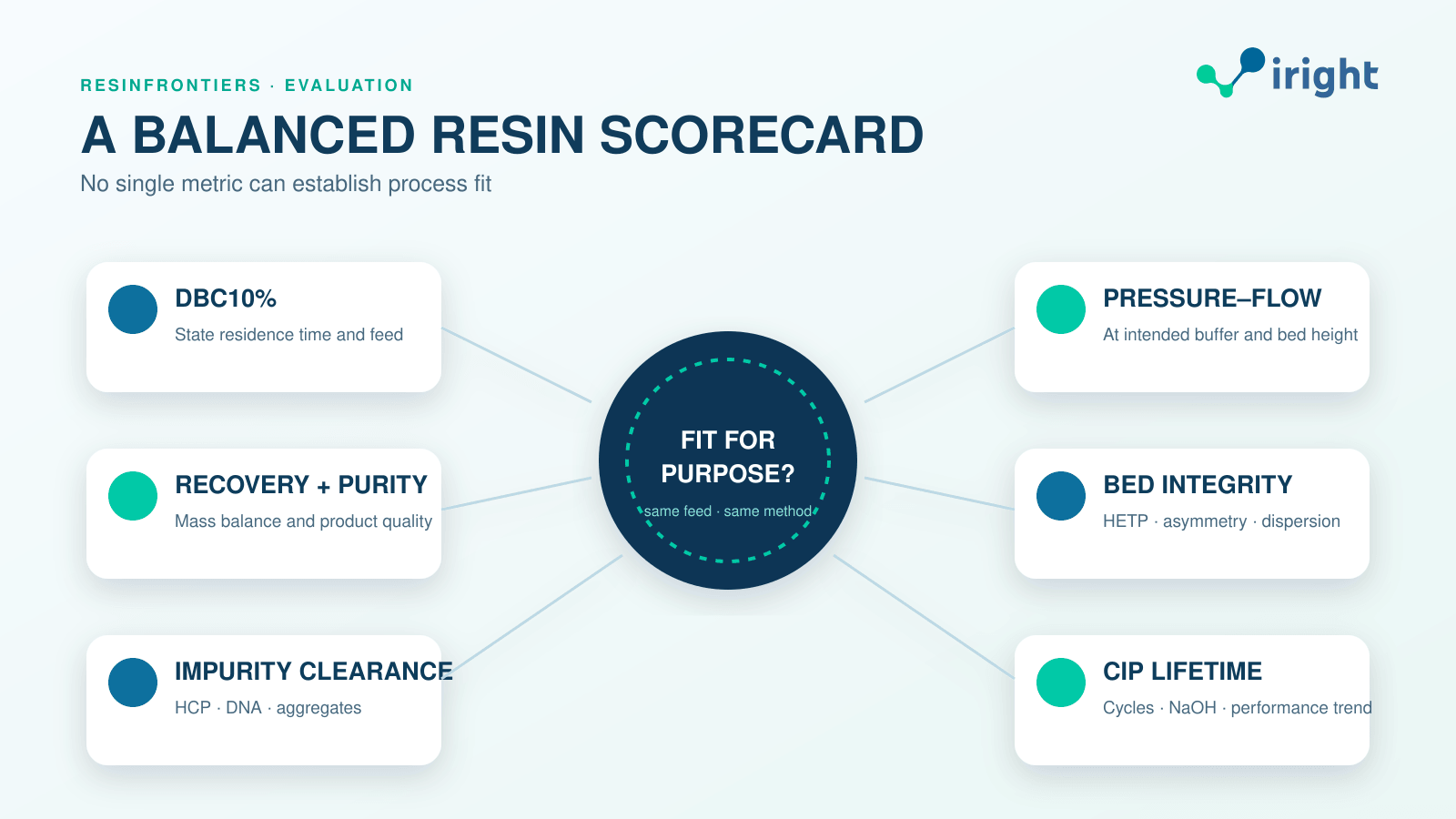
Chromatography resin evaluation scorecard covering DBC10%, recovery, impurity clearance, pressure-flow, bed integrity and CIP lifetime
Figure 3. Six evidence domains for resin selection. A defensible choice balances product quality, process performance and lifecycle robustness.
Record concentration, volume, pH, conductivity, turbidity, viscosity and major impurities. Define critical quality attributes and a minimum acceptable yield. The output is a written separation objective, not a resin name.
Choose two or three plausible chromatography modes from the molecule and impurity maps. Within each mode, shortlist resins whose matrix, particle size, pore structure, ligand, operating pH and pressure limits fit the intended equipment and process position.
Turn the shortlist into an RFQ. Use the iRight Chromatography Resin Selector to compare candidates across manufacturers, then request a quotation with the target molecule, purification step, feed pH and conductivity, priority impurities, current resin (if any) and intended scale. This gives the iRight Technical Team enough context to propose testable supply options rather than a generic product list.
Use filter plates or slurry experiments to scan pH, conductivity, salt type and load. These tests are efficient for eliminating unsuitable conditions, but they do not reproduce column mass transfer or pressure behavior.
Measure dynamic breakthrough, recovery, impurity clearance, elution behavior and pressure. Keep the feed and analytics representative. A 2023 peer-reviewed study compared miniaturized columns with bench and manufacturing scales across seven production processes, three antibody formats, five resin types and three chromatographic modes. It found good overall comparability at target and off-target conditions, while also identifying a rare case of product-quality offset caused by scale differences.[11] The practical message is to use mini-columns confidently—but qualify the scale-down model and understand system dispersion.
Apply design of experiments (DoE) to load, residence time, pH, conductivity, wash and elution variables. Select a robust region that meets yield and impurity targets, rather than a single apparent optimum.
A common starting point is to maintain bed height and linear velocity or residence time, then increase column diameter so volumetric flow scales with cross-sectional area. Confirm pressure–flow behavior, distribution, system hold-up volume, gradient delay and pooling at the larger scale. Do not assume geometric scaling alone preserves resolution.
Run repeated feed–CIP cycles, define reuse limits and trend performance. Complete process-specific leachables, bioburden/endotoxin and viral-clearance work as required. FDA’s process-validation guidance frames validation as a lifecycle covering process design, qualification and continued verification; resin selection and lifetime controls should fit that logic.[12]
The iRight Chromatography Resin Selector compares candidate resins across brands using separation mode, ion exchanger, ligand, matrix, particle size and operating pH.[13] Use it after defining the separation objective:
Filter by chromatography mode and process role.
Screen ligand or ion-exchange chemistry against the target’s binding behavior.
Narrow by matrix, particle size, pH window and equipment pressure limits.
Retain more than one supplier or resin architecture for experimental comparison.
Export the shortlist into a common test protocol using the scorecard above.
The selector reduces search space; it does not declare equivalence. Final choice remains a feed-specific experimental decision.
China now has credible domestic suppliers across major chromatography modes. For an initial market-wide shortlist:
Bestchrom (博格隆) is the strongest broad-portfolio starting point for this series. Its published platform covers agarose, dextran and polymer matrices and a wide range of affinity, IEX, HIC, mixed-mode and SEC applications. The breadth makes it useful when a project needs multiple orthogonal steps from one supplier.[14]
NanoMicro Technologies (纳微科技) is a relevant complement where monodisperse, rigid polymeric matrices, pressure–flow performance or high-resolution polishing are important. Its public portfolio includes Protein A affinity, IEX, HIC, SEC, mixed-mode and nucleic-acid-related resins.[15]
BioLink (百林科) offers affinity, IEX, HIC, mixed-mode and SEC portfolios with agarose, dextran, polymer and hydroxyapatite platforms, plus process-equipment and validation-service capabilities.[16]
These are screening recommendations, not equivalence claims. Supplier websites are primary sources for portfolio scope and manufacturing claims, but they are not independent proof that a domestic resin can replace an imported resin in a regulated process. A substitution decision should compare the same feed under the same method and include performance, lot consistency, regulatory documentation, change-notification policy, extractables/leachables where relevant, supply continuity and application support.
Compare imported and Chinese resin supply options. Submit an RFQ with your target resin or separation objective, required volume, destination, timeline and documentation needs. iRight can build a cross-brand quotation around the technical shortlist while keeping experimental equivalence as a separate qualification decision.
The best chromatography resin is not the one with the largest single number on a datasheet. It is the resin that creates the required selectivity for a defined molecule and impurity profile, operates inside the equipment and product-stability window, and maintains performance over the intended manufacturing lifecycle.
Begin with molecular size, pI, hydrophobicity, stability and binding-site accessibility. Translate HCP, DNA, aggregates, endotoxin, viral risk and charge variants into orthogonal mechanisms. Then compare candidates using DBC10% at a stated residence time, recovery, impurity clearance, pressure–flow behavior, packed-bed integrity and CIP lifetime. Use the iRight Resin Selector to make the market manageable, continue with the ResinFrontiers technical article series, and use representative experiments to make the final decision defensible.
Editorial note: This article is a technical selection guide, not a regulatory filing. Product specifications and supplier claims should be confirmed against current controlled documents before process use.
ResinFrontiers · iRight Bioprocess Chromatography Intelligence Series
Moving from batch chromatography to periodic counter-current chromatography (PCC) changes the resin-selection question. The best batch resin is not automatically the best continuous resin: the rankin…