Article
Standalone Assay or Platform-Locked Workflow? A Procurement Guide for Diagnostic Labs
By Iri ·

Buying a diagnostic assay may appear to be a straightforward product decision. In practice, you may also be committing your laboratory to a specific staining platform, validated protocol, detection system, software environment, and recurring consumable list. Agilent’s July 2026 FDA approval for PD-L1 IHC 28-8 pharmDx provides a clear example because the assay is approved for exclusive use with the Autostainer Link 48. Before you compare quotations, you therefore need to evaluate the complete workflow—not only the assay kit. This guide shows you how to identify platform dependencies, calculate less-visible costs, prepare a stronger RFQ, and plan alternative sourcing without compromising workflow suitability.
Why the Latest PD-L1 IHC Approval Matters for Lab Procurement
A regulatory approval is not only a clinical development. It can also reveal how tightly an assay is connected to an instrument, indication, protocol, and supply system. By reading the approval from a procurement perspective, you can identify commitments that may not appear in the initial kit quotation.
The approval expanded the assay’s clinical applications
On July 14, 2026, Agilent announced that PD-L1 IHC 28-8 pharmDx had received FDA approval as a companion diagnostic for identifying certain patients with esophageal squamous cell carcinoma, gastric cancer, gastroesophageal junction cancer, and esophageal adenocarcinoma who may be eligible for specified nivolumab-based treatments. laboratory, the important procurement signal is that the assay is not simply a general-purpose PD-L1 antibody. Its use is connected to defined specimen requirements, staining procedures, interpretation criteria, treatment contexts, and regulatory documentation.
That distinction affects how you evaluate the product. You need to confirm:
The exact intended use applicable to your laboratory
The tumor indication and scoring requirements
The regional regulatory status
The required instrument and protocol
The documentation needed for implementation
The products required to complete the staining workflow
A product name alone cannot answer these questions. You must review the current instructions for use and indication-specific documentation before purchasing or implementing the assay.
The assay is linked to the Autostainer Link 48
Agilent’s announcement states that the newly approved use of PD-L1 IHC 28-8 pharmDx is exclusive to the Agilent Autostainer Link 48. The manufacturer’s product information also describes the kit as optimized for that platform with a pre-programmed, validated protocol. ns that you are not only buying an assay. Depending on your existing laboratory setup, you may also need to account for:
The Autostainer Link 48 staining instrument
A compatible pretreatment system
Instrument-specific wash and counterstaining reagents
Control materials
Cleaning and maintenance supplies
Operator training
Service and technical support
Current software and protocol requirements
If your laboratory already operates the required platform, adding the assay may fit naturally into your existing pathology workflow. If you use a different staining system, however, the purchase could involve a much larger implementation decision.
The real buying decision is made at the workflow level
A platform-linked assay may provide a standardized and documented workflow, which can be valuable for reproducibility and regulated testing. The limitation is that you have less freedom to replace individual components or move the assay to another instrument.
Before you proceed, consider three questions:
Do you already have the required platform?
Existing instrument ownership can significantly change the cost and implementation timeline.Does the platform support other assays you expect to use?
A broader assay menu may make the investment more practical than purchasing the system for a single test.Can your laboratory maintain the supporting supply chain?
Routine availability of buffers, counterstains, maintenance products, controls, and replacement parts can be as important as availability of the assay kit.
The lowest assay price may therefore be less important than the total cost and operational fit of the complete system.
How to Identify a Platform-Locked Assay Before You Buy
Not every diagnostic product creates the same degree of dependency. You need a consistent way to distinguish an assay that can fit several laboratory setups from one that is approved, validated, or documented only within a specific platform and protocol.
Check whether a named instrument appears in the intended use
Start with the manufacturer’s current instructions for use rather than a distributor description or abbreviated product listing. Look for the instrument, visualization system, software version, pretreatment method, and specimen type specified in the documentation.
A strong platform dependency may exist when:
One instrument is named in the intended use
The protocol is supplied as a locked or pre-programmed procedure
The reagents are packaged for a specific instrument
The assay relies on a named visualization system
Interpretation guidance is based on results produced by one platform
Alternative instrument configurations are not included in the documentation
For PD-L1 IHC 28-8 pharmDx, Agilent identifies the EnVision FLEX visualization system and Autostainer Link 48 as parts of the intended workflow. ant to use another staining platform, do not assume that technical feasibility and approved use are the same. Your laboratory may need additional verification or validation, and the modified workflow may no longer match the manufacturer’s documented intended use.
Map every required workflow component
The assay page or kit description may not show everything you need to run the test. Some reagents are included in the kit, while others must be ordered separately. Equipment, accessories, controls, and maintenance supplies may appear in different sections of the documentation.
Create a workflow map that covers:
Sample preparation
Slide preparation
Target retrieval or pretreatment
Primary antibody incubation
Detection and visualization
Washing and counterstaining
Control processing
Result interpretation
Instrument cleaning and maintenance
Documentation and quality control
For each stage, identify the exact product, catalog number, pack size, storage condition, expected consumption, and replacement interval.
This process prevents a common purchasing problem: receiving the main assay kit but discovering that your laboratory is missing a required buffer, pretreatment accessory, control material, or instrument-specific reagent.
Review how much protocol flexibility you actually have
A research-use antibody may allow you to optimize concentration, incubation time, retrieval conditions, and detection chemistry. A regulated diagnostic assay usually gives you less freedom because performance is connected to a documented workflow.
Before changing any component, determine:
Whether the protocol permits adjustment
Whether the replacement product has documented compatibility
Whether the change affects the intended use
Whether additional verification or validation is required
Whether your laboratory quality system allows the modification
How the change must be recorded and approved
This is particularly important when a substitute appears chemically similar to the original product. Similar composition does not automatically establish equivalent performance within a diagnostic workflow.
Separate technical compatibility from regulatory suitability
Technical compatibility asks whether a product can physically or chemically function in the workflow. Regulatory suitability asks whether the resulting combination is supported for the intended diagnostic use.
These are related but different questions.
For example, a container may fit an instrument, or a staining reagent may produce a visible result, without being included in the assay’s approved or validated configuration. You should therefore avoid describing a cross-brand product as a direct replacement unless you have appropriate documentation and your laboratory has completed the required evaluation.
When comparing alternatives, review:
Intended use
Instrument compatibility
Reagent formulation and concentration
Required controls
Performance documentation
Regional regulatory status
Manufacturer instructions
Internal validation requirements
This review helps you avoid a substitution that reduces purchase cost but creates a larger quality or compliance risk.
Products Required for an Agilent PD-L1 IHC 28-8 Workflow
The PD-L1 IHC 28-8 pharmDx kit covers major assay reagents, but it does not represent the entire purchasing list. To build an operational workflow, you must also evaluate the staining platform, pretreatment equipment, wash buffer, counterstain, and related accessories.
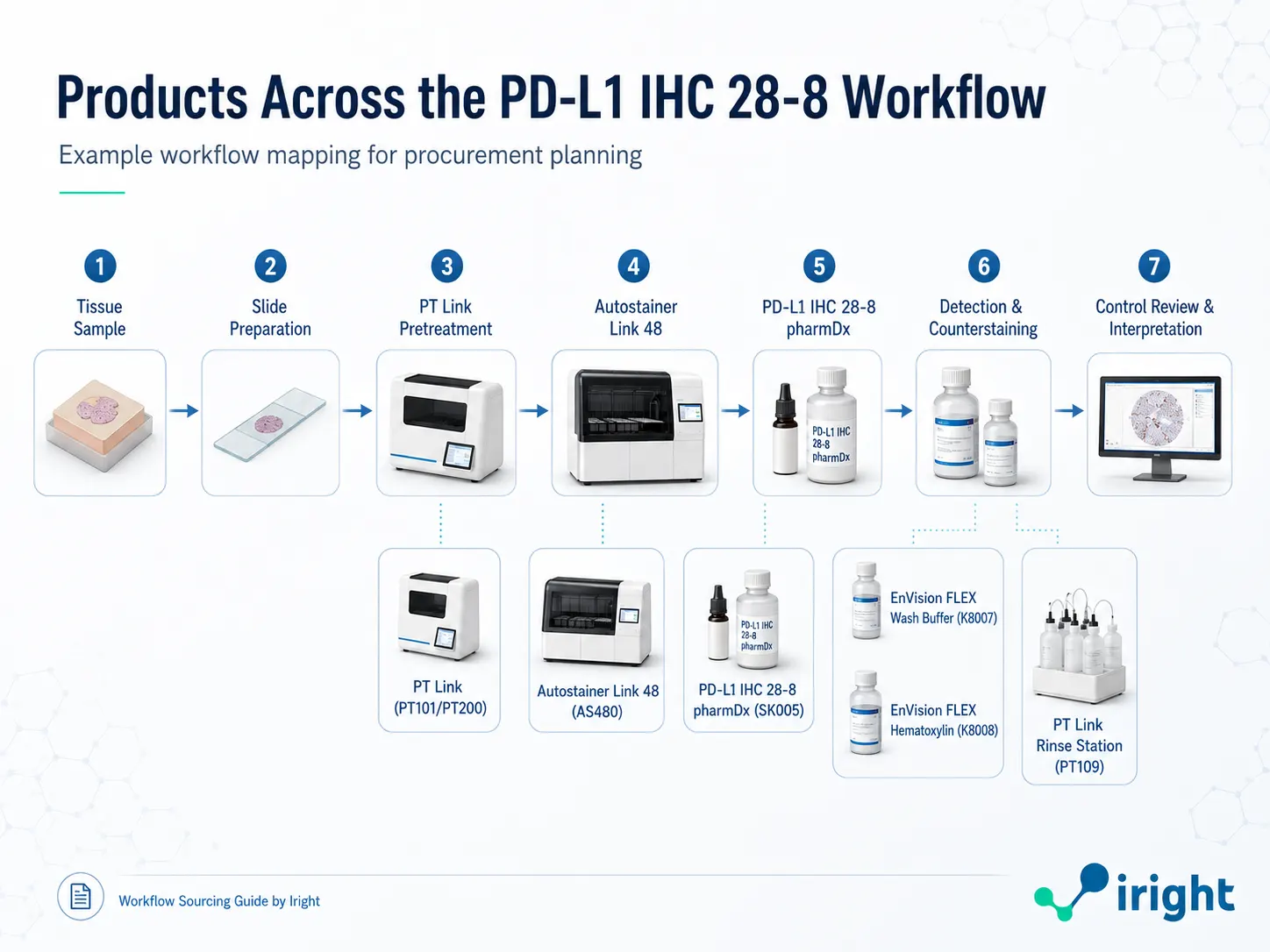
Core products to include in your purchasing assessment
Agilent lists PD-L1 IHC 28-8 pharmDx under product code SK005. Its ordering information also identifies the Autostainer Link 48, EnVision FLEX Wash Buffer, EnVision FLEX Hematoxylin, PT Link, and PT Link Rinse Station as required products that are not included in the assay kit.
Product | Agilent code | Workflow role | What you should confirm |
|---|---|---|---|
SK005 | IVD assay kit for PD-L1 detection | Intended indication, regional status, test volume, expiration date and current IFU | |
Autostainer Link 48 | AS480 | Automated slide-staining platform | Existing instrument availability, capacity, installation, software and service requirements |
K8007 | Wash buffer for the staining workflow | Expected consumption, dilution procedure, storage and backup stock | |
EnVision FLEX Hematoxylin (Link) | K8008 | Counterstain used on the linked platform | Protocol requirements, pack size and routine consumption |
PT Link | PT101/PT200 | Pretreatment and target-retrieval equipment | Instrument model, throughput, maintenance and compatibility with your setup |
PT Link Rinse Station | PT109 | Supports rinsing after pretreatment | Whether the accessory is already available or must be purchased separately |
These are not general substitute recommendations. They are products identified by Agilent as parts of the documented workflow. Product configuration and availability may differ by market, so you should confirm current regional information before ordering.
What is included in the SK005 assay kit?
Agilent describes SK005 as a complete kit containing reagents for 50 tests, together with corresponding negative-control testing capacity and 15 control slides. The listed components include:
EnVision FLEX Target Retrieval Solution, Low pH, 50x
Peroxidase-Blocking Reagent
Monoclonal Rabbit Anti-PD-L1, Clone 28-8
Negative Control Reagent
PD-L1 IHC 28-8 pharmDx Rabbit LINKER
Visualization Reagent-HRP
DAB+ Substrate Buffer
DAB+ Chromogen
DAB Enhancer
Control Slides
These components cover major staining and control functions, but the Autostainer Link 48, wash buffer, hematoxylin, PT Link, and PT Link Rinse Station are listed separately rather than as kit contents. culating how many kits you need, do not base your estimate only on the stated number of tests. You should also consider:
Expected sample volume
Control requirements
Repeat testing
Failed or interrupted runs
Training and verification work
Kit expiration dates
Batch scheduling
Shipping lead time
Safety-stock requirements
A kit that nominally covers your monthly test volume may still be insufficient if you do not account for controls, repeats, and inventory timing.
Build one RFQ for the complete product list
If you request quotations for each component separately, you may receive different lead times, shipping conditions, or availability information that is difficult to compare. A workflow-level RFQ makes dependencies more visible.
Your RFQ should state:
Exact product name and code
Required quantity
Preferred delivery date
Destination country
Minimum acceptable remaining shelf life
Required certificates or documentation
Storage and transport requirements
Whether partial shipment is acceptable
Whether equivalent products may be proposed
Which items cannot be substituted
If you need to source the assay together with staining, pretreatment, and routine workflow supplies, Iright can help you consolidate the requested products into one RFQ, check available product codes, and compare lead times across the list. Any proposed alternative should still be reviewed against the manufacturer’s documentation and your laboratory’s quality requirements.
Hidden Costs of Platform-Locked Diagnostic Workflows
The assay quotation shows only part of your financial commitment. A platform-linked workflow can also create equipment, service, validation, inventory, and switching costs. Evaluating these factors early gives you a more realistic cost-per-test estimate and reduces the chance of an unexpected implementation delay.
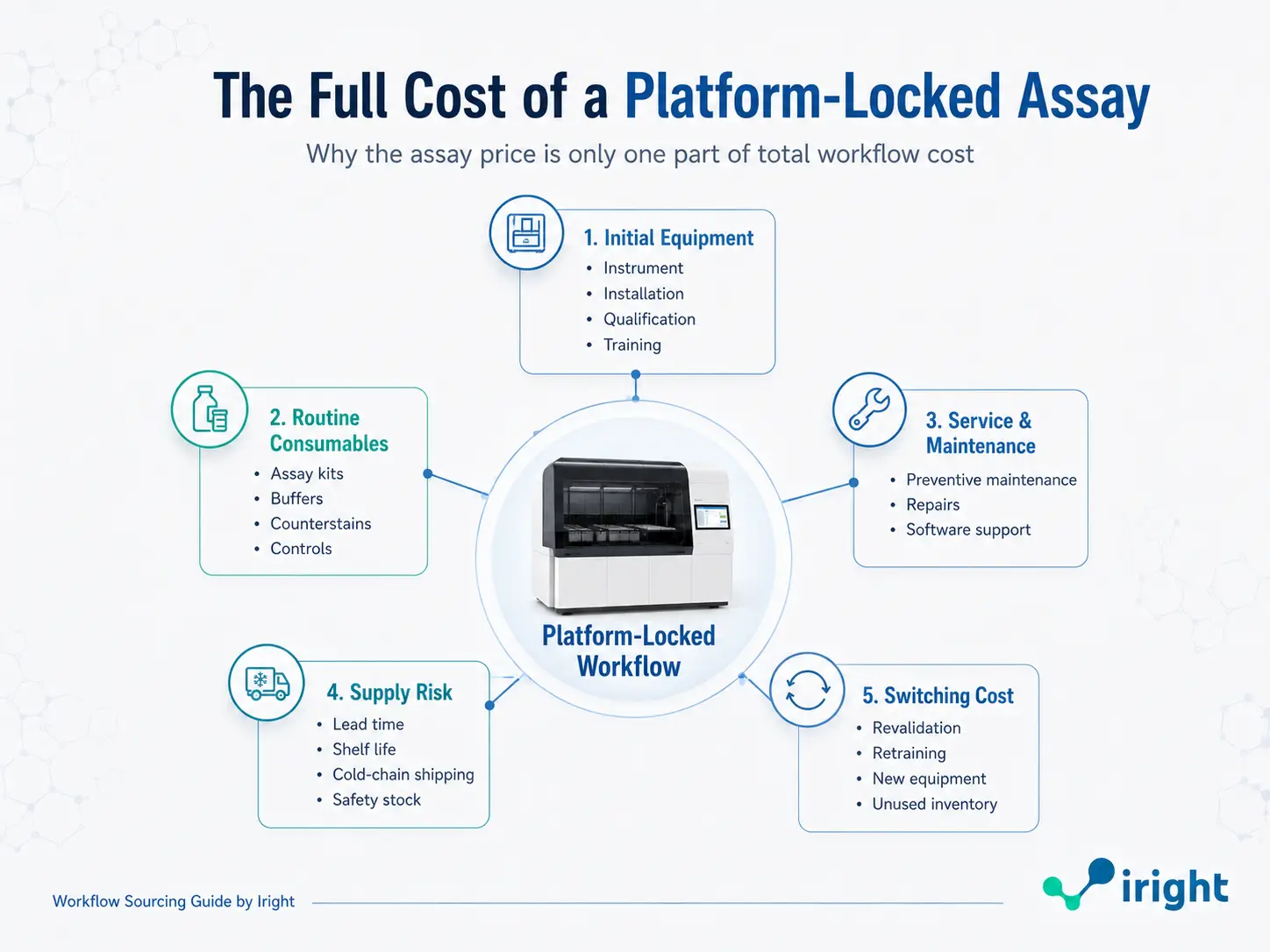
Initial equipment and implementation costs
If your laboratory does not already have the required platform, your initial cost may include more than the staining instrument.
You may need to budget for:
Instrument acquisition or leasing
Pretreatment equipment
Rinse stations and accessories
Installation and qualification
Software configuration
Laboratory information system integration
Staff training
Initial verification or validation
Workspace preparation
Electrical, ventilation, or utility requirements
You should also consider instrument capacity. A system may be technically suitable but unable to process your expected slide volume within the required turnaround time.
Compare your average demand with:
Slides per run
Runs per working day
Pretreatment capacity
Assay batching requirements
Maintenance downtime
Peak demand
Repeat-test volume
This operational assessment can reveal whether you need one instrument, additional capacity, or a different scheduling plan.
Recurring reagents, controls, and maintenance
Once the workflow is operational, you will continue purchasing more than the assay itself. Your cost-per-test model should account for all regularly consumed materials.
Include:
Assay kit consumption
Wash buffer
Counterstain
Control materials
Cleaning reagents
Slide and labeling supplies
Pretreatment reagents
Maintenance parts
Waste-disposal requirements
Repeat testing
Preventive maintenance
Service contracts
Some costs are predictable, while others depend on test volume and instrument use. A low-volume laboratory may face higher waste because opened reagents expire before they are fully consumed. A high-volume laboratory may need larger safety stock to protect against supply delays.
Instead of calculating only the assay-kit price divided by its stated test capacity, track your actual reagent use over several runs. This gives you a more useful estimate for budgeting and quotation comparison.
Supply continuity and lead-time exposure
Platform-specific supplies can create a single-source risk. If one required reagent becomes unavailable, you may be unable to run the assay even when every other component is in stock.
Review the supply position of each essential item:
Supply question | Why it matters |
Is the product routinely stocked in your region? | International sourcing may increase delivery time and shipping complexity. |
Does it require controlled-temperature shipping? | A cold-chain requirement can limit emergency delivery options. |
What remaining shelf life will you receive? | Short shelf life can increase waste or force smaller, more frequent orders. |
Is there a minimum order quantity? | You may need to buy more than your immediate consumption requires. |
Can the product be replaced temporarily? | Some platform-specific reagents may have no straightforward alternative. |
How early should you reorder? | Reorder timing should reflect lead time, consumption and safety stock. |
Is there a product-change notification process? | Code, formulation or packaging changes may require internal review. |
Do not apply one safety-stock rule to every product. A general laboratory supply that is available from several brands may need less buffer stock than a platform-specific reagent with controlled shipping and a long lead time.
Future expansion and switching costs
A platform may support additional assays that your laboratory expects to introduce, making the initial investment easier to justify. On the other hand, a narrow assay menu or uncertain future demand can increase the risk of underused equipment.
Before purchasing, ask:
Which additional assays can run on the platform?
Are they relevant to your laboratory’s expected test menu?
Will new assays require separate software or training?
Are different detection systems or accessories needed?
Can existing staff operate the expanded workflow?
How quickly can new tests be implemented?
You should also estimate the cost of leaving the platform later. Switching may require new equipment, new protocols, staff retraining, fresh verification work, updated documentation, and disposal of unused inventory.
A platform-locked assay is not automatically a poor choice. The problem arises when you evaluate only the immediate assay need and ignore the longer-term workflow commitment.
Questions to Ask Before Sending a Companion Diagnostic RFQ
A well-structured RFQ does more than request a price. It helps you expose differences in platform requirements, included components, documentation, shelf life, service support, and delivery conditions before you compare suppliers or commit your laboratory to one workflow.
Cover the complete workflow in your RFQ
Use the following questions to make your request more precise:
RFQ category | Questions to include |
Assay identity | What are the exact product name, code, kit size, intended use and regional regulatory status? |
Platform requirements | Which staining instrument, software version, visualization system and pretreatment equipment are required? |
Kit contents | Which reagents, controls and accessories are included? |
Additional products | Which buffers, counterstains, maintenance products and accessories must be ordered separately? |
Documentation | Can current IFUs, SDS documents, certificates, storage conditions and lot information be provided? |
Shelf life | What remaining shelf life will the products have at delivery? |
Shipping | What temperature, packaging and transport conditions apply? |
Availability | What is the current lead time, stock status and minimum order quantity? |
Instrument support | Who provides installation, qualification, training, maintenance and repair? |
Product changes | How are formulation, catalog-number, software or regulatory changes communicated? |
Substitution | Which items are platform-specific, and where may alternatives be evaluated? |
The answers allow you to compare complete offers rather than quotations that appear similar but cover different parts of the workflow.
Compare total workflow cost instead of kit price
Use a consistent structure when comparing purchasing options:
1. Initial cost
Instrument
Accessories
Installation
Qualification
Training
Initial inventory
2. Routine cost
Assay kits
Supporting reagents
Controls
Cleaning products
Staff time
Waste and repeat testing
3. Support cost
Preventive maintenance
Service agreement
Repairs
Software support
Replacement parts
4. Supply-risk cost
Safety stock
Expedited shipping
Short shelf life
Minimum order quantities
Inventory write-offs
5. Switching cost
New equipment
New validation work
Retraining
Documentation updates
Unused platform-specific inventory
You do not need to assign an exact monetary value to every risk immediately. Even a low, medium, or high classification can make differences between two workflows easier to see.
Ask for product-level and workflow-level lead times
A supplier may quote a short lead time for the assay kit while another required component remains unavailable. Ask for separate lead-time information for every item and identify which components determine the earliest realistic start date.
For example, distinguish between:
Assay availability
Instrument availability
Installation date
Pretreatment equipment availability
Supporting reagent availability
Documentation delivery
Training schedule
Your laboratory cannot begin the complete workflow until all critical components are ready.
Iright can help you organize assay, instrument, consumable, documentation, and delivery requirements into a consolidated RFQ. You can also request cross-brand comparison, alternative-brand evaluation, and product-level lead-time checks before selecting a procurement path.
How to Build a Second-Source Strategy Without Compromising Compatibility
Second sourcing can reduce supply risk, but it must be applied selectively. You should first separate components that are fixed by the regulated or validated workflow from general supplies that may allow further evaluation. This prevents cost-saving efforts from creating a larger performance or compliance problem.
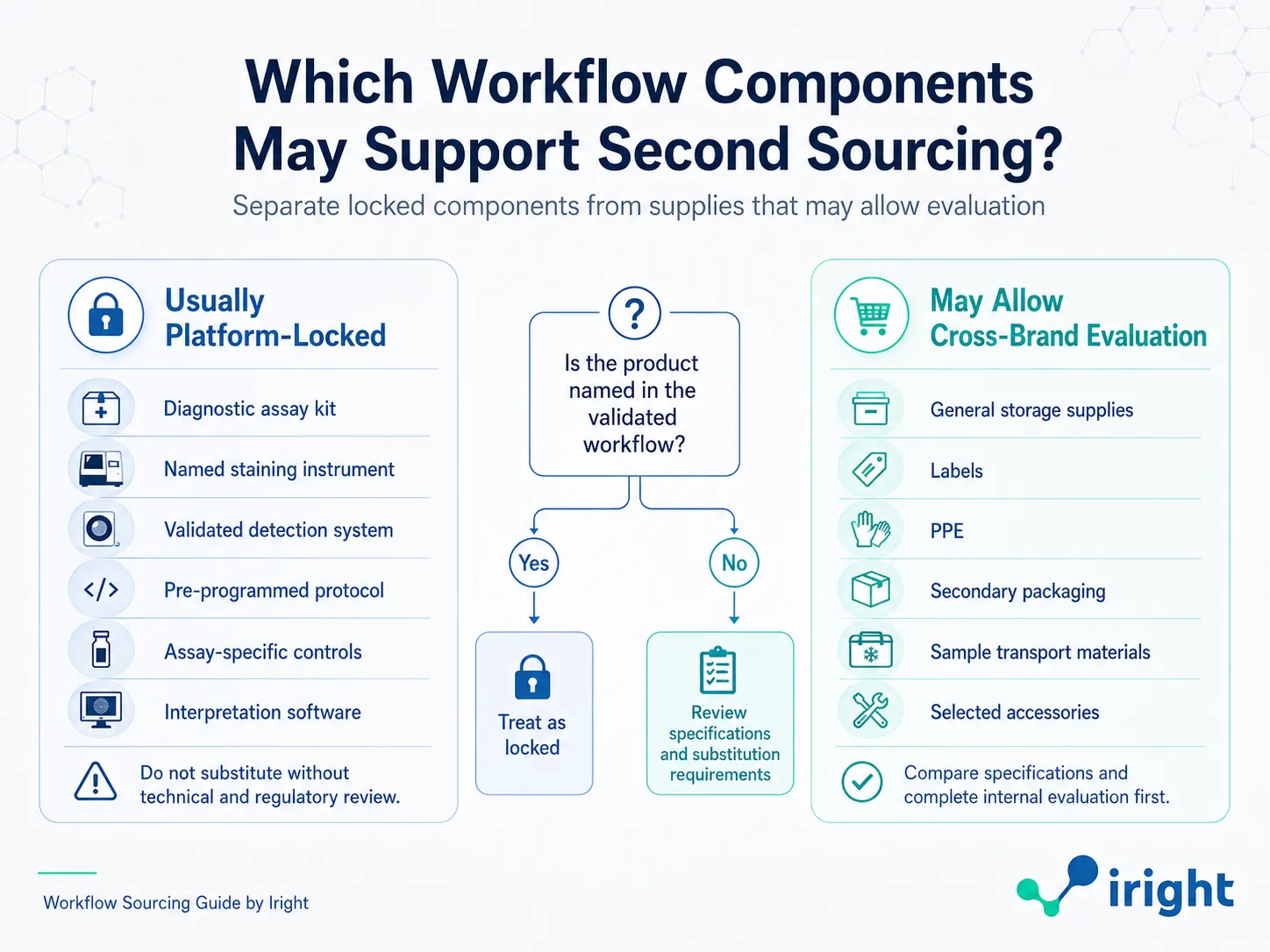
Separate locked components from potentially flexible supplies
For a platform-linked diagnostic assay, the more restricted group may include:
The regulated assay kit
The named staining instrument
The specified visualization system
Pre-programmed protocols
Assay-specific controls
Interpretation materials
Instrument-specific software
These components should not be replaced casually because they define or directly affect the documented workflow.
Potentially more flexible categories may include:
General slide-storage products
Secondary packaging
Routine PPE
Sample-transport materials
Labels and general identification supplies
Selected laboratory accessories
Non-assay-specific preparation consumables
However, “potentially flexible” does not mean “automatically interchangeable.” You still need to compare material, dimensions, chemical resistance, sterility, storage conditions, and intended use.
Define the supply problem before searching for an alternative
Your second-source strategy should respond to a specific risk. Common triggers include:
Repeated back orders
Long international lead times
Regional unavailability
Product discontinuation
High minimum order quantities
Short remaining shelf life
Unstable pricing
Excessive dependence on one supplier
Once you understand the problem, you can choose an appropriate response.
For example:
A long lead time may justify larger safety stock.
A short shelf life may require smaller and more frequent orders.
Regional unavailability may justify evaluating another supply channel.
A discontinued general consumable may require a cross-brand comparison.
A discontinued platform-specific reagent may require manufacturer guidance or a larger workflow review.
Not every supply problem is solved by replacing the product.
Use a controlled alternative-evaluation process
When a component may allow substitution, follow a documented sequence:
Confirm whether substitution is permitted.
Identify the specifications that must remain unchanged.
Collect the manufacturer’s technical documentation.
Compare format, dimensions, material, concentration, purity, and storage.
Review instrument and workflow compatibility.
Assess regulatory and quality-system implications.
Complete any required internal testing.
Record the approval decision.
Define when the alternative may be purchased.
Continue monitoring product and supplier performance.
This process gives your procurement team clearer boundaries. Buyers know which alternatives are already approved, which require technical review, and which products must remain unchanged.
If you are comparing diagnostic workflows or preparing a second-source plan, Iright can help map the requested products, check current product codes and lead times, and identify supplies that may warrant cross-brand evaluation. Final compatibility and regulatory decisions should remain with your laboratory’s qualified technical and quality teams.
Conclusion
A platform-locked assay can offer a standardized, documented diagnostic workflow, but you should assess it as more than a reagent purchase. Before committing, confirm the intended use, required instrument, supporting consumables, protocol restrictions, service needs, and regional product availability. You should also compare total workflow cost, identify single-source risks, and distinguish fixed components from supplies that may support controlled alternative sourcing. A detailed RFQ makes these dependencies visible before they affect implementation. By evaluating the full system rather than the kit price alone, you can choose a workflow that fits your laboratory’s technical requirements, purchasing capacity, and long-term testing plans.