Description
The 3A9 monoclonal antibody recognizes CD195, which is also known as the chemokine receptor, CCR5, a seven transmembrane-spanning G protein-associated molecule. The 3A9 antibody also reportedly cross-reacts with human CCR8. Results of epitope mapping and sequence comparison between CCR5 and CCR8 reveals that the first three amino acid residues for these two receptors are identical: MDY (Met-Asp-Tyr). CCR5 belongs to the β-chemokine receptor family. It is expressed on subsets of T lymphocytes, NK cells, monocytes, macrophages, and dendritic cells. CCR5 regulates lymphocyte chemotaxis activation and transendothelial migration during inflammation. It signals a response to at least three chemokines: RANTES and macrophage inflammatory protein-1 (MIP-1) α and β. Additionally, CCR5 has been found to be a co-receptor for macrophage-tropic HIV-1 on CD4+ cells, a characteristic that is important in viral transmission. Reports indicate that individuals who have partial (heterozygous) or complete (homozygous) deletion of the CCR5 allele, demonstrate resistance to HIV infection. CCR5 has been clustered as CD195 in the VIIth HLDA workshop.
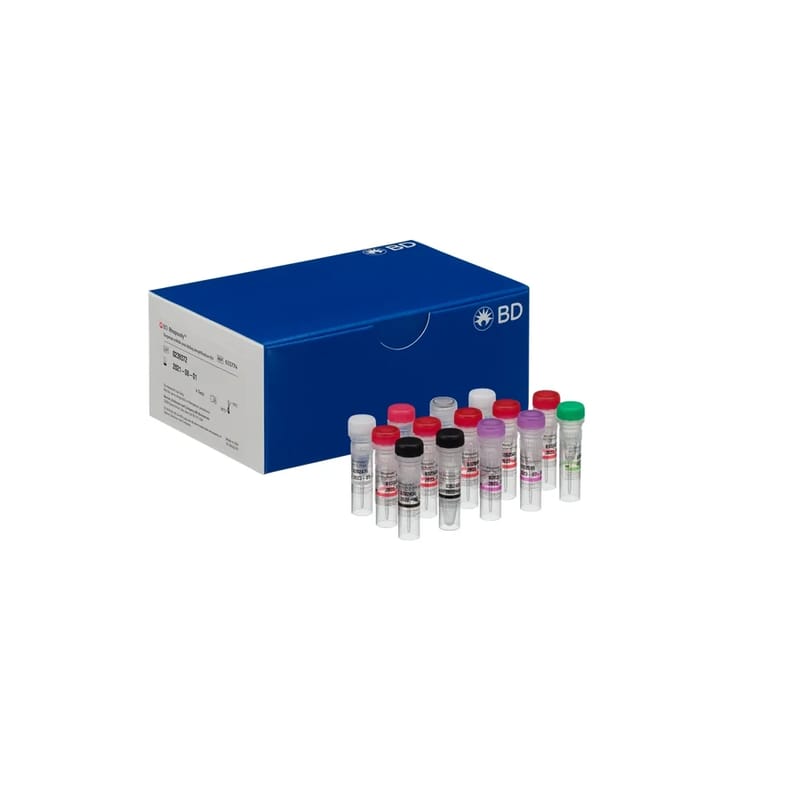
Store undiluted at 4°C and protected from prolonged exposure to light. Do not freeze. The monoclonal antibody was purified from tissue culture supernatant or ascites by affinity chromatography. The antibody was conjugated with BD Horizon BV421 under optimum conditions, and unconjugated antibody and free BD Horizon BV421 were removed.
1. This reagent has been pre-diluted for use at the recommended Volume per Test. We typically use 1 × 10^6 cells in a 100-µl experimental sample (a test).
2. An isotype control should be used at the same concentration as the antibody of interest.
3. Caution: Sodium azide yields highly toxic hydrazoic acid under acidic conditions. Dilute azide compounds in running water before discarding to avoid accumulation of potentially explosive deposits in plumbing.
4. Source of all serum proteins is from USDA inspected abattoirs located in the United States.
5. Pacific Blue™ is a trademark of Molecular Probes, Inc., Eugene, OR.
6. Species cross-reactivity detected in product development may not have been confirmed on every format and/or application.
7. For fluorochrome spectra and suitable instrument settings, please refer to our Multicolor Flow Cytometry web page at www.bdbiosciences.com/colors.
8. Please refer to www.bdbiosciences.com/us/s/resources for technical protocols.