Article
How ADC Research Growth Could Change Oncology Lab Procurement
By Iri ·

Antibody-drug conjugates (ADCs) continue to attract significant attention across oncology research. On July 6, 2026, Novartis announced an agreement to acquire Myricx Bio, a biotechnology company developing ADCs with N-myristoyltransferase inhibitor payloads. The proposed transaction includes a USD 1.1 billion upfront payment and up to USD 400 million in potential milestone payments.
For your laboratory, the practical question is not simply whether ADC research is attracting investment. You also need to consider how changing research priorities could affect assay development, sample preparation, analytical testing, product availability, and procurement planning.
What Novartis’s Myricx Bio Acquisition Signals for Oncology Research
The acquisition announcement provides useful industry context, but it does not prove that every ADC research program will expand at the same pace. Instead, it reinforces the importance of ADC platforms within oncology research and highlights why laboratories may need more flexible supply planning.
A continued focus on next-generation ADC platforms
Novartis stated that Myricx Bio has developed a payload platform based on NMT inhibitors. The company is also developing lead assets directed toward B7-H3 and HER2, with potential applications across multiple solid tumor settings.
The announcement describes a proposed acquisition rather than an approved medicine or a guaranteed commercial outcome. The transaction remains subject to customary closing conditions, including regulatory approvals. You should therefore treat it as an investment and research-direction signal, not as evidence that a specific ADC product is ready for clinical or commercial use.
Why this matters to laboratory procurement
When pharmaceutical companies continue investing in a research platform, laboratories may need to support a wider range of activities, including:
Target expression and binding studies
Cell-based screening
Assay development and optimization
Protein and conjugate characterization
Sample preparation
Analytical separation and detection
Repeat testing and validation experiments
These activities do not necessarily require the same products. They may also involve different brands, pack sizes, technical specifications, and documentation requirements. Procurement teams that plan only around individual product names may therefore face delays when research requirements change.
Which Parts of an ADC Research Program Create Procurement Pressure
ADC research can involve several connected laboratory activities, from early target evaluation to analytical characterization. Each stage creates different procurement requirements, so you should map products to the specific research task rather than treating all ADC-related supplies as one category.
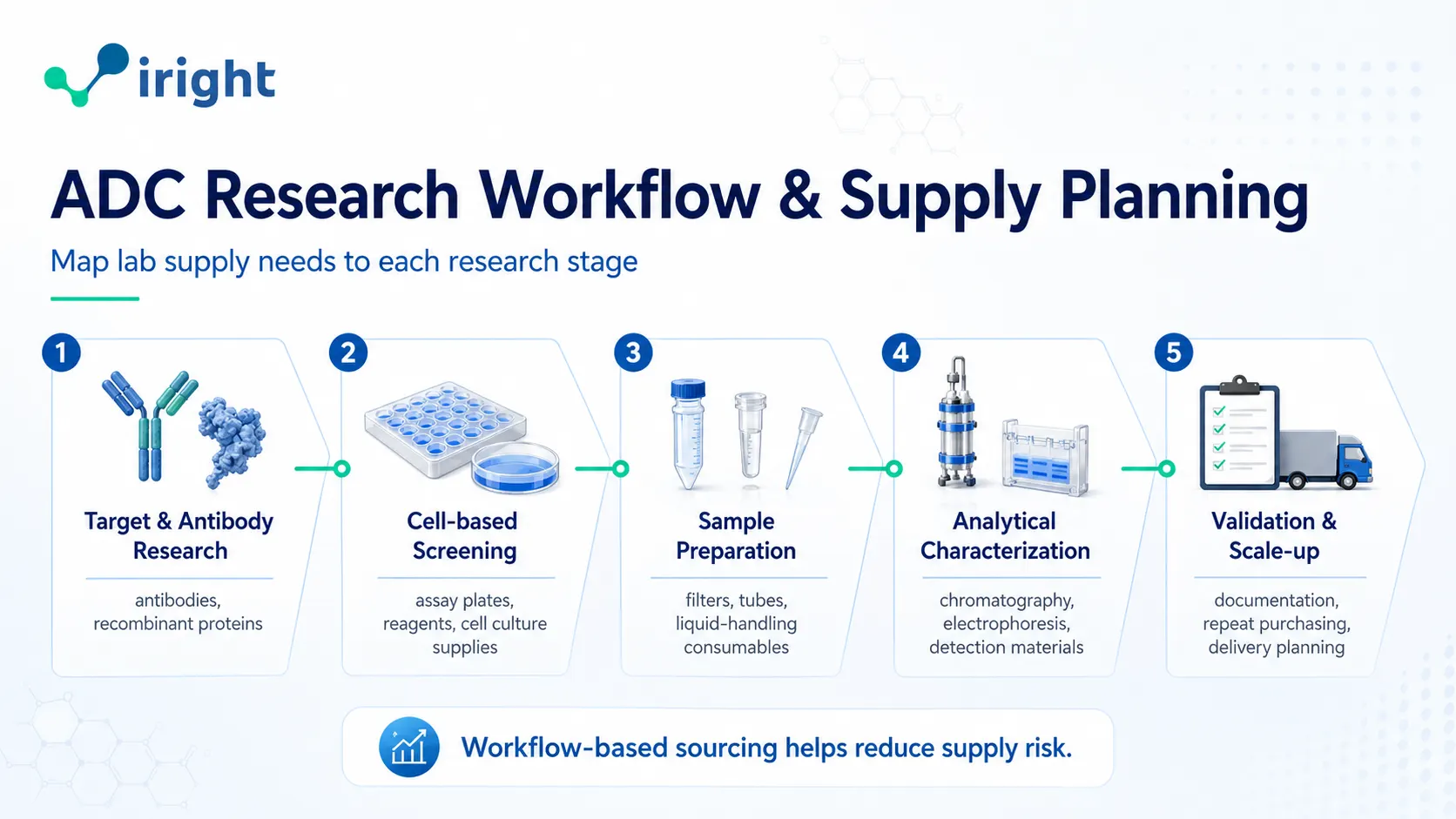
Target and antibody-related research materials
Early-stage research may require materials for target expression studies, binding evaluation, specificity testing, and cell-based validation. Depending on the experimental design, your team may need to compare products according to:
Target specificity
Species reactivity
Antibody format
Concentration
Purification method
Application validation
Storage requirements
Available technical documentation
Products that appear similar in a catalog may not be suitable for the same experiment. For example, an antibody validated for western blotting may not automatically be appropriate for flow cytometry, immunofluorescence, or a cell-based binding assay.
Cell-based assay and screening supplies
Cell-based experiments may require a combination of assay reagents, plates, culture vessels, controls, liquid-handling consumables, and detection materials. The right selection depends on your cell model, assay format, readout method, throughput, and sample volume.
You should also consider whether your team expects to repeat the same assay over several development cycles. A product that works for a small pilot study may not be the most practical option for larger screening volumes or ongoing optimization.
Sample preparation and analytical testing supplies
As research progresses, your laboratory may need supplies for sample clarification, filtration, separation, protein analysis, electrophoresis, immunodetection, or chromatography-based testing.
These products often affect more than one stage of the workflow. A change in filter material, membrane format, column specification, or sample container can influence handling requirements and analytical consistency. Procurement should therefore involve both the laboratory user and the person responsible for sourcing.
Why You Should Plan ADC Supplies by Workflow Stage
Research requirements usually change as a project moves from discovery to assay development and validation. A workflow-stage approach helps you avoid buying excessive quantities too early while ensuring that critical materials are available when the next milestone begins.
Early-stage discovery and target evaluation
During exploratory research, you may prioritize flexibility over large-volume purchasing. Your team may need smaller pack sizes, screening materials, exploratory reagents, and general cell-based supplies while the experimental design is still evolving.
At this stage, avoid locking the laboratory into a large inventory based on assumptions about future demand. Instead, confirm the immediate research objective, expected number of experiments, product storage conditions, and approximate replenishment time.
Assay development and optimization
Assay development usually requires closer comparison of performance-related factors, such as:
Sensitivity
Dynamic range
Reproducibility
Signal-to-background ratio
Control materials
Plate format
Reagent stability
Sample volume
Detection compatibility
This phase may involve repeated testing and adjustments to the protocol. You should confirm whether the selected product is available in a suitable pack size and whether the supplier can provide consistent information for future orders.
Validation and scale-up preparation
Later-stage work may place greater emphasis on lot continuity, repeatability, technical documents, larger pack sizes, and predictable delivery schedules. However, higher research volume does not automatically mean that every product should be purchased in the largest available format.
Your purchasing decision should reflect the actual study schedule, expected consumption, storage capacity, internal acceptance criteria, and likelihood of repeat orders. A carefully planned procurement list can reduce both stockouts and unnecessary inventory.
How to Evaluate Laboratory Suppliers Beyond Product Price
Price is an important procurement factor, but it is only one part of the decision. For a research workflow with multiple dependencies, a lower unit price may not provide real value if the product has a long lead time, unsuitable documentation, or unclear technical specifications.
Check technical fit before comparing brands
Before comparing prices, confirm whether each product meets the requirements of your intended application. Important questions include:
Is the product validated for your application?
Does it match your sample type?
Is the target or species reactivity suitable?
Does the format fit your assay design?
Are the storage and handling conditions manageable?
Can you obtain the required technical documentation?
Will your team need internal validation before use?
Iright can help organize product information, compare available brands, and check lead-time details, but your laboratory should determine whether an option meets its experimental acceptance criteria.
Compare availability and lead-time risk
You should review more than the supplier’s published product description. Where possible, check:
Current stock status
Estimated lead time
Backorder risk
Regional availability
Shelf life
Minimum order quantity
Delivery schedule for repeat purchases
Lead-time information can change, especially for specialized research products. A realistic procurement plan should distinguish between confirmed availability, estimated delivery, and products that require additional supplier verification.
Assess support for repeat purchasing
If you expect to use a product throughout multiple research stages, consider whether the supplier can support repeat purchasing. Useful support may include quotation updates, product documentation, alternative options, order history, and communication when availability changes.
A supplier that helps you organize this information can reduce administrative work and make it easier to respond when your preferred product becomes unavailable.
When Should You Consider Alternative Laboratory Brands?
Alternative sourcing should be treated as a structured evaluation process, not as an automatic switch to the cheapest product. The purpose is to create additional procurement options while protecting technical requirements and internal quality controls.
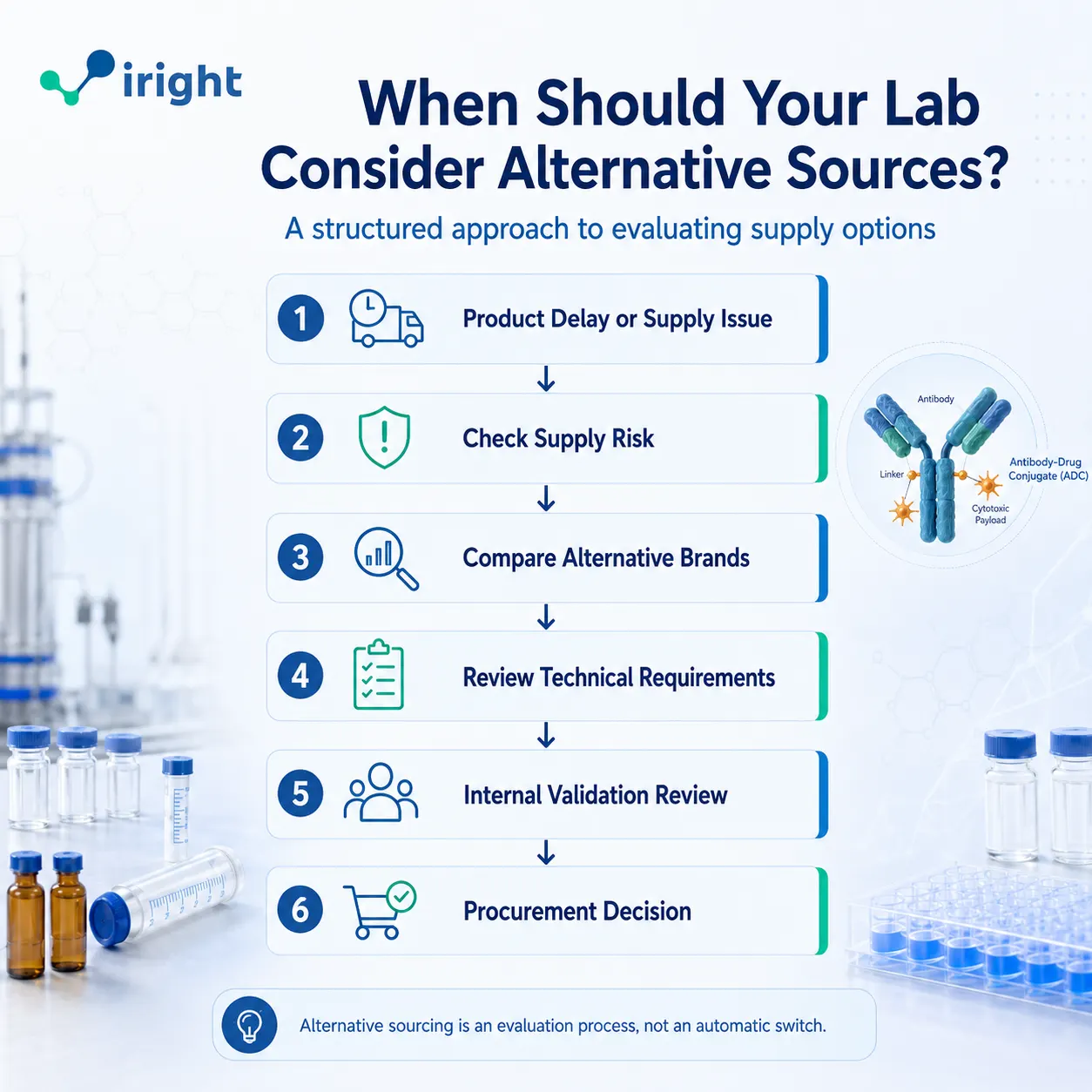
Common triggers for alternative sourcing
You may need to investigate alternative brands when you encounter:
Extended or uncertain lead times
Product discontinuation
Repeated availability problems
Unsuitable pack sizes
Unexpected minimum order quantities
Missing technical documents
Regional delivery limitations
Recurrent supply interruptions
These situations do not necessarily mean that the original product is unsuitable. They indicate that your team may benefit from having additional options available for review before a supply problem affects the research schedule.
Build a structured alternative-product shortlist
A useful shortlist should include:
Original brand and catalog number
Alternative brand and catalog number
Intended application
Key technical specifications
Pack size
Storage requirements
Documentation availability
Estimated lead time
Internal validation status
Reason for considering the alternative
This format allows your laboratory, procurement team, and technical reviewers to compare options using the same criteria.
Separate procurement alternatives from experimental replacements
You should distinguish between a procurement alternative and a validated experimental replacement.
A procurement alternative is a candidate product identified for price, availability, or lead-time comparison. An experimental replacement is a product that your laboratory has reviewed and accepted for a specific application. The first category supports sourcing decisions; the second requires technical assessment according to your internal procedures.
A supplier can help identify and organize candidates, but your research team should decide whether an alternative is suitable for actual experimental use.
What to Include in an Oncology Research Supply RFQ
A well-structured request for quotation allows suppliers to provide more comparable information. If you send only a product name or general description, you may receive quotations that differ in pack size, specifications, delivery assumptions, or substitution terms.
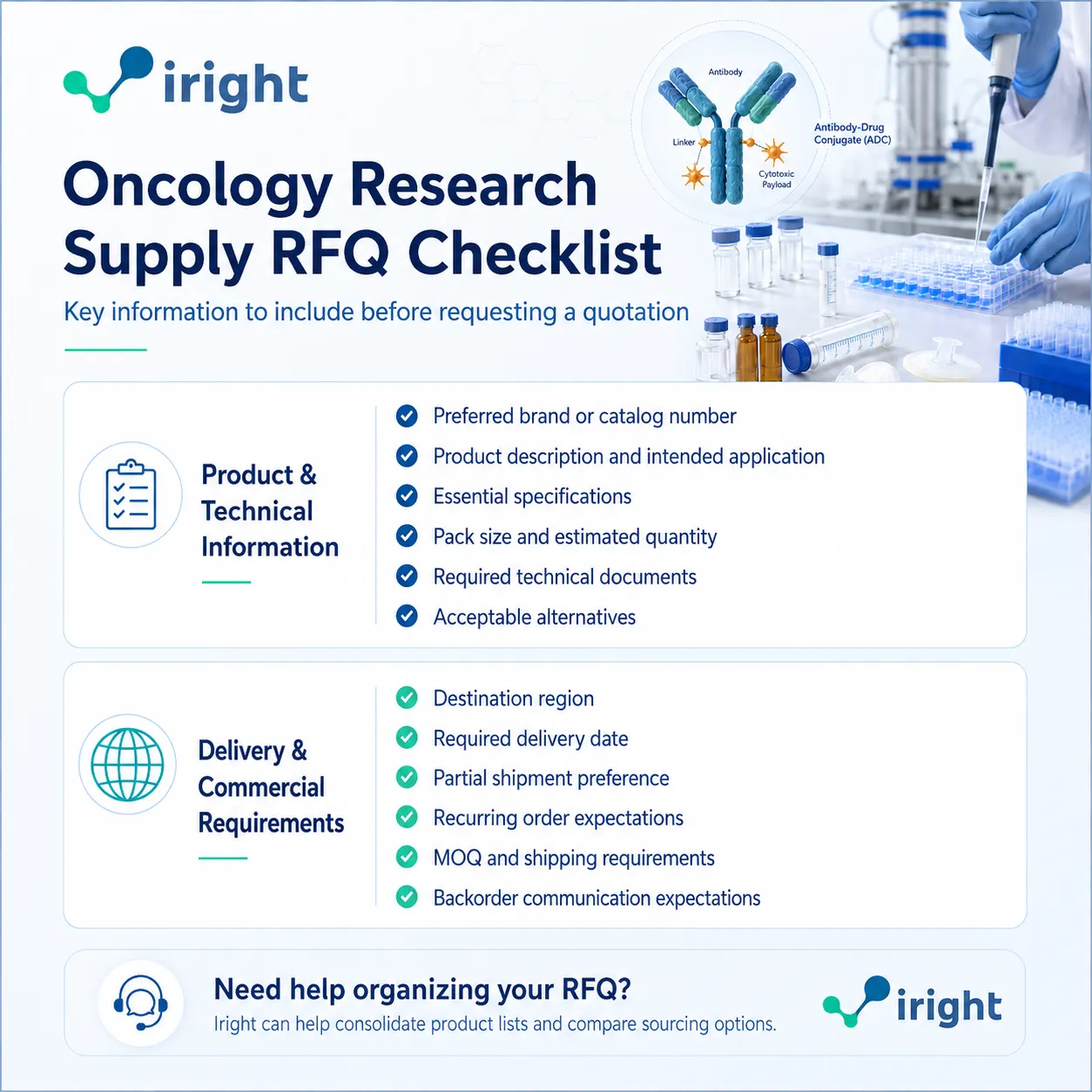
Product and technical information
Your RFQ should include:
Preferred brand or acceptable brands
Catalog number
Product description
Intended application
Essential specifications
Pack size
Estimated quantity
Required technical documents
Acceptable alternative options
You should clearly separate mandatory requirements from preferred features. This helps suppliers identify genuine alternatives without treating every product attribute as equally important.
Delivery and commercial requirements
Also include:
Destination country or region
Required delivery date
Partial shipment preference
Recurring order expectations
Quotation validity
Minimum order quantity
Shipping requirements
Backorder communication expectations
If the research schedule is tied to a specific milestone, state the relevant timing clearly. This gives suppliers a better basis for checking availability and proposing practical delivery options.
Consolidate related purchasing needs
If several products support the same research stage, consider including them in one consolidated RFQ. This can make it easier to compare total sourcing requirements, identify products with similar delivery risks, and evaluate whether different brands can be combined within the same purchasing plan.
Iright can help consolidate product lists, compare cross-brand options, check sourcing details, and organize RFQ information for oncology research supplies.
How to Build a More Resilient Procurement Plan for ADC Research
A resilient procurement plan does not require you to purchase every item far in advance. It requires you to understand which products are critical, which products are replaceable, and which decisions require technical review.
Divide products into critical and replaceable categories
You can classify supplies into several groups:
Workflow-critical products
Products requiring internal validation
General laboratory consumables
Products with several acceptable options
Products that should not be substituted without approval
This classification helps determine where you need early purchasing, closer inventory monitoring, or a documented backup option.
Forecast demand by research milestone
Instead of estimating annual demand in isolation, connect purchasing forecasts to specific milestones:
Study initiation
Assay setup
Optimization cycles
Validation runs
Repeat experiments
Expanded screening or testing
Your forecast will not be perfect, especially during early-stage research. A rolling review process is more useful than relying on one fixed estimate created months in advance.
Maintain a documented backup plan
Your backup plan may include:
Alternative product candidates
Secondary supplier contacts
Lead-time review dates
Reorder points
Inventory checks
Technical document storage
Internal approval steps for substitutions
The objective is to give your team time to respond before a delay becomes a research interruption.
Practical Checklist for Oncology Lab Procurement Teams
Use the following questions before issuing an RFQ or approving a new product. They help you connect technical requirements with purchasing decisions and make it easier to identify supply risks early.
Which research stage will use the product?
Which technical specifications are essential?
Is the product critical to the workflow?
How much will you need before the next milestone?
What documentation must the supplier provide?
What lead time can your schedule tolerate?
Are alternative brands acceptable for review?
Will the product require internal validation?
Can related products be quoted together?
What will you do if the preferred product is delayed?
Conclusion: Turn Research Momentum Into Better Procurement Planning
ADC research investment may continue to influence oncology workflows, but the practical procurement impact will depend on your laboratory’s research stage, assay design, validation requirements, and supply model. You can reduce avoidable disruption by mapping products to workflow stages, checking technical fit before comparing prices, monitoring lead times, and preparing alternatives for review. A clear RFQ can also help you compare brands and delivery options more effectively. When you need broader sourcing support, Iright can help organize cross-brand options, consolidate product requests, and structure a more practical laboratory supply plan around your research priorities.