Article
Generative AI and the Experimental Bottleneck in Drug Discovery
By Iri ·
Abstract
Generative AI expands the range of targets, molecules and experiments a drug discovery team can consider. It also changes how teams spend their experimental capacity. A large candidate list has value when the team can make suitable samples, run informative assays and use the results to decide what to advance. Drawing on peer-reviewed research and a hypothetical first-round screen, this article examines what AI contributes, where practical bottlenecks emerge and how to measure whether a campaign reaches reproducible evidence faster.
Consider a hypothetical discovery campaign. A model generates 100 candidates against a chosen target. The team can make and test only 10 in its first round. Taking the top 10 by score is easy to justify if the score has already been shown to predict the project’s experimental endpoint. On a new target, the team may have little evidence that the score can make such fine distinctions. The first batch now has two jobs: finding candidates worth following and learning which predictions can guide the next batch.
The numbers are illustrative. The constraint is the point. In generative AI drug discovery, model throughput and experimental throughput are measured in different units, and one can rise far faster than the other. A thousand plausible structures do little for a project if the team cannot obtain interpretable results on the first few. Conversely, a modest batch can change the direction of a programme if it answers a question the model alone cannot resolve.
What generative AI contributes
Research hypotheses. A language-model system can review literature, organise evidence around a disease mechanism and suggest a target or a drug repurposing opportunity. The proposal is most useful when it identifies the intervention, the biological model, the readout and the result that would weaken the hypothesis. A plausible mechanism still depends on assumptions about the disease context. The team needs to know which links are supported by direct evidence and which rest on inference. The same evidence can justify an exploratory experiment while leaving the therapeutic rationale open. [1, 2]
Molecular design and prioritisation. Generative models can propose sequences or structures, and prediction and scoring models can help select which candidates to make. These functions can sit in the same pipeline. In an antibody design study published in Nature, researchers coupled an adapted RFdiffusion model with yeast-display screening to identify binders directed at selected epitopes, then used structural methods to check the binding pose for selected designs. In small-molecule design, the MolGenBench study examined 17 methods across de novo design and hit-to-lead optimisation, reporting limitations that included generalisation to unseen targets. A benchmark of model outputs and experimentally measured behaviour in a specific campaign answer different questions. [3, 4]
Experiment proposals and analysis. AI can suggest a readout, outline controls or analyse data for a follow-up decision. Scientific review still has to connect the proposed measurement to the project question. A cell assay may use a tractable proxy for a disease mechanism, for example, while the candidate ultimately needs evidence in a more relevant model. The team can use the simpler assay for an early decision if it records what the proxy measures and what follow-up would be needed. [1, 2]
These contributions have different success criteria. A hypothesis may be valuable because it yields a decisive experiment. A molecular design is judged against measurements on the resulting material. An analysis is judged by whether its inputs, assumptions and results can be checked. Treating all three as a single measure of “AI performance” can hide where a campaign is actually gaining time.
A project brief can make these differences explicit. For a target proposal, record the proposed mechanism and the strongest plausible competing explanation. For a molecular design, specify the intended form, such as an antibody format or a defined small-molecule structure, together with the measurements that would justify advancing it. For an assay proposal, document the biological context, controls and expected readout. A useful brief also records where the output came from, including the version of the model or ranking method and the information available to it. These details matter when the team tries to reproduce a selection or explain why a promising design disappeared from the shortlist.
Two campaigns using generative AI can therefore have very different starting points. One may begin with a well-characterised target, a reliable reference compound and an assay already running. The main question is whether a new design adds useful activity or diversity. Another may start with a disease hypothesis and no established experimental model. There, the first valuable output may be a feasible experiment that tests the mechanism. A shared label such as “AI-designed” conveys little about which uncertainty remains, or how much time and work will be needed to resolve it. [2]
What the Robin study shows
In a peer-reviewed Nature study, Ghareeb and colleagues used the multi-agent system Robin to explore a repurposing strategy for dry age-related macular degeneration. Robin proposed increasing phagocytosis by retinal pigment epithelium (RPE) cells and suggested ways to measure that change. The researchers chose ARPE-19 cells for the initial screen and used pH-sensitive fluorescent beads as a practical assay substrate. They performed the experiments and returned the resulting flow-cytometry data to the system for analysis. The study reports that a human analysis of the initial data confirmed the corresponding AI analysis. [1]
The experiment changed the questions the team could ask. Robin proposed RNA sequencing after an initial result with the ROCK inhibitor Y-27632 and generated further candidate hypotheses. Later experiments reported that ripasudil increased phagocytosis in cultured RPE models, including primary human RPE cells. These were in vitro findings on a defined phenotype. Whether ripasudil would benefit patients with dry age-related macular degeneration remained a clinical question. The study illustrates AI-assisted hypothesis generation, experimental iteration and analysis in a particular project, with laboratory choices and measurements made by researchers. [1]
Two details matter for research teams. First, the exact experiment was shaped by what the lab could run. Cell and reagent availability affected the first implementation. Second, the first result helped determine the follow-up. The initial screen did not need to settle the full disease mechanism to be useful. It needed to yield an interpretable result that justified a more focused next experiment. A campaign can therefore gain value from AI when the system proposes a testable question and the lab can obtain a result that narrows the possibilities.
The same distinction applies when reading a headline about a model designing a drug. In Robin, the example involved the proposed use of existing compounds in a new research context. In the RFdiffusion study, the researchers designed new antibody sequences and then measured and structurally characterised selected examples. A repurposing proposal and a new sequence can both be valuable, but they start with different amounts of prior information and require different preparation. In a repurposing campaign, an existing compound may be obtainable quickly while the disease-relevant assay still needs work. In a sequence-design campaign, the assay can be ready while the team waits for candidate expression and purification. [1, 3]
Allocating a limited experimental budget
Return to the hypothetical batch of 10. Start with the decision that the first experiment must support. An antibody programme may need to know whether several sequence families can produce recoverable, soluble material and bind the target. A small-molecule programme may first need to check whether chemically distinct candidates show concentration-dependent activity in a qualified biochemical assay. These are different uses of the same budget. The answer determines which samples belong in the batch and how many wells, sensors or instrument runs they actually require.
A team could reserve some slots for high-ranked candidates, some for distinct sequence or chemical families, and some for candidates that help test the model’s ranking or a design trade-off. For instance, a high-scoring antibody and a related variant with an improved expression prediction could help the team decide which designs to prioritise in a second round. Those two candidates can be more informative together than two near-identical top-ranked sequences. The right mix depends on what the team already knows about the target and assay. The 10 slots refer to candidate samples. Controls, repeats and any confirmation runs need capacity of their own.
Selection factor | First-round question | How it can change the batch |
|---|---|---|
Prediction and uncertainty | Has the score shown value for this endpoint and target class? | Retain strong candidates and include a few informative comparisons where the ranking is uncertain. |
Candidate diversity | How many distinct sequence families or chemical scaffolds are represented? | Spread the batch across families when testing several near-duplicates would yield similar information. |
Sample feasibility | Can the molecules be sourced, made or expressed on the first-round timeline? | Flag candidates that need a different route and retain that reason in the record. |
Assay readiness | Are the target reagent, controls, detection method and instrument time available? | Give priority to measurements that can produce an interpretable result and reserve time for repeats. |
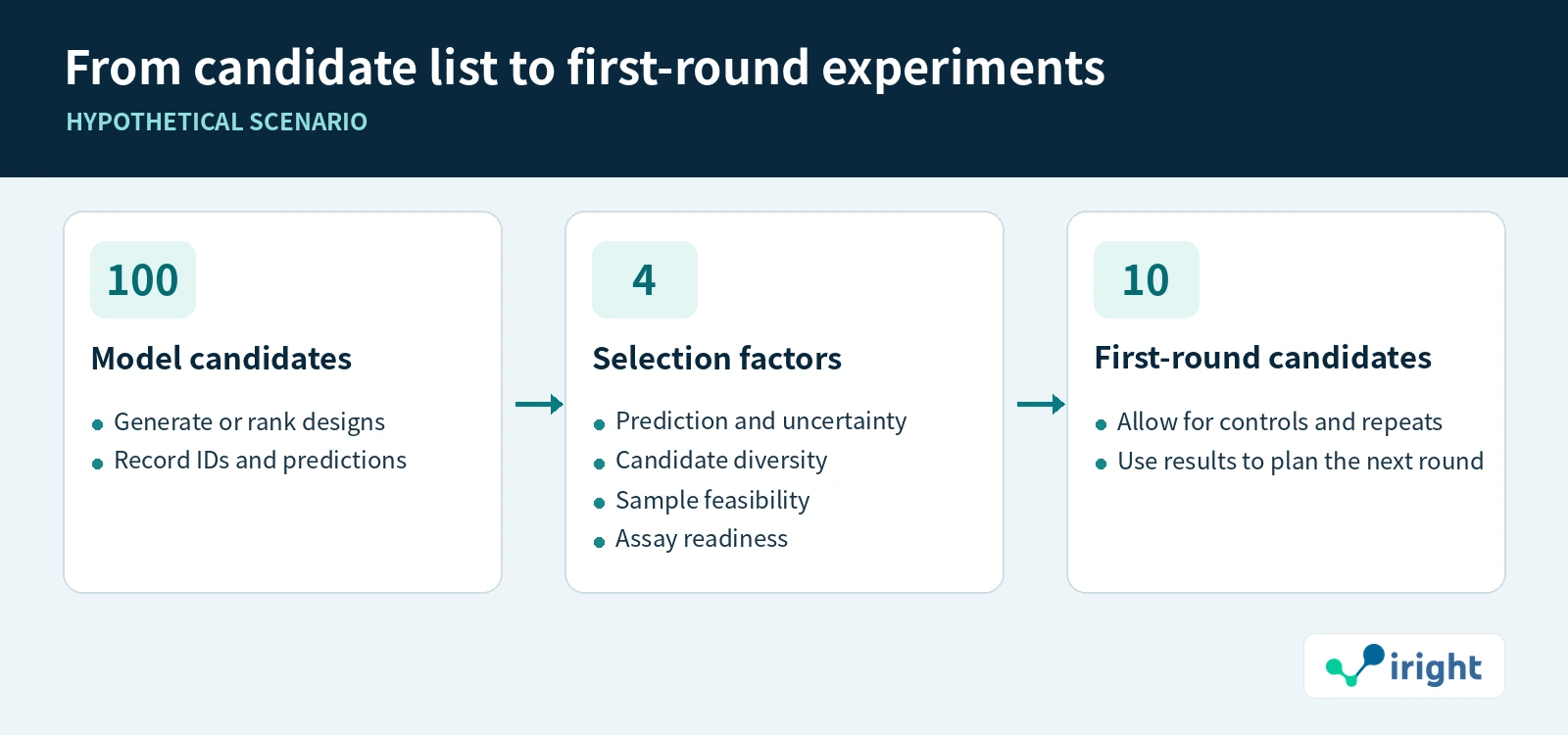
Illustrative scenario. The 10 slots are for candidate samples. Plan controls and repeats separately.
One illustrative allocation would be four high-ranked candidates from different families, three additional candidates selected for diversity, and three chosen as informative comparisons. One comparison might pair a highly ranked design with a nearby variant expected to express better. Another might probe a family the model ranks lower but that has a credible route to production. A candidate can satisfy more than one criterion. The allocation is a way to spell out what the team wants to learn before the results arrive. It also makes clear which candidates the team is still leaving untested.
In practice, the ranking and the assay have to describe the same biological question. A model may rank candidates against an isolated domain while the laboratory works with a larger protein construct. A project may also score a single binding pose while the experimental endpoint is a change in cellular function. Before sampling from the ranked list, check how closely the physical target and the readout match the assumptions behind the score. A difference can be acceptable when it is deliberate. It matters when an apparent failure would otherwise lead the team to discard an entire design family.
Assay readiness can dominate the economics of that decision. A target protein may exist in several constructs or formats, and the one available on the required timeline may differ from the biological form assumed by the model. A target or assay format change can alter what the measurement means. Before committing a full batch, the team can check that the assay responds to a reference where one exists, that the negative or background control is informative and that the proposed readout supports the intended comparison. An assay that has not yet established a usable window can consume the entire batch without resolving the model question. [2, 5]
Record why each candidate entered the batch and what outcome would change its priority. If a candidate was excluded because it could not be made in time, carry that status forward. It can still be relevant once the synthesis route changes. If the team uses a model score to choose nearly all candidates, the first round mainly evaluates the top of that ranking. If it also includes a defined set of comparisons, the team can learn where to put the next increment of experimental capacity. Both choices can be appropriate. They answer different questions.
The team can also plan explicitly for three possible first-round outcomes. If the strongest score group yields reproducible activity across several families, expand the families while retaining an independent confirmation step. If activity appears mainly in one family regardless of score, investigate that family’s shared features and whether the apparent pattern could come from the assay. If most samples are unavailable or unsuitable, treat material preparation as the next experiment. That may mean reviewing the synthesis route or expression strategy before spending the remaining assay budget. A simple decision plan written in advance makes the first round useful across a wider range of outcomes.
Sample Preparation and Assay Capacity: The Experimental Bottleneck
A protein sequence must first become a sample that the assay can use. Expression host, construct format, solubility and recovery after purification affect whether there is enough suitable material to test. A candidate that gives poor recovery or an ambiguous quality-control result should be tracked at that stage. A candidate with acceptable material and no detectable binding under the assay conditions has a different experimental outcome. Combining those results under a single “failed” label makes it harder to decide whether to adjust the construct, change how the sample is prepared or move on to another candidate. [2, 3]
The same principle applies to small molecules. Identity, purity, handling and solubility can affect a biological measurement. A strong signal in a primary assay may require follow-up to check whether it reflects the intended activity or interference with the detection method. A measurement using a different detection principle can be appropriate when that distinction affects whether a candidate advances. In either modality, the usable capacity of a screen includes all the work needed to interpret the readout, including sample intake, reference materials, controls and confirmation. [4, 5]
That distinction also changes the purchasing question. For teams running an Expi293 workflow in-house, one input to plan for is Gibco Expi293™ Expression Medium (Thermo Fisher Scientific, Cat. No. A1435101, 1 L), a medium for suspension-adapted HEK293 cells in the Expi293 expression system. Teams starting with supported sequences, such as VHH or human IgG1, can also use AssayDirect’s Protein & Antibody Expression QC for expression, purification and quality control. The service lists concentration or yield, SDS-PAGE and candidate-level status among its outputs. It addresses sample readiness. Binding is a separate experimental question. [6, 7]
A practical handoff between computational and experimental teams begins with the same candidate identifier on the design file, the sample and the result. For each candidate, retain the structure or sequence version, why it was selected, the sample status and the assay conditions. Track outcomes separately for material unavailable, quality criteria unmet, assay invalid, signal below the detection criterion and confirmed activity. If a batch produces mostly missing measurements, that record shows where to improve the workflow. If it produces a high proportion of valid negatives, the team can revisit the design or scoring assumptions.
Consider what happens when the design team sends a ranked list on Friday and expects the lab to return a ranked list the following week. The list may arrive as sequence or structure files, while the lab needs construct definitions, sample formats, material requirements and the assay conditions that make the comparison meaningful. Waiting for any of those inputs adds time between design and measurement. Teams can make that time visible by recording when a candidate was nominated, when an acceptable sample became available and when a valid result was returned. Those dates help distinguish an instrument bottleneck from a bottleneck in sample preparation.
Planning repeat work is equally important. A first-pass readout may be suitable for triage while still being too uncertain for confirmation. If a screen consumes every available plate, sensor or instrument slot, follow-up can be delayed even when the primary run went well. Assigning capacity to controls and repeats at the outset makes the campaign’s nominal candidate count smaller, but gives the team a better chance of obtaining results it can act on. This is especially relevant when experiments are outsourced. Agree on what qualifies as a usable sample, which raw or processed data will be returned, and how inconclusive results will be identified before comparing turnaround or cost.
Measuring progress in the lab
Counting designs tells a team how much its system produced. The following three measures tell it more about how the project moved. Define them before the round begins and apply the same definitions when comparing an AI-assisted workflow with an existing approach. Where feasible, use comparable targets, endpoints, assay thresholds and cost coverage. Disclose differences in starting material, prior knowledge and workflow maturity that could shift the result. [2]
Metric | Operational definition | What it helps assess |
|---|---|---|
Time to first reproducible hit | Elapsed time from a declared start, such as an approved target brief, to the first candidate meeting a predefined confirmation rule. Include sample production and retesting. | Whether faster design shortened the wait for a result that could support a decision. |
Cost per confirmed hit | Total eligible campaign costs divided by confirmed hits. Define whether this includes compute, synthesis or expression, controls, staff time, repeat runs and external fees. If there are zero hits, report spend and zero hits separately. | Whether the workflow used resources efficiently under a consistent confirmation standard. |
Share of candidates whose priority changed after testing | Among candidates with interpretable results, the share moved to a different predefined priority category. Report the number tested and the number with interpretable data alongside it. | Whether experimental results changed the decisions the team would have made from predictions alone. |
A change in priority can be informative even when it means stopping work. If the first-round winners differ from the highest-ranked designs, a team might update the ranking or reconsider the score’s relevance to the endpoint. If most candidates failed to produce testable material, a different change may matter more, such as adding a feasibility screen before committing resources to expression or synthesis. If the first batch has no confirmed hits but rules out a family or exposes an assay problem, record the cost and the decision it enabled. The value of that round can then be assessed alongside later results rather than lost in an average.
Comparisons also need a clear denominator and an honest baseline. Suppose an existing workflow and an AI-assisted workflow each nominate 10 candidates, but one starts from compounds already in stock and the other requires new synthesis. The observed time difference combines design and material availability. A useful comparison can report the end-to-end time and then show separately how much elapsed before samples were ready. Similarly, if only some candidates yield interpretable data, report both the fraction confirmed among those measured and the fraction confirmed among all selected candidates. The two rates reveal different parts of the workflow.
Interpret the three measures together. A shorter time to first confirmed hit can coexist with higher spend if the team runs several workflows in parallel. A lower cost per hit can coexist with less useful coverage if all confirmed candidates come from one very similar family. And a large share of changed priorities can reflect genuinely informative data or weak initial ranking. For a meaningful review, report what moved up, what moved down, and why. An experimental result can also confirm the original prioritisation, which is valuable when the team has a defined next decision.
For example, imagine a programme in which the first batch contains mostly closely related designs and produces a single reproducible hit. The team could immediately order more variants around that hit, or reserve part of the next round for other families. The choice depends on the project’s objective. If the goal is a backup scaffold, expanding one family may yield more hits without providing the diversity the team needs. If the goal is to test whether a particular interaction can be improved, a focused round may be exactly what the project requires. The metrics show how the work is progressing. The decision still depends on the scientific question.
This is also where a pilot can help answer a management question. A team evaluating AI for an existing workflow can keep the assay and its confirmation rule fixed for an initial comparison, then examine whether the AI-assisted selection reaches useful evidence with fewer samples or less time. Where starting conditions differ too much for a fair comparison, describe the result as a project observation and report the conditions. A clear baseline helps distinguish a genuine improvement from a difference in assay readiness or starting materials.
An end-of-round review can be brief. For each outcome, ask which assumption changed, which candidates should now be made, and what result would justify another round. A consistent review also makes it easier to compare campaigns after they finish, because the record shows what was known at each decision point. That is more informative than counting successful candidates retrospectively and inferring that the earlier model ranking must have been sound. [2]
The advantage of faster design depends on how well the rest of the project can use it. A team that couples candidate selection with sample feasibility, assay readiness and predefined decision rules can direct its first experiments toward evidence that changes the programme. That is where the value of generative AI becomes measurable: in the time, cost and quality of the decisions that follow.
AssayDirectExperimental validation services for drug discovery
An Iright brand · assaydirect.com