Article
Resin Strategies for Bispecifics, ADCs and Fragments
By Iri ·

Article
By Iri ·
The least expensive chromatography resin is not the resin with the lowest price per liter. It is the resin–process combination that delivers the lowest cost per accepted batch or per gram of released…
Mixed-mode chromatography can sometimes collapse two purification operations into one—but only when its additional selectivity survives the real feed, recovery target, hydraulic limits and lifecycle…
A conventional IgG platform is a useful starting hypothesis—not a transferable process. Bispecific antibodies, antibody–drug conjugates (ADCs), Fab/scFv fragments and Fc-fusion proteins can differ in Protein A avidity, surface hydrophobicity, charge distribution, aggregation pathway and product-related impurities. The winning resin train is therefore built backward from the molecule and its hardest-to-clear impurity.
The familiar Protein A–CEX–AEX platform works because a conventional IgG presents a predictable Fc capture handle and a relatively well-understood impurity profile. New formats disturb both assumptions. An asymmetric bispecific may generate half antibodies, hole–hole or knob–knob homodimers and light-chain mispairs. A fragment may lack Fc entirely. Conjugation can create an ADC population spanning several drug-to-antibody ratio (DAR) species while raising hydrophobicity and aggregation risk. An Fc fusion may bind Protein A, yet elute differently from the mAb on which the platform was built.
This fifth article in ResinFrontiers · iRight Bioprocess Chromatography Intelligence Series applies the molecule- and impurity-driven framework from Chromatography Resin Selection: A Bioprocessing Framework to these complex formats. It also extends the practical logic developed in Mixed-Mode Chromatography: Can One Step Replace Two?.
“Next-generation antibody” is not a chromatographic class. The structural feature that creates therapeutic function also changes the separation problem.
Format | Structural consequence | Typical downstream risk | Resin implication |
|---|---|---|---|
IgG-like bispecific | Two different arms and often asymmetric heavy/light-chain pairing | Half antibody, homodimers, light-chain mispair, aggregates, charge variants | Use engineered affinity only when the intended domain pattern creates selectivity; otherwise combine Protein A with CEX, HIC or mixed-mode polishing |
Fab, scFv, VHH or other fragment | Fc may be absent; size and surface-to-volume ratio differ | No conventional Protein A capture, proteolysis, fragments, weak retention or low recovery | Screen CH1-, kappa-, lambda-, VH3- or Protein L-selective affinity ligands, then IEX/SEC or mixed-mode as needed |
Fc-fusion protein | Fc remains, while the fused domain changes hydrophobicity, pI and stability | Variable Protein A capacity/elution, clipping, oligomerization and fusion-domain impurities | Treat Protein A as a candidate capture—not proof of platform equivalence |
ADC | Hydrophobic payload and linker add heterogeneity after conjugation | Free drug/linker, aggregates, unconjugated antibody and a distribution of DAR species | UF/DF or membrane operations for small molecules; HIC or alternative modes for DAR/aggregate control; analytics must track average DAR and distribution |
Li and colleagues at WuXi Biologics reviewed IgG-like bispecific purification and emphasized that manufacturing strategies depend on molecule design, especially the presence or absence of differential affinity handles (Li et al., 2019). That is the central design principle: map domains and expected by-products before choosing media.
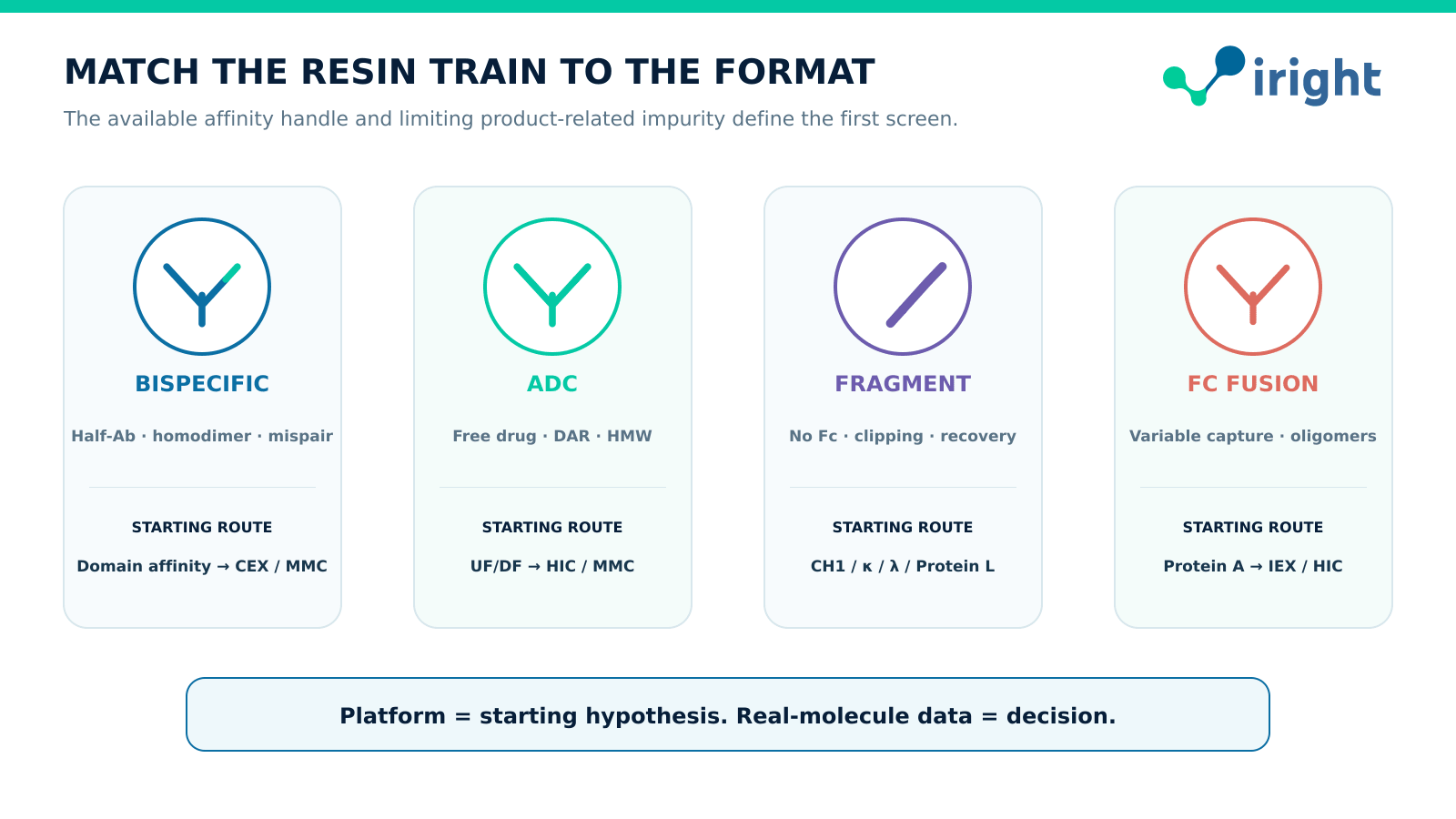
The first useful screen is driven by the molecule’s available affinity handles and dominant product-related impurity—not by copying the resin train used for a conventional IgG.
Protein A remains the natural capture starting point for an Fc-containing bispecific or Fc fusion. It offers strong enrichment from clarified harvest and removes much of the HCP and DNA burden. For a conventional Fc-containing candidate, an alkali-stable resin such as MabSelect SuRe LX (Cytiva 17547401) may therefore belong in the first screen.
But “contains Fc” is not enough to predict process performance. Protein A binding depends on subclass, Fc accessibility, construct geometry, avidity and, for some ligands, interactions with VH3-family variable domains. Ghose, Hubbard and Cramer, in an Amgen–Rensselaer Polytechnic Institute collaboration, compared antibodies and Fc-fusion proteins and showed that apparent capacity can change with the test molecule and operating conditions (Ghose et al., 2007). A vendor DBC measured with a standard IgG is a starting value, not a capacity specification for a new fusion protein.
The capture mechanism can also be turned into a separation mechanism. If the desired asymmetric bispecific presents a domain that selected by-products lack—or presents one copy where an impurity presents two—avidity or domain-specific affinity can separate species that conventional Protein A captures together. This must be engineered into the molecular design and demonstrated experimentally; it cannot be added retrospectively by changing only buffer conditions.
For any Fc-containing new format, measure:
DBC10% at two or more residence times with the actual clarified feed;
capture recovery and concentration factor;
HCP, DNA and leached ligand;
monomer, HMW and LMW across load, wash, elution and neutralization;
elution pH, pool volume and time below the stability threshold; and
binding and elution behavior of the dominant product-related impurities.
The conclusion may still be “use Protein A.” The difference is that it is now an evidence-based decision rather than an inherited platform assumption.
When Fc is absent—or when Fc capture cannot distinguish the desired format from its by-products—substructure-specific affinity media can be more informative than another generic Protein A screen.
CH1-selective capture. CaptureSelect CH1-XL recognizes the human IgG CH1 domain and is designed for IgG and Fab capture independent of light-chain isotype; Thermo Fisher catalog number 1943462005 is the 5 mL format. In a 2024 peer-reviewed study, Dong and colleagues at WuXi Biologics evaluated CH1-specific media for complex antibody formats and showed why domain-selective capture can generate useful process selectivity rather than merely replace Protein A (Dong et al., 2024).
Kappa- and lambda-selective capture. KappaSelect (Cytiva 17545801) targets the constant region of human kappa light chains and is intended for kappa Fab fragments. LambdaFabSelect (Cytiva 17548203) performs the analogous role for human lambda Fab. These resins can be valuable when the correct light-chain constant region is a distinguishing handle. They are not interchangeable: light-chain isotype and the accessibility of the binding epitope must match the construct.
Protein L and engineered VL/VH3 affinity. Protein L binds selected kappa variable-region families and can capture some Fabs, scFvs and domain antibodies without Fc. Capto L (Cytiva 17547802) is a Protein L option. Newer MabSelect VH3 (Cytiva 17549301) removes Fc binding from the ligand and targets VH3-family variable heavy domains; this creates a possible capture discriminator for constructs in which only the desired chain architecture exposes the relevant VH3 handle.
These media are not universal “fragment resins.” Before screening, create a domain-binding matrix:
Candidate medium | Targeted handle | Questions that decide suitability |
|---|---|---|
CH1 affinity | Human CH1 | Is CH1 present and accessible in target and by-products? Does low-pH elution preserve activity? |
KappaSelect | Human kappa constant region | Is the target kappa? Which mispaired species share the same constant region? |
LambdaFabSelect | Human lambda constant region | Is the target lambda and is the epitope accessible? |
Protein L / VL-selective affinity | Compatible kappa variable families | Does the exact VL family bind? Can avidity distinguish target from homodimer? |
VH3-selective affinity | VH3-family heavy variable domain | Does only the desired species present the VH3 pattern required for selectivity? |
Affinity is most valuable when it simultaneously enriches the target and rejects a predictable product-related impurity. If target and impurity share the same handle and valency, high affinity can concentrate both and merely move the real separation problem downstream.
An asymmetric bispecific process may contain the intended heterodimer plus half antibody, heavy-chain homodimers, light-chain mispairs, fragments and aggregates. These species are difficult because they are structurally close to the target. Total HCP or overall purity does not describe the separation challenge.
The first question is whether molecular design creates a differential affinity handle. If yes, a domain-selective capture step can exploit it. Chen and colleagues at WuXi Biologics used Protein L chromatography to monitor and separate homodimer impurities in an asymmetric bispecific process, demonstrating that light-chain-domain interactions can become a process analytical and preparative lever (Chen et al., 2020). Dong and colleagues later compared six chromatographic approaches—including HIC, CEX, KappaSelect, CaptureSelect CH1-XL and Protein L—for monitoring hole–hole homodimer, underscoring that no single mode wins independently of construct design (Dong et al., 2023).
When affinity cannot supply enough discrimination, charge and hydrophobic patches often become the next useful axes:
CEX is attractive when target and mispair differ in pI or local charge. Gradient shape, load density and pool cut can be more important than vendor DBC.
HIC can separate species with different exposed hydrophobic surface, but the required salt and the molecule’s aggregation sensitivity may limit recovery.
Mixed-mode CEX adds hydrophobic and hydrogen-bonding contributions to charge. This can resolve half antibody, homodimer and aggregate populations that overlap on conventional CEX.
SEC is a strong analytical method and can resolve size variants, but preparative throughput and dilution often make it a late or niche manufacturing option.
Tang and colleagues at WuXi Biologics reported removal of half antibody, hole–hole homodimer and aggregates with Capto MMC ImpRes in an asymmetric bispecific process (Tang et al., 2020). A more recent Rensselaer Polytechnic Institute/AstraZeneca study used a single Capto MMC ImpRes column to raise bispecific purity from 67.3% to 94.5% while recovering 72% of the product after removing half antibody, homodimer and light-chain mispair (DiSpirito et al., 2026). Both are compelling examples, but neither creates a universal recipe: their value is the demonstrated mechanism and test design.
Capto MMC ImpRes (Cytiva 17371601) is a useful mixed-mode screening anchor, but its ranking should be established against CEX, HIC and at least one alternative mixed-mode chemistry using the same bispecific feed.
ADC manufacture creates a second downstream problem after the antibody has already been purified. Conjugation introduces small-molecule reactants and changes the product distribution. The critical separations are not limited to HCP and DNA; they include:
unconjugated antibody;
residual free payload, linker or payload–linker;
process reagents and solvents;
soluble aggregates or particles;
positional isomers, where relevant; and
low-, target- and high-DAR populations.
Matsuda’s review identifies DAR, free drug–linker and aggregates as central ADC purification attributes and discusses UF/DF, SEC, HIC and other modes as complementary tools (Matsuda, 2022). The practical implication is that one resin should not be forced to solve every ADC impurity. Small unbound species are often most efficiently removed by UF/DF or size-based membrane operations; a chromatography step is justified when it creates selectivity among intact ADC populations or removes aggregates that membrane processing cannot adequately control.
Payload hydrophobicity matters beyond chromatography. Buecheler and colleagues demonstrated that increasing payload hydrophobicity can destabilize ADC structure and increase self-association or aggregation propensity (Buecheler et al., 2018). Resin and buffer screening must therefore measure recovery and physical stability together. A sharper DAR separation that produces HMW during loading or elution is not a process improvement.
The comparator should not be limited to packed-bed resin. Cordova and colleagues from Abzena, Seagen and Sartorius combined a cation-exchange membrane for free-payload clearance with a phenyl membrane for higher-DAR and aggregate reduction. At scale, the reported target fraction contained 1.45 g of ADC, corresponding to 85% total yield, with a DAR of 1.82 and less than 1% aggregate (Cordova et al., 2021). This study does not rank conventional HIC resins, but it is valuable experimental evidence that residence time, mass transfer and device format can change the best solution for an ADC.
Average DAR is also insufficient. Two pools can share the same average DAR while having different proportions of DAR0, DAR2, DAR4 and higher species. For heterogeneous conjugates, report:
average DAR by an orthogonal method;
full drug-load distribution;
monomer/HMW and particles;
residual free payload/linker with a sensitive small-molecule assay;
potency and target binding; and
recovery across conjugation, purification and hold.
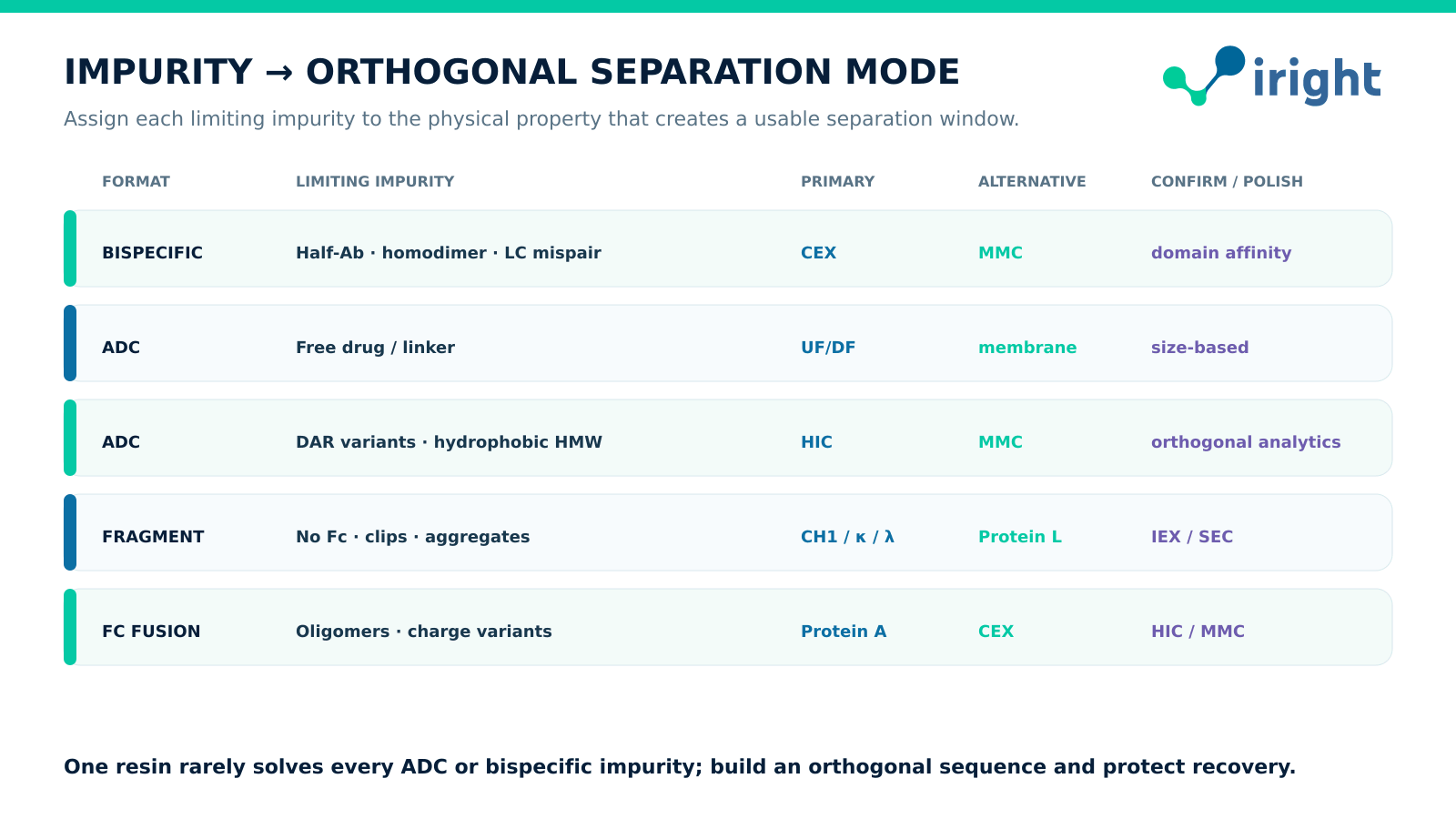
Small molecules, mispaired antibodies, DAR variants and aggregates occupy different separation spaces; an orthogonal sequence is more defensible than assigning every impurity to one resin.
Hydrophobic interaction chromatography separates proteins under non-denaturing aqueous conditions by differences in exposed hydrophobic surface. For many cysteine-linked ADCs, increasing drug load increases retention, which is why analytical HIC is widely used for DAR distribution. Ouyang and colleagues described HIC as the method of choice for measuring DAR and drug-load distribution in cysteine-linked ADCs (Ouyang et al., 2013).
Analytical success does not guarantee preparative success. Preparative HIC must balance:
resolution between adjacent DAR populations;
recovery of the intended pool;
aggregate formation during salt addition, loading and elution;
conductivity adjustment and subsequent desalting;
pressure and pool volume at manufacturing scale; and
compatibility with the actual conjugation buffer and solvent.
Müller, Sevilla and Endres compared HIC media with an ADC-mimetic model of adjustable hydrophobicity, illustrating how ligand chemistry and operating conditions alter purification ranking (Müller et al., 2020). Matsuda and colleagues used preparative HIC to isolate homogeneous site-specific ADC populations with DAR 1 and DAR 2 while retaining biological activity (Matsuda et al., 2020). These studies support HIC as a selective process tool, but only for chemistries whose hydrophobic differences create a usable window.
Begin a broad HIC screen with more than one ligand strength. Capto Butyl ImpRes (Cytiva 17371901) and Capto Phenyl ImpRes (Cytiva 17548402) provide different hydrophobic selectivity. The stronger-looking ligand is not automatically better: excessive retention can compress the elution window, lower recovery and magnify aggregation.
For ADCs, use the analytical DAR method to characterize every preparative fraction, then confirm the proposed pool with orthogonal intact-mass or subunit analysis where appropriate. HIC retention can be affected by payload/linker chemistry and antibody surface properties; it is a proxy for hydrophobic heterogeneity, not a direct identity assay.
Mixed-mode ligands combine ionic, hydrophobic, hydrogen-bonding or aromatic interactions. That combination is useful when the target and impurity differ only subtly in charge or hydrophobic surface. It can also preserve binding at conductivity levels that weaken conventional IEX.
For bispecifics, the most persuasive published examples are impurity-specific. Capto MMC ImpRes removed half antibody, homodimer and aggregates in the WuXi study cited above. A separate WuXi comparison evaluated Chinese-made Diamond MMC Mustang against Capto MMC ImpRes with two asymmetric WuXiBody bispecifics. At a 5-minute residence time, reported DBC values were 123 and 94 mg/mL for Diamond MMC Mustang versus 111 and 71 mg/mL for Capto MMC ImpRes; resolution was comparable and lot-to-lot consistency was reported as good (Zhang et al., 2021).
That evidence supports a deliberately narrow conclusion: Diamond MMC Mustang is a credible candidate for matched screening against Capto MMC ImpRes in intermediate purification of similar asymmetric bispecifics. It does not establish a drop-in alternative for every bispecific, ADC, Fab or Fc fusion.
For ADCs, mixed-mode can sometimes reduce aggregates or separate charge/hydrophobic variants without the salt burden of classical HIC. But conjugate recovery and DAR distribution must be measured explicitly. For fragments, mixed-mode can be valuable after affinity capture when size is too similar for scalable SEC and charge alone is insufficient.
The development discipline is the same: run a resin × pH × conductivity matrix, define a hard minimum recovery, and compare impurity breakthrough or elution resolution with conventional CEX, AEX and HIC. The best mixed-mode result is not the condition with the lowest impurity value; it is the broadest operating window that meets recovery, quality, pressure and lifecycle requirements.
Affinity capture commonly concentrates the product and then exposes it to acidic elution. New formats may be less tolerant of that transition than conventional IgG. Instability can appear during the column elution, the viral-inactivation hold, neutralization or the time between operations.
Mazzer and colleagues from University College London and UCB Celltech showed that Protein A chromatography could increase the aggregation rate of a mAb during the subsequent low-pH viral hold (Mazzer et al., 2015). Shukla and colleagues at Amgen separately quantified Protein A-related aggregation kinetics in an Fc-fusion case study (Shukla et al., 2007). These molecule-specific studies do not prove that every complex format will aggregate; they establish why low-pH exposure must be designed and measured rather than treated as an invisible platform constant.
For bispecifics, fragments, Fc fusions and ADC intermediates:
establish a pH–time stability map at the intended concentration;
include the actual elution buffer, neutralization strategy and temperature;
quantify SEC-HMW/LMW, particles, charge shift and potency;
measure the lowest local pH during mixing, not only the final bulk pH; and
compare recovery and impurity clearance at the mildest elution condition that still produces a robust pool.
If a domain-selective resin requires harsh elution that destroys the molecule, its theoretical selectivity is irrelevant. Conversely, a lower-capacity resin with milder elution may generate more acceptable product per cycle.
Model proteins are useful for checking column packing and basic ligand function. They are weak evidence for ranking resins for a new format. The real candidate carries the domain architecture, payload, charge patches and aggregation pathway that determine the separation.
A defensible screening program has four stages:
List every domain, affinity handle, pI estimate, hydrophobicity risk, known clipping site and expected product-related impurity. For ADCs, add linker–payload chemistry, conjugation site and target DAR distribution. Define which attributes are release-critical and which are process-development diagnostics.
Screen orthogonal chemistries in plates or miniature columns. For capture, include Protein A plus relevant CH1, kappa, lambda, Protein L/VL or VH3 options. For polishing, include CEX, AEX, HIC and mixed-mode. Cross pH and conductivity rather than changing one factor at a time.
Confirm leaders at two residence times and realistic load. Record full chromatograms and mass balance. Match feed composition, temperature, column geometry and gradient delay. Plate equilibrium data do not reproduce axial dispersion, intraparticle transport or pressure.
Challenge feed lots, load, pH, conductivity, residence time and pool cuts. Add representative CIP cycles and trend selectivity, not only capacity. For affinity media, measure ligand leakage. For HIC and mixed-mode, monitor cumulative fouling and changing HMW clearance.
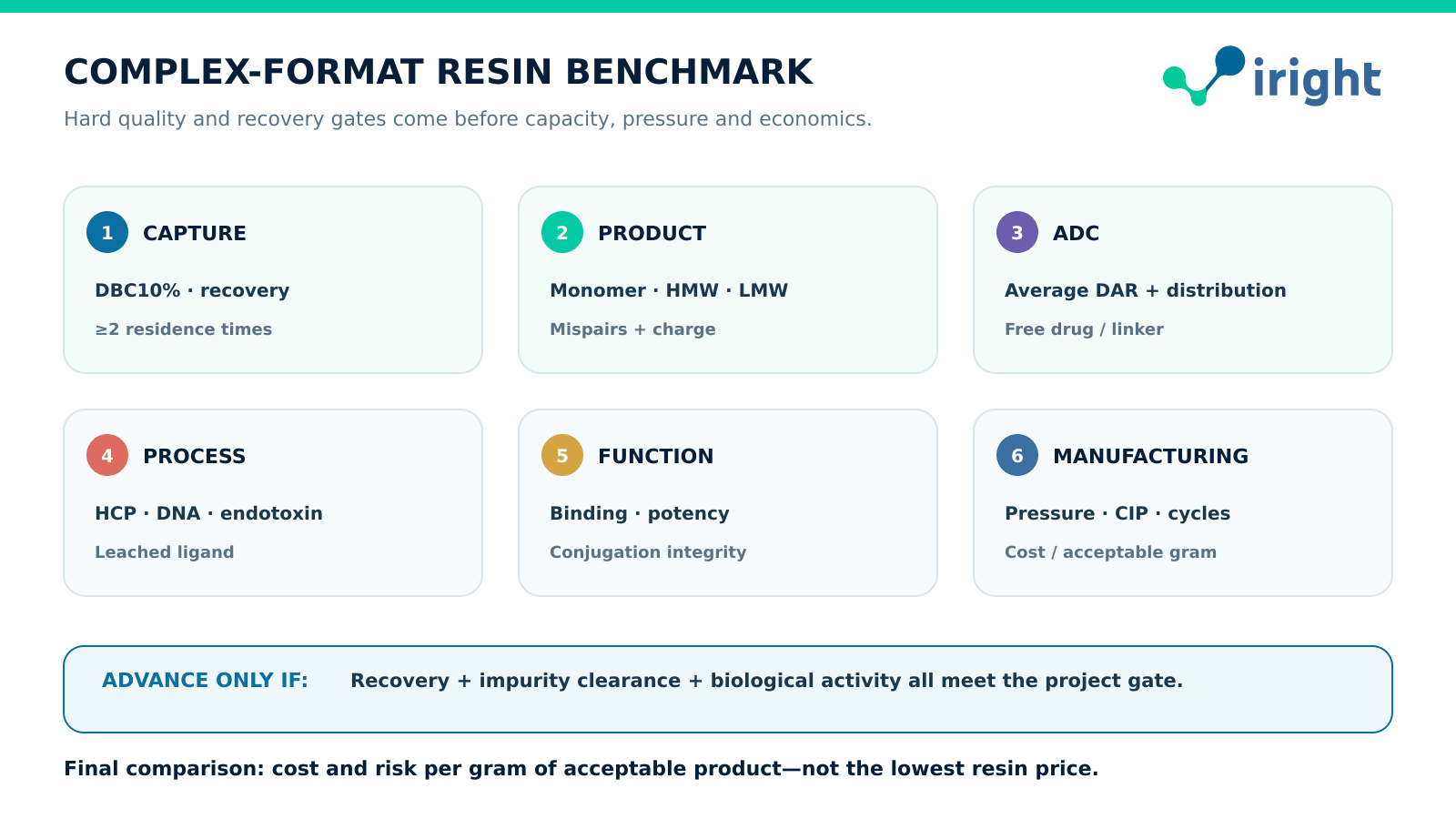
A resin advances only when it meets hard gates for recovery, product-related impurity clearance and biological activity; capacity and pressure then determine manufacturing efficiency.
Use a common benchmark panel:
Domain | Required response |
|---|---|
Capture performance | DBC10% at multiple residence times, recovery, concentration factor and cycle productivity |
Product quality | Monomer/HMW/LMW, particles, charge variants and molecule-specific mispairs |
ADC-specific quality | Average DAR, full DAR distribution, residual free drug/linker and conjugation-site integrity where relevant |
Process impurities | HCP, residual DNA, endotoxin and leached affinity ligand |
Function | Binding, potency or relevant bioactivity—not purity alone |
Manufacturability | Pressure–flow, buffer volume, pool volume, cleaning tolerance, resin lifetime and cost per gram of acceptable product |
Planning a matched resin screen?Use the iRight Resin Selector to build an orthogonal shortlist, or send a pre-filled RFQ for a side-by-side development set.
Platform processes remain valuable. They shorten early development, standardize analytics and focus experiments. The error is to convert a useful prior into a fixed recipe.
Reusing Protein A–low-pH hold–CEX–AEX without testing can fail in several ways:
a fragment lacks the Fc handle;
a bispecific’s product-related impurities co-bind Protein A and overlap on conventional CEX;
an Fc fusion binds but elutes at a damaging pH or with unacceptable recovery;
an ADC becomes too hydrophobic after conjugation, changing aggregate and resin interactions; or
a product-quality attribute such as DAR distribution is invisible to the legacy control strategy.
A better platform is modular. Define a capture module by available domain handles, an intermediate module by the hardest product-related impurity, and a polishing module by residual process impurities and viral-safety needs. Keep common equipment, buffers and analytics where they remain suitable, but allow resin chemistry and operating mode to change.
FDA does not “approve” or rank chromatography resins. ICH Q6B establishes principles for specifications and analytical procedures, while ICH Q5A(R2) addresses viral-safety evaluation. Resin choice remains the sponsor’s process decision, justified by product- and process-specific evidence.
Chinese suppliers now offer credible Protein A, HIC, IEX and mixed-mode portfolios. The evidence base is uneven, so supplier specifications and peer-reviewed head-to-head results must remain separate.
Supplier | Relevant routes for complex formats | Public evidence and reasonable use | What must still be verified |
|---|---|---|---|
NanoMicro (纳微科技) — iRight inquiry · affinity portfolio · HIC portfolio | UniMab EXE and UniMab 50HC Protein A; rigid monodisperse polymer/core-shell routes; UniHR and NanoHR phenyl/butyl HIC families | Supplier pages establish that the affinity and HIC families exist. No peer-reviewed, product-level ADC comparison was identified for UniHR or NanoHR; they are therefore portfolio candidates for a matched ADC HIC screen, not evidence-backed drop-in alternatives. | Actual DBC and elution pH with the candidate; DAR/aggregate selectivity; pressure–flow at target bed height; CIP cycling, ligand leakage, lot consistency and regulatory support |
Bestchrom (博格隆) — iRight inquiry · supplier portfolio | AT Protein A capture; Diamond Phenyl/Butyl/Octyl HIC; Diamond MMC Mustang and MIX-A mixed-mode media | Zhang et al. 2021 provides product-level evidence only for mixed-mode purification of two WuXiBody bispecifics: at 5-minute residence time, Diamond MMC Mustang DBC was 123/94 mg/mL versus 111/71 mg/mL for Capto MMC ImpRes, with comparable resolution. The supplier lists Diamond HIC media, but this study does not validate them for ADC purification. | Repeat on the project feed; verify HIC selectivity for the actual ADC or hydrophobic antibody; demonstrate recovery, potency, CIP lifetime, scale supply and change control |
NanoMicro is especially relevant when a team wants to compare Protein A on a rigid polymeric platform and evaluate phenyl/butyl HIC in the same supplier family. Bestchrom has the stronger public, peer-reviewed product-level comparison for this article’s bispecific mixed-mode question. Neither brand should be described as a drop-in substitute across formats.
Domestic sourcing decisions should use a staged claim:
Portfolio candidate: the ligand class and scale format exist.
Performance candidate: matched-feed screening meets recovery and selectivity gates.
Process alternative: packed-column robustness, pressure and cleaning data are comparable.
Manufacturing substitute: lifecycle, lot consistency, documentation, supply and change control satisfy the project.
Only the last stage supports “replacement” in a regulated process.
Use four questions in order:
Which domain can capture the target? Fc, CH1, kappa, lambda, compatible VL or VH3?
Which near-neighbor impurity is hardest to remove? Half antibody, homodimer, light-chain mispair, aggregate, unconjugated antibody or high-DAR species?
Which orthogonal interaction separates that impurity without damaging the product? Charge, hydrophobicity, mixed-mode interaction or size?
Does the result survive manufacturing reality? Residence time, pressure, pool volume, low-pH exposure, CIP, feed variability, potency and cost per gram of acceptable product?
The best resin combination may be Protein A–mixed-mode for one bispecific, CH1 affinity–CEX for a Fab, Protein A–HIC–AEX for one ADC, and Protein A–CEX for an Fc fusion. That diversity is not a failure of platform development. It is the expected consequence of designing purification around the molecule.
Peer-reviewed experimental studies are weighted above reviews and supplier literature. Author institutions are stated so readers can judge provenance; six cited studies come from WuXi Biologics, reflecting the concentration of publicly accessible bispecific-process literature rather than an assertion of independence. Supplier pages are used only to confirm candidate portfolios and product positioning, not comparative performance. FDA/ICH documents define development and control expectations; they neither rank nor endorse chromatography resins.
ResinFrontiers · iRight Bioprocess Chromatography Intelligence Series
Chinese chromatography resins can replace imported products in many development and manufacturing settings, but substitution is not a property printed on a datasheet. It is a conclusion earned at thr…