Article
Mixed-Mode Chromatography: Can One Step Replace Two?
By Iri ·
Article
By Iri ·
A conventional IgG platform is a useful starting hypothesis—not a transferable process. Bispecific antibodies, antibody–drug conjugates (ADCs), Fab/scFv fragments and Fc-fusion proteins can differ in…
Chinese chromatography resins can replace imported products in many development and manufacturing settings, but substitution is not a property printed on a datasheet. It is a conclusion earned at thr…
Mixed-mode chromatography can sometimes collapse two purification operations into one—but only when its additional selectivity survives the real feed, recovery target, hydraulic limits and lifecycle requirements. The useful question is not whether a resin is “multimodal.” It is which interactions dominate in the intended buffer window, which impurity is limiting, and whether the step remains robust outside its optimum.
Mixed-mode chromatography (MMC), also called multimodal chromatography, has moved from a specialist option to a mainstream process-development tool. The reason is practical. High-titer cultures, bispecific antibodies, Fc fusions, antibody fragments and antibody–drug conjugates create impurity profiles that a conventional Protein A–CEX–AEX platform may not resolve efficiently. MMC ligands add a second or third interaction mechanism—often hydrophobicity, hydrogen bonding or aromatic contacts—to an ionic backbone. That added dimension can preserve binding at higher conductivity, separate closely related product variants or capture impurities that pass through conventional ion exchange.
In practical terms, a multimodal chromatography resin should be selected by the separation window it creates for the actual molecule and limiting impurity—not by the class label alone.
The trade-off is equally important: more interaction mechanisms create a larger design space. A resin that looks exceptional at one pH and salt concentration can lose recovery a few millisiemens per centimetre away, or produce an elution window too narrow for manufacturing. This fourth article in ResinFrontiers · iRight Bioprocess Chromatography Intelligence Series extends the molecule- and impurity-driven framework in Chromatography Resin Selection: A Bioprocessing Framework and the charge logic in IEX for Antibody Polishing: CEX, AEX and Process Design.
A conventional ion exchanger is designed so that electrostatic attraction dominates. A hydrophobic interaction chromatography (HIC) resin is designed around hydrophobic association, normally strengthened by kosmotropic salt. A mixed-mode ligand intentionally combines two or more interaction types within the same stationary phase. Depending on ligand structure and operating conditions, those contributions may include:
electrostatic attraction or repulsion;
hydrophobic association;
hydrogen bonding;
aromatic or π–π interactions;
dipole and van der Waals interactions; and
in hydroxyapatite, distinct calcium-site and phosphate-site interactions.
The word mixed does not mean that every mechanism contributes equally. pH changes the charge state of both protein and ligand. Salt screens electrostatics but may strengthen hydrophobic association. Additives such as arginine can change solubility and interaction strength. A ligand that behaves mainly like a cation exchanger at low conductivity may become hydrophobically dominated as salt increases.
That conditional behavior is the source of MMC selectivity. It is also why supplier labels are insufficient. “Mixed-mode AEX,” “mixed-mode CEX” and “hydrophobic charge-induction” describe a dominant design intent, not a complete retention model. The 2026 systematic review by Javidanbardan and colleagues at University College London and Instituto Superior Técnico catalogues ionic, hydrophobic, hydrogen-bonding and π–π contributions across commercial media and concludes that mechanistic descriptors can narrow the search, but empirical data remain essential for resin selection (Javidanbardan et al., 2026).
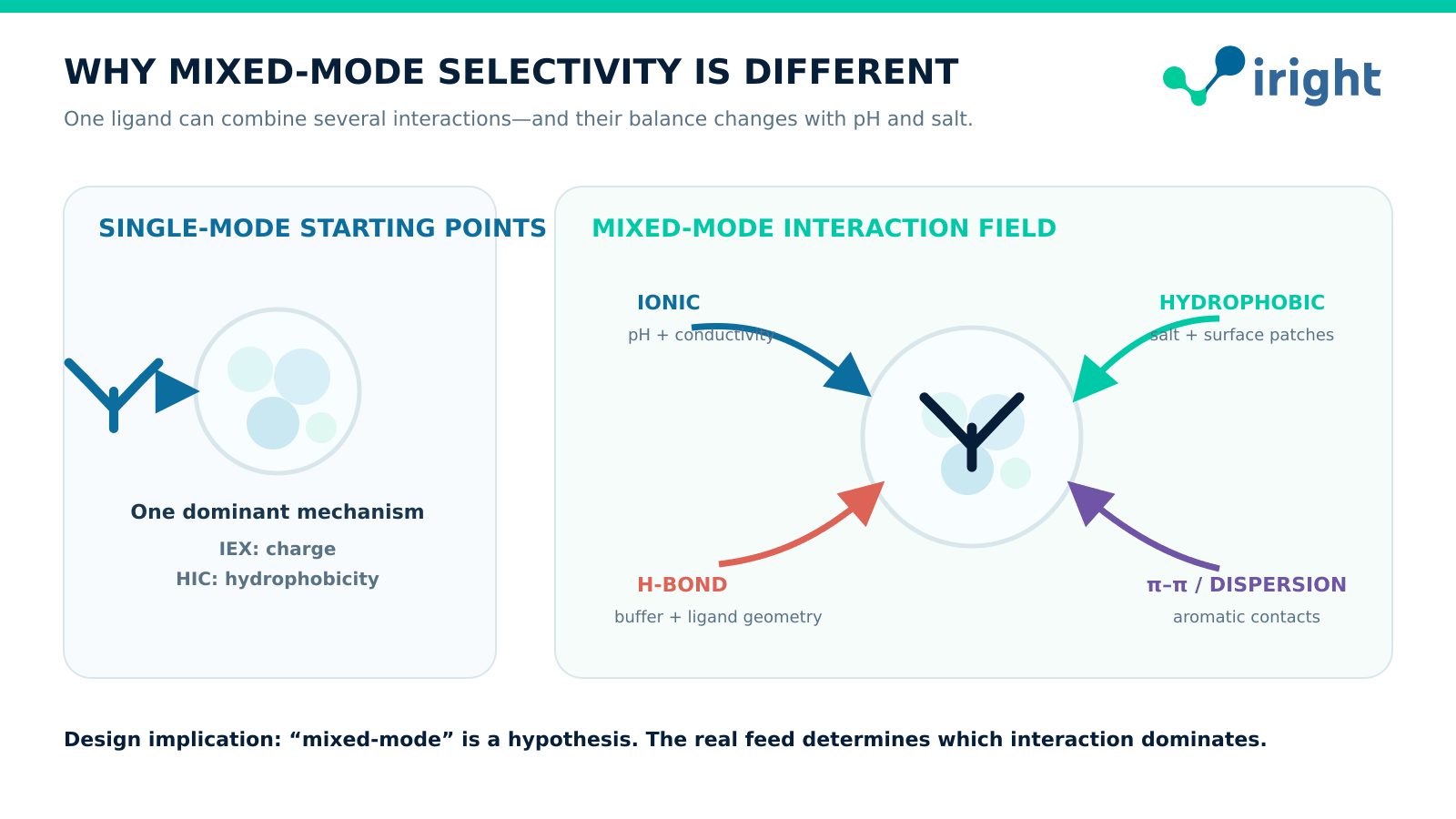
As salt concentration rises, electrostatic attraction is screened while hydrophobic contributions may strengthen; the dominant retention mechanism can therefore shift across the design space.
These media carry a net positive functionality plus hydrophobic or hydrogen-bonding character. They are frequently evaluated for flow-through or weak-partition polishing after Protein A. The product is recovered while DNA, acidic HCP, leached Protein A, endotoxin, viruses or selected aggregates are retained. In bind–elute mode, the same chemistry can resolve product variants that a simple Q ligand does not.
Capto adhere and Capto adhere ImpRes are common screening anchors. The smaller-particle ImpRes architecture is positioned for greater resolution, but a product-specific comparison must test pressure and residence time as well as selectivity. Nuvia cPrime is another widely studied multimodal polishing medium and may be included when a team is assessing a Capto adhere alternative, although it should not be presumed to be a drop-in substitute. Request Capto adhere ImpRes or Nuvia cPrime through a pre-filled iRight inquiry.
These media combine negative charge with a hydrophobic or aromatic group. They are often used in bind–elute mode for intermediate purification or polishing, particularly when aggregates, fragments, mispaired species or high-salt feeds are problematic. Capto MMC, Capto MMC ImpRes and Eshmuno HCX are representative screening anchors. The relevant distinction is not simply “CEX plus hydrophobicity”: ligand accessibility, hydrophobic strength, pore architecture and particle size determine whether selectivity is useful or whether product recovery becomes fragile.
Hydrophobic charge-induction chromatography (HCIC) uses a ligand that is relatively hydrophobic and often uncharged under loading conditions, then becomes charged when pH is lowered. Antibodies can adsorb under near-physiological conductivity and desorb through electrostatic repulsion after ligand ionization. MEP HyperCel is the best-known example; HEA HyperCel and PPA HyperCel provide different hydrophobic and charge characteristics.
Boschetti, affiliated with BioSepra when the work was published, reported that 4-mercaptoethylpyridine HCIC could load antibodies from crude feed without preconcentration and achieve feed-dependent purity as high as 98% (Boschetti, 2002). That result demonstrates the mechanism’s potential, not a universal alternative to Protein A: crude-feed composition, antibody stability at elution pH, HCP co-elution and cleaning validation still determine feasibility.
Hydroxyapatite and layered core-shell media are also multimodal, but they solve different problems. Hydroxyapatite combines calcium affinity and cation-exchange-like phosphate interactions. Core-shell media such as Capto Core 700 and Diamond Layer 700 BA exclude large targets from an adsorptive core while smaller contaminants enter and bind. They should not be benchmarked as if they were interchangeable with a conventional porous MMC bead.
High conductivity weakens long-range electrostatic attraction because mobile ions screen charge and compete for ionic sites. That is why a conventional IEX step often requires dilution, diafiltration or inline conditioning. In selected MMC ligands, however, hydrophobic and other short-range interactions can continue to contribute as electrostatics weaken. Salt can even strengthen hydrophobic association. The result may be useful binding in a conductivity range where a single-mode exchanger loses capacity.
“Salt tolerant” is therefore a conditional property, not a product-class guarantee. It depends on:
salt species as well as conductivity;
target surface hydrophobicity and charge patches;
ligand type and density;
pH relative to both protein and ligand ionization;
feed HCP, lipid, DNA and excipient content; and
residence time and pore access.
WuXi Biologics researchers demonstrated one practical use case: a Protein A process with at least 400 mM calcium chloride or sodium chloride produced a high-salt eluate that would not bind directly to conventional IEX. A salt-tolerant mixed-mode bind–elute step accepted the neutralized pool without conductivity adjustment and also removed most of the polyethylene glycol introduced upstream (Zhang et al., 2019). This is evidence for a specific process connection, not proof that all MMC media can load all high-salt feeds.
When high conductivity is the business case, compare the incumbent route with the MMC route at the same feed composition. Include the water, tank time, membrane area and yield risk avoided by removing a conditioning step. Also measure the new risks: product loss, aggregate formation, elution volume and resin fouling. A salt-tolerant step that requires extensive post-elution conditioning may merely move the bottleneck.
MMC does not remove an impurity class through one universal mechanism. It creates an alternative partition surface. The useful outcome is often the simultaneous clearance of impurity subpopulations that differ in charge, hydrophobicity and association with the product.
Host-cell proteins. Cui and colleagues at AstraZeneca used high-throughput development to select Nuvia cPrime for a therapeutic protein with persistent HCP co-purification. Fraction analysis showed that weak-binding HCP eluted before the product; an intermediate low-salt wash then reduced total HCP content by 80%, including difficult species such as peroxiredoxin-1, HTRA1, clusterin and lipoprotein lipase (Cui et al., 2024). The study is valuable because it identifies the wash mechanism and individual HCPs; the 80% reduction remains molecule- and condition-specific.
In a separate supplier-affiliated study, JNC Corporation researchers modified a polyallylamine ligand with hydrophobic groups. Under a 6 mS/cm flow-through condition, the optimized MMC reduced HCP to 21–23 ppm, compared with 145 ppm for the unmodified ligand. But increasing phenyl modification also reduced mAb yield from 95% to 90%, while a butyl modification kept yield above 95% (Matsumoto et al., 2022). This is a particularly useful warning: the chemistry that improves HCP binding can also increase product retention.
Aggregates and product-related variants. Capto MMC ImpRes has been reported to remove half antibody, hole–hole homodimer, light-chain-missing species and aggregates from bispecific-antibody processes. These peer-reviewed case studies were authored by WuXi Biologics process-development scientists, not by the resin manufacturer (Tang et al., 2020; Wan et al., 2020). Their relevance is strongest for similar construct and feed behavior; they do not establish a general product ranking.
DNA, endotoxin, leached Protein A and viruses. A positively charged multimodal surface can retain polyanionic DNA and endotoxin while hydrophobic contacts add discrimination among protein impurities. Leached Protein A and viruses may also be cleared under suitable conditions. These must be measured separately. DNA clearance does not predict virus clearance, and an HCP ELISA does not reveal whether a single high-risk HCP remains. Viral clearance, when claimed, requires process-specific validation consistent with ICH Q5A(R2), implemented by FDA.
A robust impurity panel therefore includes total HCP plus targeted LC–MS when warranted, residual DNA, SEC-HMW/LMW, charge variants, endotoxin, leached Protein A and relevant potency or conjugation attributes. “Purity” alone is too compressed a response variable for MMC.
At capture, the challenge is crude-feed capacity, recovery, clarification tolerance and cycle productivity. HCIC and selected mixed-mode sorbents can capture antibodies without Protein A, but HCP selectivity and low-pH exposure must be tested. Toueille and colleagues, affiliated with Pall Life Sciences, combined 96-well screening and DoE to build four two-step mAb processes; three delivered residual CHO protein below 100 ppm with overall yield above 70% (Toueille et al., 2011). Because the authors worked for a resin supplier, the study should be read as peer-reviewed experimental evidence with a disclosed commercial affiliation—not labeled simply “independent.”
At intermediate purification, MMC is most attractive when it removes a major impurity family and simplifies feed conditioning. Bind–elute operation can concentrate the product and create strong aggregate or variant resolution. It can also create a narrow elution window and a concentrated local environment that promotes aggregation.
At polishing, the product is already relatively pure and resin volume may be sized by impurity challenge rather than product mass. Flow-through or weak-partition operation can support very high product loading. In the polyallylamine study cited above, an MMC flow-through step coupled to CEX reduced aggregates from 2.3% to below 1.0%, maintained mAb yield above 93% and operated around 1,000 mg mAb/mL resin (Matsumoto et al., 2022). The high apparent loading is possible because the product is not captured conventionally; impurity breakthrough, not product DBC, becomes the sizing constraint.
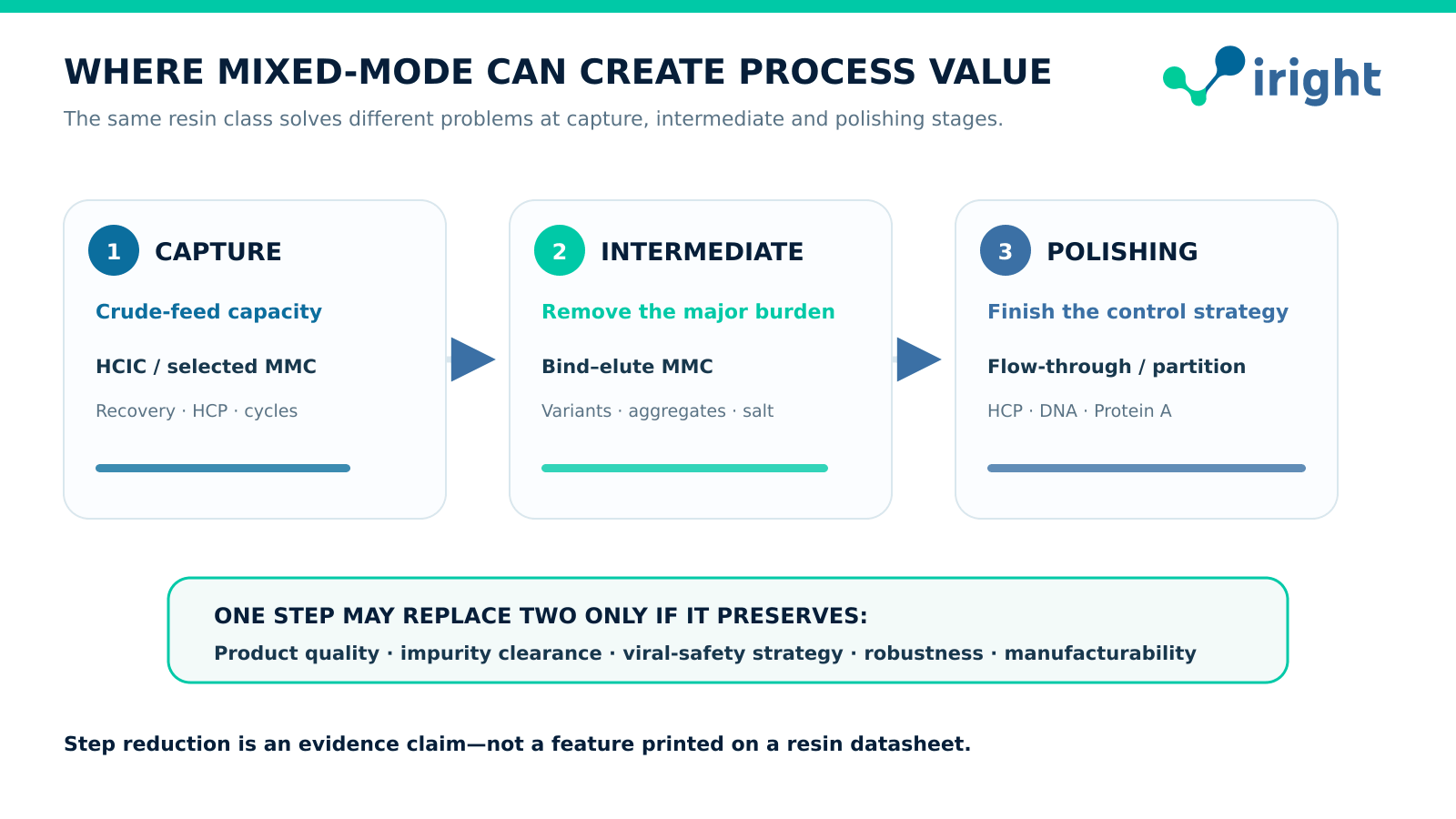
Step consolidation is credible only when the mixed-mode operation preserves the product-quality, impurity-clearance, viral-safety and manufacturability contributions of the operation it replaces.
Sometimes. The claim is credible only when the new step reproduces the combined control strategy of the operations it replaces.
An academic study from the University of Bordeaux developed a three-step Protein A-free process using two mixed-mode resins and an AEX membrane. For a recombinant mAb, the optimized process achieved 88% yield and 99.9% purity, with aggregates, HCP and DNA reported below relevant specifications (Pezzini et al., 2015). This shows that MMC can reorganize a platform. It does not show that one resin alone universally replaces Protein A, IEX and HIC.
A Roche/Merck study provides a more focused example. A moderately hydrophobic mixed-mode CEX ligand purified a very hydrophobic bispecific antibody in one operation to greater than 97% purity, more than 3-log HCP reduction and 70% recovery, eliminating an additional column step in that process (Schelter et al., 2023). The recovery figure also reveals the trade-off: step reduction is not automatically yield improvement.
Before deleting a column, demonstrate equivalence or improvement in five dimensions:
Product quality: monomer, aggregates, fragments, charge variants, potency and molecule-specific attributes.
Process impurities: HCP, DNA, residual Protein A, endotoxin and any media or additive residuals.
Viral safety: the overall clearance strategy, not an assumed resin-class contribution.
Robustness: acceptable performance across feed lots, pH, conductivity, load and residence-time ranges.
Manufacturability: recovery, buffer volume, cycle time, pressure, column utilization, cleaning and supply risk.
The correct economic comparison is not resin price per litre. It is cost and risk per gram of acceptable product, including avoided tanks, membranes, buffers, testing, validation and batch time—plus the consequences of a narrower operating window.
MMC is valuable when it is orthogonal, meaning that its impurity ranking differs from the preceding and following steps. Orthogonality is experimental, not semantic. Adding a hydrophobic group to an ion-exchange ligand does not guarantee that the column will remove a different HCP population.
Comparison | Where MMC may add value | What conventional mode may still do better | Test that resolves the choice |
|---|---|---|---|
MMC vs CEX | Salt tolerance; additional aggregate, fragment or hydrophobic-variant selectivity | Simpler retention model; often broader, easier-to-control elution | Fraction-level SEC, charge profile, recovery and salt sensitivity |
MMC vs AEX | Wider impurity interaction space in flow-through; HCP and residual Protein A capture | Well-established DNA/virus platform behavior and simple scale-up | Impurity breakthrough at realistic load and conductivity |
MMC vs HIC | Hydrophobic selectivity without the same high-salt loading requirement in some chemistries | Strong, tunable hydrophobic ranking for exposed-surface differences | Recovery, aggregate formation and required salt/additive levels |
Mechanistic work explains why prediction is difficult. Studies of antibody fragments and full mAbs show that Fc and Fab domains contribute differently to retention depending on the molecule’s surface charge and hydrophobic patches (Robinson et al., 2018). Two antibodies with similar pI and global hydrophobicity can therefore rank differently on the same resin.
Use an orthogonality matrix: assay the load, flow-through, wash and elution fractions from each candidate with the same analytical panel. Compare which individual HCPs and product variants move, not only the total ppm or SEC purity. If MMC clears exactly the same species as the existing CEX step but with lower recovery, it is not adding orthogonality.
Single-factor-at-a-time development is especially weak for MMC because pH and salt often interact. Changing pH can change product charge, ligand charge and solubility simultaneously; changing salt can weaken ionic attraction while strengthening hydrophobic interaction. A one-dimensional screen can miss a useful diagonal window or select an unstable optimum.
A practical first screen crosses:
resin chemistry;
pH spanning the product-stability window;
conductivity and salt species;
bind–elute, flow-through or weak-partition mode; and
load challenge.
Use 96-well filter plates or miniature columns for broad mapping, then confirm leaders in packed columns because equilibrium plates do not reproduce residence time, intraparticle transport, axial dispersion or pressure. Randomize plate position, include replicates and use feed from more than one lot when HCP variability is material.
DoE should model at least recovery plus one product-quality and one impurity-clearance response. Desirability functions are useful only after hard acceptance gates are defined. A condition with excellent HCP clearance but 75% recovery should not be “averaged” into acceptability by a composite score.
Predictive modeling is improving but has not eliminated experimental work. A KIT/Boehringer Ingelheim study used 64 antibodies and 1,312 calculated descriptors to predict pH-gradient elution on Capto adhere; six structural features produced a test-set R² of 0.898 (Kang et al., 2023). A subsequent multiscale study across 59 antibodies reported adsorption-parameter test accuracy above Q² 0.83 (Kang et al., 2024). These are substantial advances for selecting initial conditions. They are not universal models for all ligands, feeds, load densities or impurities.
Recovery collapses. Multiple attractive interactions can retain the product more strongly than expected. Elution may require high salt, low pH, organic modifiers or arginine. Those conditions can enlarge pool volume, complicate the next step or damage a sensitive molecule.
The elution window is too narrow. A sharp optimum is scientifically interesting but operationally weak. Small pH or conductivity errors can move the product into the wash or carry impurities into the pool. Map the edges of failure and set guard bands; do not validate only the optimum.
The resin ranks differently after scale-up. Plate data emphasize equilibrium. Production columns introduce residence time, flow distribution, bed compression, extra-column dispersion, gradient delay and viscous pressure. Match residence time—not only linear velocity—and confirm gradient formation at the column inlet.
Hydrophobic binding promotes aggregation. Strong local retention, concentrated elution and long hold times can increase HMW or reduce potency. Track aggregate formation across load, wash, elution, neutralization and hold, not only in the final pool.
Fouling erodes selectivity. Lipids, DNA, HCP and product aggregates can occupy hydrophobic or ionic sites differently over cycles. Capacity retention alone may miss a changing impurity profile. Trend pressure, yield and fraction-level quality through representative cleaning cycles.
A high-conductivity claim is generalized too far. Conductivity does not identify the ions present. Repeating a sodium-chloride screen with a phosphate-, acetate- or calcium-containing process pool can change ranking. Test the real buffer composition.
A substitution is declared from first-cycle data. A resin replacement also depends on lot consistency, extractables/leachables support, change notification, supply, scalable packing, cleaning limits and regulatory documentation. Chromatographic similarity is necessary, not sufficient.
Start with a written hypothesis: target impurity, intended mode, expected mechanism and the operation that might be simplified. Then run both a common-condition comparison and a resin-optimized comparison. The common condition measures drop-in simplicity; optimized conditions measure attainable performance.
Domain | Matched measurement | Why it matters |
|---|---|---|
Binding/partition | Full breakthrough or partition coefficient at ≥2 residence times | Reveals transport sensitivity and usable safety margin |
Recovery | Complete mass balance through load, wash, elution and strip | Separates irreversible loss from pooling loss |
Product quality | SEC-HMW/LMW, charge variants, potency and molecule-specific attributes | Prevents total purity from hiding product damage |
Clearance | HCP, targeted HCP where needed, DNA, endotoxin, leached Protein A | Tests the actual control strategy |
Hydraulics | Pressure–flow curve at process temperature and viscosity | Establishes column and facility fit |
Efficiency | HETP and asymmetry before/after cycling; pool volume and buffer use | Connects resin behavior to scale-up and productivity |
Lifecycle | Quality, recovery, pressure and capacity after representative CIP cycles | Detects selectivity drift and fouling |
Economics | Cost per gram of acceptable product and avoided operations | Tests whether step reduction is real |
For bind–elute candidates, compare gradient slope, step-elution window and pool-cut robustness. For flow-through candidates, load until impurity breakthrough—not merely until a convenient product mass—and include a safety factor tied to feed variability. Measure at the highest expected conductivity and lowest expected residence time.
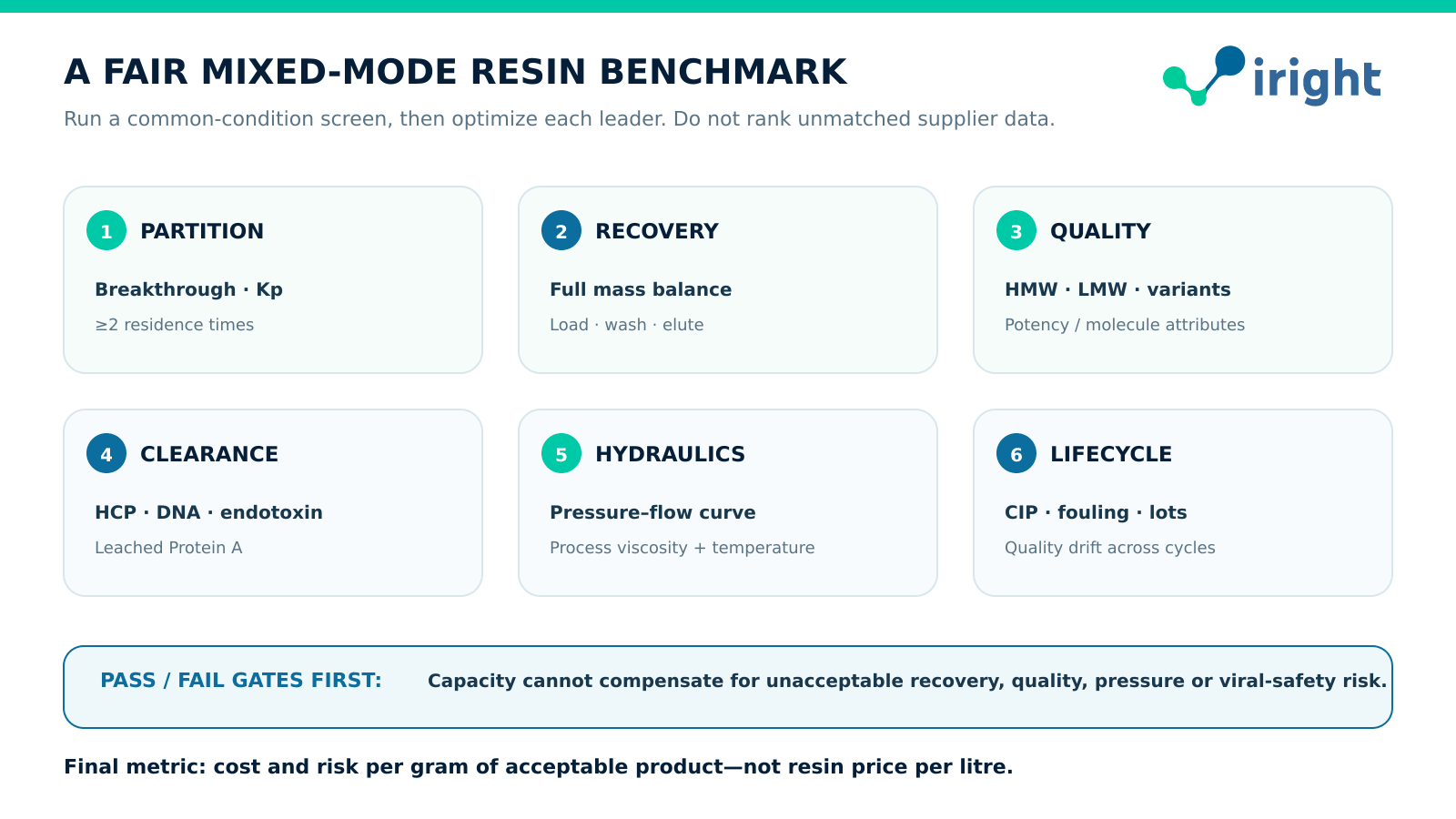
A fair resin comparison combines matched-feed separation data with recovery, pressure–flow behavior, cleaning stability and cost per gram of acceptable product.
Do not combine supplier results obtained with different proteins, buffers and residence times into a league table. Supplier data are appropriate for setting starting conditions; head-to-head conclusions require the same feed and protocol. FDA’s ICH Q6B guidance provides the broader framework for justified specifications, but it does not test or endorse chromatography media.
Planning an MMC screen?Shortlist distinct ligand families, then request matched sample volumes or prepacked formats for a common-condition and optimized-condition study. Start a Mixed-Mode Resin RFQ
Chinese suppliers should be evaluated as architectural alternatives, not grouped into a single “domestic resin” category. The public evidence base is uneven. Bestchrom has a peer-reviewed, same-study comparison against a named imported benchmark, while BioLink publishes directly relevant mixed-mode product families. Supplier specifications are useful for defining candidates, but only matched experiments can establish project-specific substitution.
Supplier | Candidate products and route | Public evidence | What must be confirmed |
|---|---|---|---|
Bestchrom (博格隆) — iRight inquiry · supplier portfolio | Diamond MMC Mustang and Diamond MMC: weak-CEX/hydrophobic agarose media; Diamond MIX-A Mustang and Diamond MIX-A: strong-AEX/hydrophobic media; MMC Bestarose FF; Diamond Layer 700 BA core-shell route | In two asymmetric WuXiBody bispecific-antibody cases, WuXi Biologics reported Diamond MMC Mustang DBC values of 123 and 94 mg/mL at a 5-minute residence time, versus 111 and 71 mg/mL for Capto MMC ImpRes under the same condition. Resolution was comparable and Diamond MMC Mustang showed good lot-to-lot consistency (Zhang et al., 2021). | Repeat with the project feed at matched residence time, load, pool cut and pressure; verify CIP cycling, scale supply and change control. |
BioLink (百林科) — iRight inquiry · MaXtar MMC supplier page · MaXtar MMA supplier page | MaXtar MMC and MaXtar MMA mixed-mode families; hydroxyapatite is a separate orthogonal option | Supplier portfolio confirms relevant product families. No matched, peer-reviewed comparison against a named imported MMC resin is cited here. | Obtain exact ligand/matrix, particle-size, pressure–flow, capacity method, CIP and regulatory-support data before screening. |
The strongest domestic substitution statement supported by public data is deliberately narrow: for intermediate purification of the two asymmetric WuXiBody bispecific antibodies evaluated by WuXi Biologics, Diamond MMC Mustang was a credible Capto MMC ImpRes alternative candidate. At a 5-minute residence time, its reported DBC was 123 versus 111 mg/mL for bsAb A and 94 versus 71 mg/mL for bsAb B. The study also reported comparable resolution and good lot-to-lot consistency (Zhang et al., 2021). These results justify inclusion in a matched screen; they do not demonstrate drop-in equivalence for other antibodies, feeds, column sizes or cleaning regimes.
For a first domestic screen, include the incumbent imported control, Diamond MMC Mustang, one mixed-mode AEX candidate such as Diamond MIX-A Mustang when flow-through impurity capture is the objective, and a different architecture such as MaXtar MMC/MMA after documentation review. Advance only candidates that pass predefined recovery, impurity, pressure and lifecycle gates.
Building a domestic MMC shortlist?Request one cationic mixed-mode, one anionic mixed-mode and the imported incumbent in matched formats; define the feed, mode and target impurity in the RFQ. Request a Domestic MMC Comparison
The best mixed-mode resin is the medium whose combined interactions create a wider, more robust separation window than a single-mode alternative for the limiting impurity—without transferring cost or risk to recovery, conditioning, pressure, cleaning or validation.
MMC can replace an operation when it reproduces the deleted step’s product-quality, impurity and viral-safety contribution across a justified design space. It can also be the wrong choice when selectivity is strong but the window is narrow, recovery is fragile or the feed requires molecule-specific development that a simpler platform step avoids.
Use the iRight Resin Selector once to narrow candidates by dominant interaction, matrix and intended process position. Then compare the shortlist with the same feed, matched residence times and a scorecard that includes recovery, HCP/DNA/aggregate clearance, pressure, pool volume, CIP stability and cost per gram—not capacity alone.
Evidence note: Peer-reviewed original studies support comparative and quantitative claims. Author affiliations are stated so readers can judge source independence and commercial involvement. Supplier specifications define candidates and starting conditions; they are not treated as proof of equivalence. FDA/ICH guidance defines regulatory expectations and does not test, rank or endorse chromatography resin brands.
ResinFrontiers · iRight Bioprocess Chromatography Intelligence Series
Artificial intelligence can accelerate chromatography resin selection, but it cannot infer a universally “best resin” from catalog specifications. The practical route is a closed evidence loop: gener…