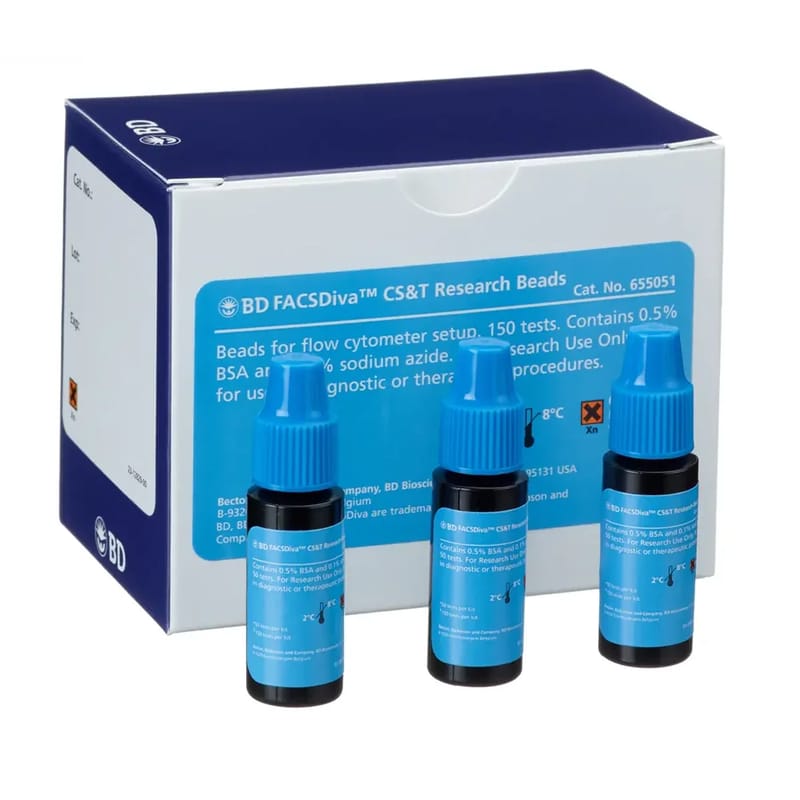
BD, 570516, RB744 Streptavidin
0.1 mg
Catalog Number: 570516
Send an RFQ.
Category
| Source | Human IL-17A, amino acids Ile20-Ala155 (Accession # NM_002190) was expressed in E. coli. |
|---|---|
| Molecular Mass | The 137 amino acid N-terminal methionylated recombinant protein has a predicted molecular mass of 16 kD. This protein exists as a disulfide-linked homodimer. The DTT-reduced protein migrates at approximately 16 kD by SDS-PAGE. The non-reduced protein migrates as a homodimer, at approximately 28 kD by SDS-PAGE. |
| N-terminalSequence Analysis | Met-Ile-Val-Lys-Ala-Gly-Ile-Thr-Ile-Pro |
| Purity | ≥ 95%, as determined by Coomassie stained SDS-PAGE |
| Formulation | 0.1 μm filtered protein solution is in 10 mM Sodium Phosphate buffer, 300 mM NaCl, pH 7.2. |
| Endotoxin Level | Less than or equal to 0.1 EU per μg of protein as determined by LAL method. |
| Residual Host Cell Protein Content | ≤ 0.500 ng/μg by ELISA |
| Concentration | 25 μg & 100 μg sizes are bottled at 0.5 mg/mL |
| Storage & Handling | Unopened vials can be stored at ≤ -70°C for 4 years, ≤ -20°C for 6 months, and between 2°C and 8°C for 2 weeks. Aliquots can be stored between -20°C to -70°C for 3 months and between 2°C and 8°C for 1 week. For maximum results, quick spin vial prior to opening. Stock solutions can also be prepared at 50 - 100 μg/mL in appropriate sterile buffer, carrier protein such as 0.2 - 1% endotoxin-free BSA or HSA can be added when preparing the stock solution. Avoid repeated freeze/thaw cycles. |
Unless otherwise stated, the minimum order amount is USD 1,000.
For orders below USD 1,000, an additional handling fee may apply, or we may arrange local delivery / local handover where available.
All quotations are subject to final confirmation, including product availability, lead time, batch information, shipping cost, and applicable export or handling requirements.
For quotation requests, please send an RFQ from website or contact:
Please send inquiries directly to us in the “To” field. Emails sent via BCC, mass mailing, or with unrelated recipients may be automatically filtered and will not be processed.
| Activity | Cell-Vive™ GMP Recombinant Human IL-17A induces IL-6 production in human neonate dermal fibroblasts in a dose-dependent manner. The ED50 for this effect is 0.06 – 0.36 ng/mL. |
|---|
| Application | Bioassay |
|---|
| Application Notes | BioLegend carrier-free recombinant proteins provided in liquid format are shipped on blue ice. Our comparison testing data indicates that when handled and stored as recommended, the liquid format has equal or better stability and shelf-life compared to commercially available lyophilized proteins after reconstitution. Our liquid proteins are verified in-house to maintain activity after shipping on blue ice and are backed by our 100% satisfaction guarantee. If you have any concerns, contact us at [email protected]. |
|---|
| Application References(PubMed link indicates BioLegend citation) | Crawford MP, et al. 2020. Proc Natl Acad Sci U S A. 117:19408. PubMed Kakiuchi N, et al. 2020. Nature. 577:260-265. PubMed Akaki K, et al. 2021. Elife. 10:e71966. PubMed Luo J, et al. 2019. Mediators Inflamm. 2019:9050965. PubMed Luo X, et al. 2021. Neuron. 109:2691. PubMed Jaeger N, et al. 2020. Cell Rep. 33:108331. PubMed |
|---|
| Disclaimer | BioLegend Cell-Vive™ GMP Recombinant proteins are for research use only. Suitable for ex vivo cell processing. Not for injection or diagnostic or therapeutic use. Not for resale. BioLegend will not be held responsible for patent infringement or other violations that may occur with the use of our products. |
|---|
| Structure | Cytokine |
|---|
| Ligand/Receptor | IL-17A signals through a heteromeric receptor composed of IL-17RA and IL-17RC. |
|---|
| Bioactivity | Human IL-17A induces IL-6 production in human neonate dermal fibroblasts. |
|---|
| Cell Sources | IL-17A is largely produced by activated memory T lymphocytes, CD4+ T helper cells (Th17), neutrophils, CD8(+), NK, and gamma-delta T cells. |
|---|
| Cell Targets | IL-17AR is expressed in epithelial cells, fibroblasts, B and T lymphocytes, myelomonocytic cells, bone marrow stromal cells, synovial endothelial cells and chondrocytes from arthritic patients express IL-17R. |
|---|
| Antigen References | Yu J, et al. 2008. Front Biosci. 13:170-177 Toy D, et al. 2006. J. Immunol. 177:36-39 Benghiat FS, et al. 2009. Transplant Rev. 23:11-18 Honorati MC, et al. 2001. Rheumatology. 40:522-527 Rouvier E, et al. 1993. J. Immunol. 150:5445-5456 Liang SC, et al. 2007. J. Immunol. 179:7791-7799 Ouyang W, et al. 2008. Immunity. 28:454-467 |
|---|
| Regulation | IL-17A is a potent regulator of granulopoiesis and neutrophil recruitment under normal and inflammatory conditions. Organ overexpression of IL-17A increases circulating neutrophil numbers and recruitment into the organs by induction of CXCL2, IL-1β, and G-CSF. IL-17A induces CXCL1, CXCL2, CXCL5, and CXCL8 in human epithelial cells. IL-17A also cooperates with TLR ligands, IL-1 beta, and TNF alpha to enhance inflammatory reactions and stimulate production of beta-defensins and other antimicrobial peptides. |
|---|
| Gene ID | 3605 |
|---|
| UniProt | View information about IL-17A on UniProt.org |
|---|
| Other Names | Interleukin-17A, Cytotoxic T-lymphocyte-associated antigen 8, cytotoxic T-lymphocyte-associated serine esterase 8, CTLA-8, IL-17 |
|---|