Article
IEX for Antibody Polishing: CEX, AEX and Process Design
By Iri · · Updated
Article
By Iri · · Updated
Chinese chromatography resins can replace imported products in many development and manufacturing settings, but substitution is not a property printed on a datasheet. It is a conclusion earned at thr…
Artificial intelligence can accelerate chromatography resin selection, but it cannot infer a universally “best resin” from catalog specifications. The practical route is a closed evidence loop: gener…
Ion exchange chromatography (IEX) is often described as a choice between CEX and AEX. In practice, the useful question is more specific: which charge interaction, operating mode and buffer window will remove the limiting impurity without sacrificing antibody recovery, product quality or scale-up robustness?
After Protein A capture and low-pH virus inactivation, the antibody pool is cleaner but not finished. It may still contain host-cell proteins (HCP), residual DNA, aggregates, leached Protein A, endotoxin, viruses and charge variants. IEX remains one of the most versatile ways to address these risks because protein charge can be tuned through pH and ionic strength. Yet this tunability also makes IEX easy to benchmark badly. A supplier capacity value measured with lysozyme or bovine serum albumin is not a prediction of aggregate resolution for a specific monoclonal antibody (mAb).
This third article in ResinFrontiers · iRight Bioprocess Chromatography Intelligence Series applies the molecule- and impurity-driven logic introduced in the pillar guide, Chromatography Resin Selection: A Bioprocessing Framework, to antibody polishing. The preceding capture step is covered in the companion article, Beyond DBC10%: A Smarter Protein A Resin Benchmark.
An ion exchanger is named for the species it binds. A cation exchanger (CEX) carries negatively charged ligands and binds positively charged solutes. An anion exchanger (AEX) carries positively charged ligands and binds negatively charged solutes. The target and impurities do not have fixed charges: their net and local surface charges change with pH.
For a conventional mAb with a basic isoelectric point (pI), CEX is commonly operated below the mAb pI. The antibody is net positive and binds to sulfonate- or carboxylate-bearing media. AEX is commonly used in flow-through polishing at a pH below the antibody pI, where the mAb is insufficiently negative to bind strongly, while DNA, endotoxin, many viruses and acidic protein impurities are retained.
That textbook model is necessary but incomplete. Antibodies have heterogeneous surface-charge patches, and impurities can associate with the antibody itself. Two proteins with similar pI values can show different retention because charge distribution, conformation, hydrophobic contacts, counterions and pore accessibility also matter. pI therefore defines a rational starting region; it does not define a process.
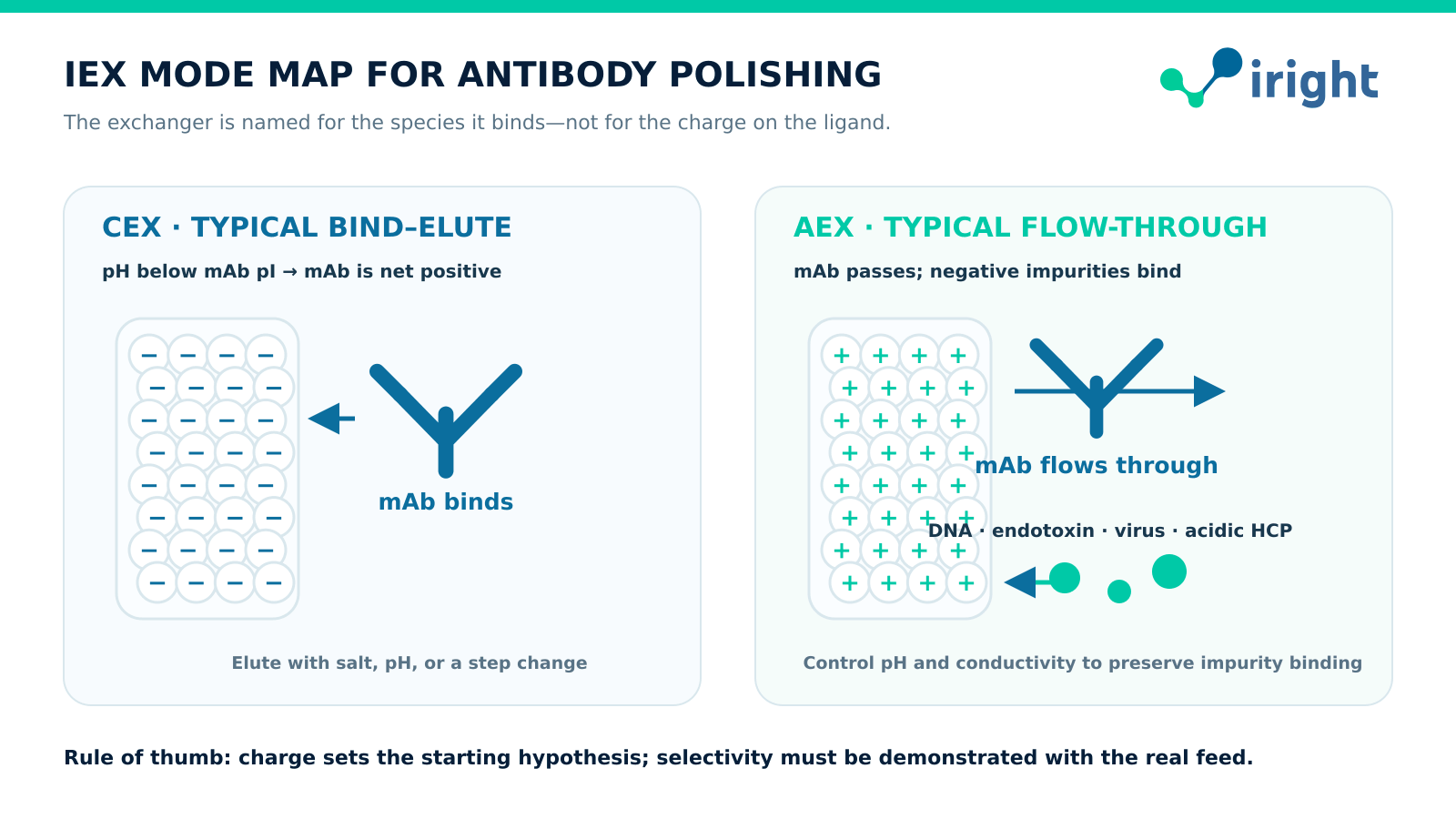
CEX bind–elute and AEX flow-through operating modes for antibody polishing
The industrial importance of IEX is well established. Liu and colleagues’ peer-reviewed review of mAb recovery describes CEX as a widely used polishing step for aggregates and HCP, and AEX as a common flow-through step for residual process impurities and virus control (Liu et al., 2010). The review supports the platform logic, but it does not imply that the same resin or buffer window will work for every antibody.
A practical selection sequence begins with four questions.
1. What is the antibody’s measured pI and charge-variant profile? Sequence-based pI is useful for planning, but glycation, deamidation, C-terminal lysine processing, sialylation and other modifications can shift the observed distribution. Use analytical CEX, capillary isoelectric focusing or an orthogonal method to characterize the actual molecule.
2. Over what pH range is the antibody stable? A buffer that gives strong electrostatic binding is not useful if it promotes aggregation, fragmentation, oxidation or loss of potency. The usable pH window is the intersection of separation selectivity and product stability.
3. What is the feed conductivity and counterion composition? Conductivity is a convenient process measurement, but equal conductivity does not guarantee equal binding. Chloride, acetate, phosphate and other ions differ in competition and buffering behavior. Record both conductivity and composition.
4. Which impurity is limiting the process? If aggregates or charge variants define the specification, a high-resolution CEX bind–elute step may deserve priority. If DNA, endotoxin or virus clearance is limiting and the mAb can pass under a suitable window, AEX flow-through may be more efficient.
For CEX screening, start at one or more pH values below the mAb pI and a conductivity low enough to create measurable binding. For AEX flow-through, start where the mAb recovery remains high but the impurity partition coefficient is still meaningful. Do not force an arbitrary “one pH unit from pI” rule: patch charge and impurity association can make the useful window closer to or farther from the measured pI.
In bind–elute mode, the product binds during loading, weakly retained species are washed away, and the antibody is recovered by increasing salt, changing pH or applying a step. This mode concentrates product and creates the greatest opportunity to separate closely related species, but it requires capacity, gradient or step development, pool cuts and regeneration.
In flow-through mode, the product is collected during load and wash while impurities bind. The column can often be smaller because it is sized for impurity mass rather than product mass. Flow-through also avoids a concentrated elution peak and may reduce cycle time and buffer demand. Its risk is silent impurity breakthrough: product recovery can remain excellent even while DNA, HCP or virus binding capacity is being exhausted.
There is also a useful middle ground. Kelley and colleagues at Wyeth described weak partitioning chromatography (WPC), an AEX mode in which the mAb interacts measurably with the resin but is recovered isocratically in the effluent. In one reported robustness window at pH 8.2 and 18–28 mM chloride, HMW remained below 0.7%, HCP log reduction value (LRV) exceeded 3.0, leached Protein A LRV exceeded 3.2 and product loss remained below 6%. Across seven consecutive humanized-mAb cGMP processes at 1–10 kg per batch, HMW was reduced from as high as 18% to below 2% in some cases (Kelley et al., 2008). These are study-specific results, not platform guarantees: stronger product interaction can trade yield against impurity clearance. WPC is not simply “flow-through with more salt”; it requires a defined partition window.
Packed-bed resin is no longer the only mainstream architecture for AEX flow-through. Membrane chromatography uses convective transport, which can support high flow and short residence time when impurity mass is low relative to product throughput. In an Amgen report, a Q membrane unit operation achieved a process capacity greater than 3,000 g/m² (10.7 kg/L) and LRV above 5 for four model viruses (Zhou and Tressel, 2006). A later FDA/CDER head-to-head study using the same process fluids and comparable run conditions found that clearance of PPV, X-MuLV and PR772 was largely comparable across multiple AEX resin columns and membrane adsorbers, with exceptions attributed to non-optimized, device-specific conditions (Miesegaes et al., 2014). Membranes can therefore be a serious flow-through option, but capacity, pressure, hold-up volume, impurity challenge and viral-clearance validation still need a process-specific comparison.
The choice can therefore be framed as follows:
Process question | CEX bind–elute | AEX flow-through / weak partitioning |
|---|---|---|
Primary objective | Resolve aggregates, charge variants and selected HCP | Bind DNA, endotoxin, virus and acidic impurities while recovering mAb |
Column sizing basis | Product mass, DBC and pool strategy | Impurity challenge, breakthrough and required safety margin |
Main development levers | Load pH/conductivity, residence time, wash, gradient slope, pool cuts | Load pH/conductivity, product partitioning, impurity capacity, wash volume |
Main failure mode | Product breakthrough or loss of resolution/recovery | Impurity breakthrough hidden behind high product recovery |
Commercial product names should be treated as testable architectures, not conclusions. Common CEX screening anchors include Capto S ImpAct, POROS XS, Eshmuno CPX and Toyopearl GigaCap S-650M. Common AEX anchors include Q Sepharose Fast Flow, POROS 50 HQ and Fractogel EMD TMAE HiCap. Their first screening value is architectural diversity—matrix, pore system, particle size and ligand presentation—not a supplier ranking. Product names remain plain text here because an exact, currently listed iRight SKU and /products/{handle} page could not be verified; linking them to a generic selector would imply availability and create a misleading destination.
CEX is a workhorse for mAbs because many antibodies remain positively charged in a practical mildly acidic buffer. The desired monomer, HMW aggregates, acidic variants, basic variants and HCP can differ in binding strength. A shallow gradient and carefully defined pool cuts can turn those differences into separation.
Aggregate removal. Aggregates often bind more strongly because they present larger contact areas or multiple charge patches. That can place HMW species on the late-eluting side of a CEX peak, although exceptions occur. Resolution must be measured across the full load and gradient range; a clean peak apex can conceal aggregate enrichment in the tail.
Charge-variant control. Acidic variants often elute earlier and basic variants later in a typical CEX method, but the order and resolution depend on the molecule and buffer system. Analytical charge profiles should be measured in every preparative fraction before final pool cuts are selected. Charge variants are not automatically impurities: their criticality depends on structure, potency, pharmacokinetics and the product control strategy.
HCP removal. CEX does not remove one homogeneous “HCP” population. Some HCPs bind more weakly than the mAb, some more strongly, and some travel as mAb-associated complexes. Khanal, Kumar and Lenhoff at the University of Delaware showed in a peer-reviewed CEX displacement study that mAb monomer could separate more acidic from more basic HCP populations, while higher-affinity aggregates displaced monomer (Khanal et al., 2021). That work supports displacement as a mechanistic design option; it does not make overloaded operation universally superior.
The same point appears in product architecture studies. In a peer-reviewed comparison of strong and weak CEX media, Staby and colleagues evaluated pH dependence, efficiency, binding strength, particle distribution, static and dynamic capacity. Their competitive-binding example used aprotinin in a yeast fermentation feed—not an mAb feed—and showed a significant DBC decrease relative to purified aprotinin (Staby et al., 2006). It is a non-mAb model with a deliberately limited use here: to show that purified-protein capacity and real-feed performance answer different questions.
AEX flow-through is attractive after Protein A because many conventional IgG molecules have basic pI values. Under a suitable pH and conductivity, the product passes while negatively charged impurities bind. The step can reduce DNA, endotoxin, acidic HCP, some HMW species and viruses without requiring product elution.
Residual DNA is strongly polyanionic, but DNA fragments vary in length and may be associated with protein or particles. Endotoxin also carries negative charge at common process pH values, yet its micellar state and association with protein can alter removal. Viruses differ in size, envelope, surface chemistry and pI; viral clearance is therefore a validated process claim, not an intrinsic resin label.
Peer-reviewed viral-clearance studies are especially important here. Strauss and colleagues at Genentech developed a Q Sepharose Fast Flow design space spanning pH 7.0–8.5, conductivity 5–14 mS/cm, load density 50–200 mg/mL resin, temperature 15–30 °C and flow 50–250 cm/h. In the 18-run full-factorial study, all three model viruses were below the assay limit of quantification: reported LRV ranges were at least 5.6–6.1 for X-MuLV, 4.9 to at least 5.9 for SV40, and at least 5.3–6.0 for MMV (Strauss et al., 2010). These values belong to that feed, resin, assay and operating space; they are not transferable viral-clearance claims for another process. The current regulatory context is FDA’s final implementation of ICH Q5A(R2), which expects a risk-based viral-safety strategy and data supporting the contribution of relevant unit operations. Neither source ranks resin brands, and neither permits viral clearance to be inferred from DNA or HCP performance.
AEX selectivity can differ sharply among media even when all carry strong anion-exchange ligands. Zhang and colleagues from the University of Virginia and Pfizer compared Fractogel EMD TMAE HiCap, Q Sepharose Fast Flow and POROS 50 HQ under WPC conditions using mAb monomer, dimer, multimers and BSA. They reported different diffusion and adsorption mechanisms: in that model system, the Sepharose medium’s small pores limited multimer removal, POROS bound multimers and BSA while giving greater monomer/dimer resolution, and Fractogel showed slow monomer/dimer diffusion but rapid multimer/BSA adsorption (Zhang et al., 2017). This is precisely the kind of user-side, mechanism-resolved evidence that a supplier capacity table cannot replace. It is still condition-specific, not a universal product ranking.
Strong exchangers maintain their charge over a broad pH range. Typical examples are sulfonate or SP/S groups for strong CEX and quaternary ammonium or Q groups for strong AEX. Weak exchangers change ionization over a narrower pH range; common examples are carboxymethyl (CM) for weak CEX and diethylaminoethyl (DEAE) for weak AEX.
“Strong” does not mean higher mechanical strength, higher capacity or stronger binding for every protein. A weak exchanger can offer useful pH-dependent selectivity and milder elution. A strong exchanger usually offers a broader and more predictable charged operating range. Matrix rigidity, pore access and ligand density remain separate variables.
For platform polishing, strong CEX and strong AEX are frequent starting points because the functional group remains charged across common process windows. Weak exchangers are worth including when:
a strong exchanger binds the product or impurity too tightly;
pH-dependent ligand ionization creates a useful selectivity window;
mild elution is important for a sensitive molecule; or
a legacy process already demonstrates robust impurity clearance.
Because weak-exchanger capacity is more pH-dependent, compare candidates at the exact process pH—not at each supplier’s preferred condition.
Electrostatic attraction is screened as ionic strength rises. Counterions compete with proteins and impurities for charged sites, so the equilibrium shifts toward weaker adsorption. In CEX bind–elute, high conductivity can cause earlier product breakthrough and lower DBC. In AEX flow-through, the product may still recover well while DNA, HCP or virus begins to break through.
This is why a post-Protein A pool cannot be described only by pH. Neutralization chemicals, prior washes, low-pH hold conditions and inline dilution all set the conductivity presented to IEX. A conductivity excursion at the start or end of a pool can create local breakthrough even when the blended pool meets target.
Useful responses include dilution, diafiltration, buffer exchange, inline conditioning, stronger ligand density or a mode with a wider partition window. Each response has a cost. Dilution increases volume and cycle time; diafiltration adds equipment and yield risk; stronger binding may worsen elution or reduce selectivity. The correct metric is not “lowest required conductivity” but total process performance at the controlled operating window.
For DBC work, report the complete breakthrough curve rather than DBC10% alone. DBC10% sizes a conservative load, while curve shape reveals mass-transfer limitations and how abruptly the safety margin disappears. Test at a minimum of two residence times and include the highest expected feed conductivity.
A salt gradient progressively weakens electrostatic interactions. It is robust for scouting and often straightforward to transfer, but can consume substantial buffer and may not maximize charge-variant resolution.
A pH gradient changes the charge state of the product and impurities. It can produce strong charge-based selectivity, but buffer chemistry and local ionic strength must be controlled. Zhang and colleagues showed that controlling ionic strength materially improved pH-gradient CEX behavior for mAbs; pH alone did not describe the separation (Zhang et al., 2013).
A step elution compresses a known window into a fast manufacturing operation. It is efficient only after the binding and impurity boundaries are understood. A step placed too close to the early cut loses yield; one placed too close to the late cut sacrifices HMW or charge-variant control.
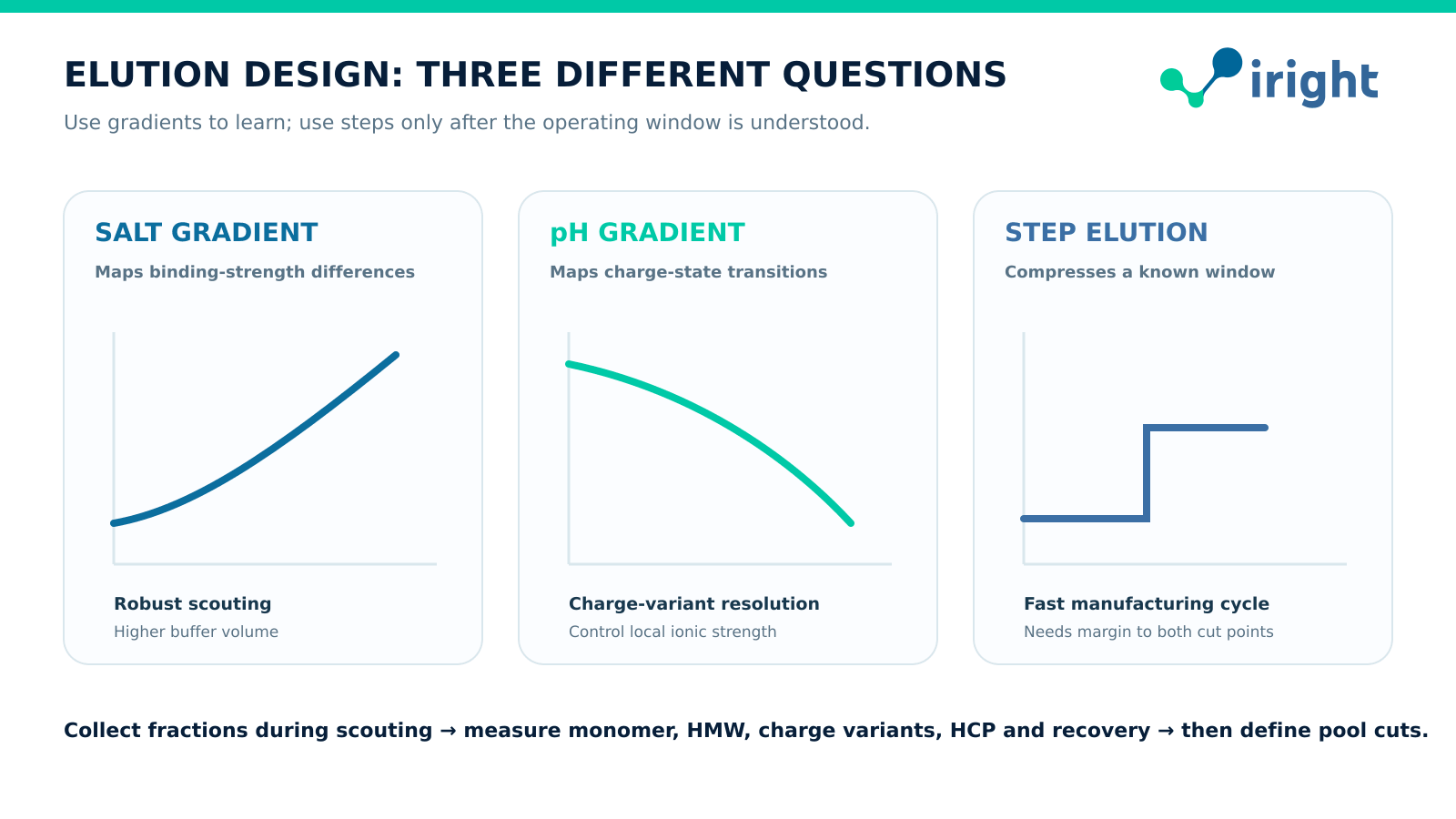
Salt gradient, pH gradient and step-elution design choices for ion exchange chromatography
The usual development sequence is gradient first, fractions second, step last. During scouting, collect enough fractions across the leading edge, apex and tail to measure monomer, HMW, charge variants, HCP and recovery. Only then define pooling criteria. A chromatogram at 280 nm cannot identify which side of a peak contains the critical impurity.
Scale-up normally preserves bed height, residence time, normalized load and buffer volumes in column volumes (CV) while increasing diameter. That rule is a starting point, not a guarantee. Distribution hardware, packing uniformity, system dwell volume, skid mixing, feed viscosity and gradient delay become more important as scale changes.
Tailing can reflect strong secondary interactions, overloading, slow desorption, a broad particle-size distribution, fouling or an asymmetric bed. Peak broadening can come from intraparticle mass transfer, channeling, tubing volume, distributor mixing or a gradient that reaches the production column differently from the development column. Pressure increase can result from smaller particles, higher linear velocity, greater bed height, feed viscosity, compressible beads, fines, precipitate or fouling.
Diagnose the system rather than blaming the resin by default:
measure the pressure–flow curve with equilibration buffer before loading;
perform a tracer test and calculate HETP and asymmetry after packing;
repeat the test after defined cycles to distinguish packing change from fouling;
separate column pressure from skid and filter pressure;
verify actual gradient formation and conductivity at the column inlet; and
examine the load for turbidity, aggregates or precipitation after pH adjustment.
HETP and asymmetry are packing diagnostics, not product-resolution substitutes. A column can pass a salt-tracer test and still produce poor mAb separation because chemistry, loading or gradient design is wrong. Conversely, chemistry optimization cannot correct a channeled bed.
A useful comparison has two stages. Stage 1 maps the operating space with small columns or high-throughput plates: pH × conductivity × mode × resin. Stage 2 confirms the leading candidates in equivalently packed columns with the real process feed.
Predefine the test protocol before seeing results:
Domain | Minimum matched measurement | Why it matters |
|---|---|---|
Capacity | Full breakthrough and DBC10% at ≥2 residence times | Detects mass-transfer-sensitive ranking and safety-margin shape |
Product quality | SEC monomer/HMW and charge-variant profile by fraction | Prevents recovery from hiding impurity enrichment |
Clearance | HCP, DNA, endotoxin; virus study where relevant | Connects the step to the control strategy |
Recovery | Complete mass balance and predefined pool cuts | Separates binding loss from pooling loss |
Process efficiency | Gradient/CV, buffer volume, cycle time | Converts chromatographic performance into manufacturing impact |
Hydraulics | Pressure–flow curve at process viscosity and temperature | Tests scale and facility fit |
Packing | HETP and asymmetry before and after cycling | Detects bed deterioration or fouling |
Lifecycle | Capacity, quality and pressure trend after representative CIP cycles | Prevents first-cycle optimization from winning falsely |
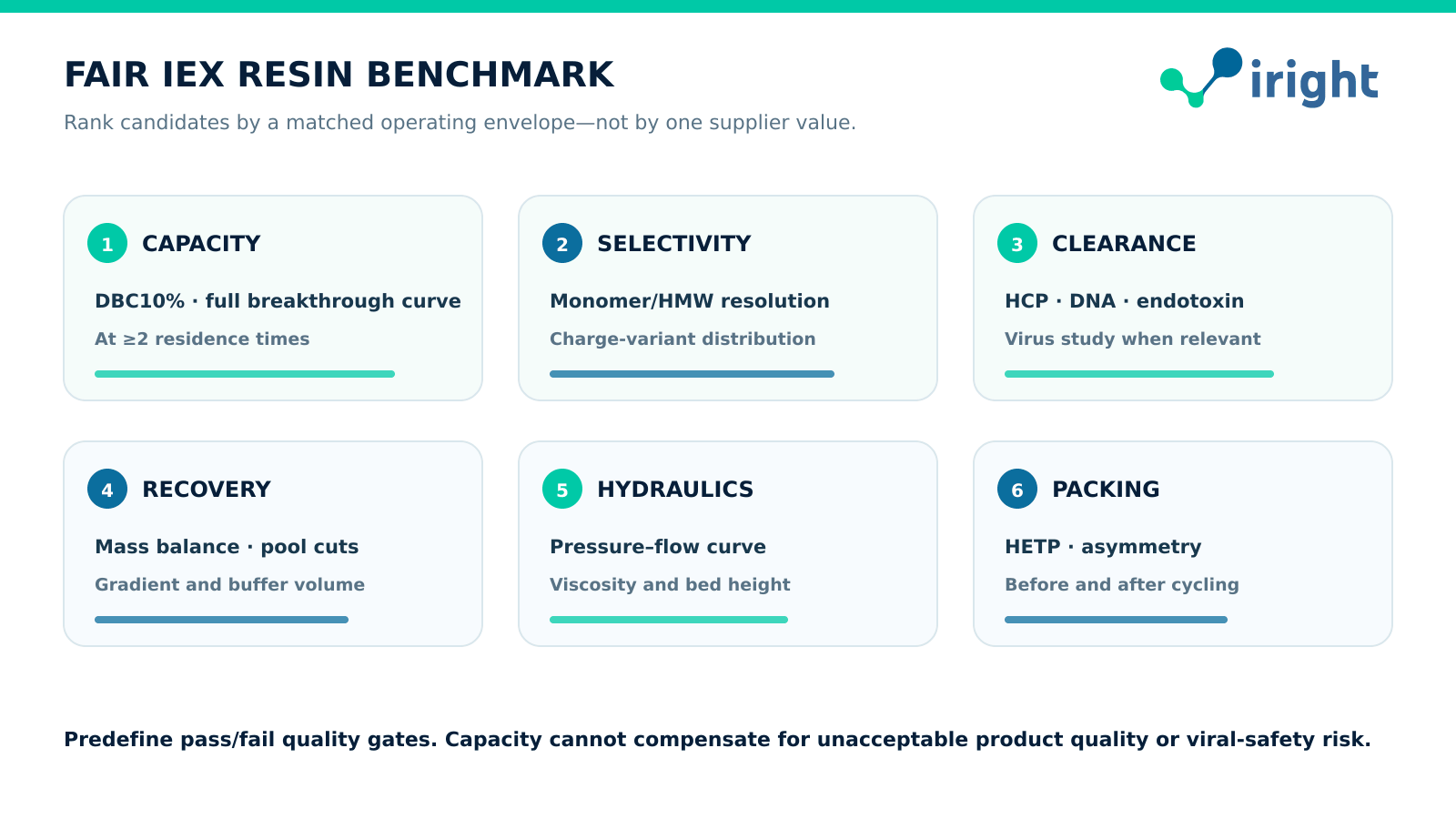
Matched scorecard for comparing ion exchange chromatography resins
Run both a common platform condition and a resin-optimized condition. The common condition measures drop-in simplicity; the optimized condition measures attainable performance. Use at least two representative feed lots when variability is meaningful. Keep bed height, residence time, load challenge, analytical methods and sample handling equivalent. Report supplier specifications separately from in-house data.
Predefine pass/fail gates. A resin with higher DBC should not win if monomer recovery, HMW, charge variants, viral-safety margin or pressure is unacceptable. FDA’s ICH Q6B guidance provides the broader framework for justified product specifications, but it does not prescribe or endorse a resin.
Planning a matched CEX/AEX screen?Use the iRight Resin Selector to shortlist different matrix and ligand architectures, then request matched prepacked formats and documentation for the same-protocol study. Start an IEX Resin RFQ
Bestchrom, NanoMicro and BioLink now offer broad IEX portfolios. Public information is useful for defining screening hypotheses, but most numerical performance claims are supplier-generated and use different model proteins, residence times and buffers. No public evidence located for this review establishes a universal drop-in substitute for a specific imported IEX resin across antibodies and processes.
Supplier | Product families worth shortlisting | Architecture question to test | Evidence boundary |
|---|---|---|---|
Bestchrom (博格隆) — iRight RFQ · supplier portfolio | Strong CEX Diamond SP and BestPoly 30S; strong AEX Diamond Q Mustang XL and BestPoly 30Q; CM and DEAE weak exchangers | Compare agarose and rigid polymer routes for short-residence-time capacity, pressure and resolution | Public portfolio confirms ligand classes and product families; it does not provide a harmonized mAb comparison across all products. |
NanoMicro (纳微科技) — iRight RFQ · supplier portfolio | Polymethacrylate UniGel SP, UniGel Q, UniGel CM and UniGel DEAE; rigid PS-DVB NanoSP, NanoQ, NanoGel-50SP HP and NanoGel-50Q | Test how monodispersity, rigidity and pore access affect pressure, DBC and HMW/charge resolution | Supplier data list matrices, particle sizes and model-protein methods. Lysozyme/BSA DBC cannot be read as mAb polishing performance. |
BioLink (百林科) — iRight RFQ · supplier portfolio | Modified-agarose MaXtar S, MaXtar strong AEX and MaXtar DEAE; rigid-polymer ChromaX MonoPS 50S and ChromaX MonoPS 50Q | Compare agarose process scalability with smaller, rigid polymer media for resolution and pressure | Supplier materials describe matrix route and scale-up positioning; matched antibody data remain necessary. |
These are not three interchangeable catalogs. Bestchrom spans agarose and polymer product families; NanoMicro emphasizes monodisperse polymethacrylate and PS-DVB architectures; BioLink offers modified-agarose process media and rigid polymer polishing media. That diversity is commercially useful because it allows a domestic screen to test genuinely different transport and hydraulic hypotheses.
A rational first screen includes: one high-capacity process CEX, one high-resolution rigid CEX, one process AEX, the incumbent control and—when weak ionization could create selectivity—one CM or DEAE candidate. Advance only products that pass the same recovery, impurity, hydraulic and documentation gates. Then confirm representative CIP cycling, lot consistency, scale supply, change control and regulatory support before claiming substitution.
Building a domestic IEX shortlist?Select candidates by matrix rigidity, particle size, ligand class and intended mode—not by nominal capacity alone—and compare them with the incumbent under one protocol. Request a Three-Supplier IEX Screen
The best IEX resin is the medium that creates the required impurity selectivity and product recovery across the validated pH, conductivity, load, residence-time and lifecycle window—while remaining packable, scalable and supportable in the intended facility.
CEX versus AEX is the first branch, not the final decision. Bind–elute versus flow-through defines what must be sized and monitored. Strong versus weak ligands define the charge window, not a quality hierarchy. The final ranking must integrate DBC and breakthrough shape, monomer/aggregate resolution, charge variants, HCP/DNA/endotoxin clearance, recovery, buffer consumption, HETP, asymmetry, pressure and CIP stability.
Use the iRight Resin Selector to narrow the candidate set by mode, ligand and matrix. Then compare the candidates with the same antibody, the same feed and the same process-relevant operating envelope.
Evidence note: Peer-reviewed studies are prioritized for mechanistic and comparative claims. Author affiliations are stated where relevant so readers can judge the evidence source. Supplier specifications are explicitly labeled and are used to define candidates, not to establish equivalence. FDA/ICH guidance defines regulatory expectations; it does not test, rank or endorse chromatography resin brands.
ResinFrontiers · iRight Bioprocess Chromatography Intelligence Series
AAV, plasmid DNA and mRNA cannot be purified by simply shrinking or enlarging a monoclonal-antibody platform. Their size, surface charge, topology, shear sensitivity and product-related impurities ch…